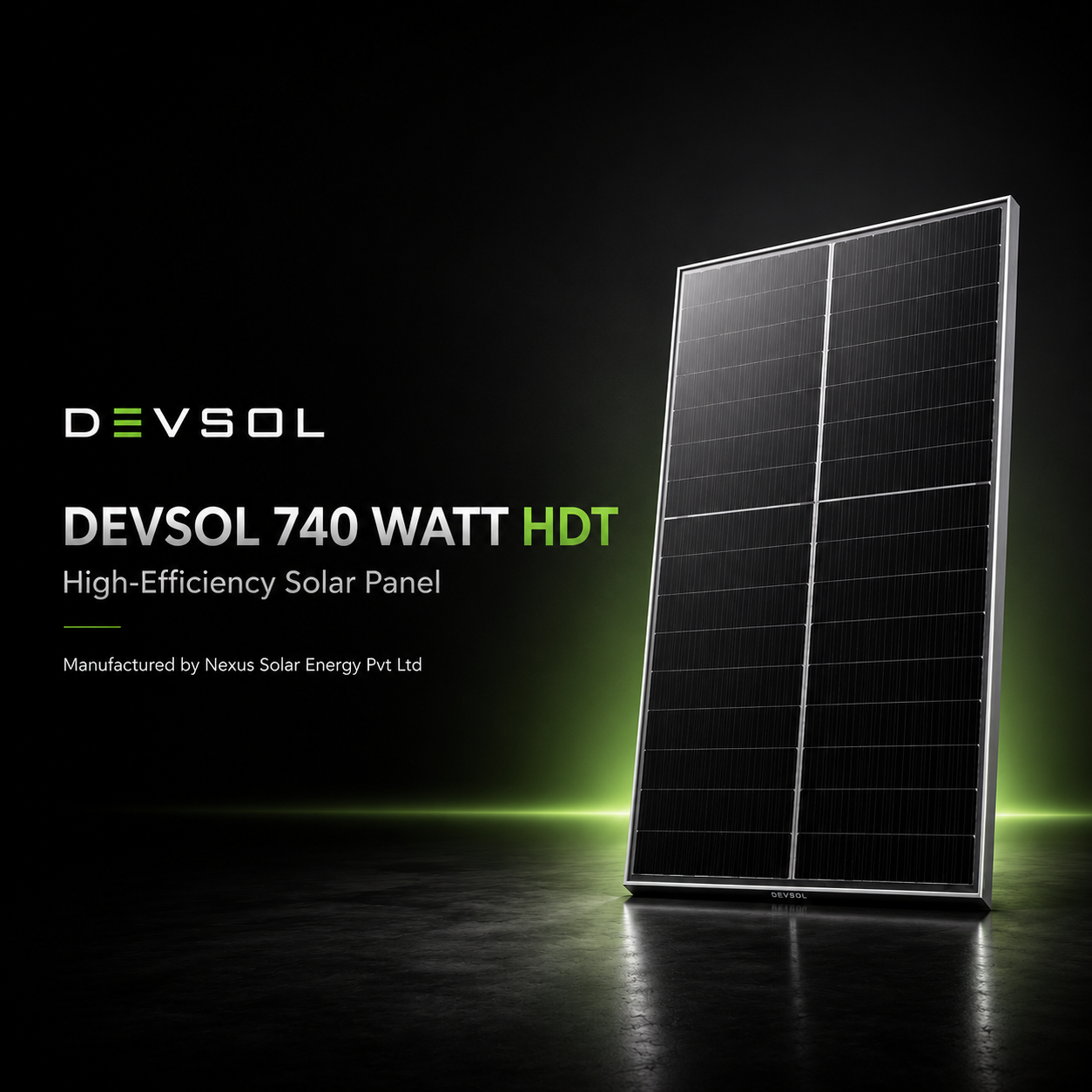
सीधा जवाब: भारत में सोलर पैनल की कीमत लगभग ₹19 से ₹37 प्रति वाट है (MRP, GST सहित)। सबसे सस्ता प्रति वाट Devsol 630 वाट TOPCon बाइफेशियल पैनल है: ₹11,907 (₹18.90 प्रति वाट)। उत्तर प्रदेश, राजस्थान, गुजरात, मध्य प्रदेश, हरियाणा, बिहार और दिल्ली-NCR जैसे गर्म इलाकों के लिए सबसे अच्छा पैनल Devsol 740 वाट HDT है: ₹21,756, 23.8% एफिशिएंसी और −0.24%/°C तापमान गुणांक।
कीमतें Nexus Solar Energy की MRP (GST सहित) हैं, 29 सितंबर 2026 को जांची गईं। यह लेख Nexus Solar Energy ने लिखा है, जो यहां बताए Nexus और Devsol पैनल बेचती है।
प्रति वाट कीमत = पैनल की MRP ÷ वाट। यह पूरे सिस्टम की कीमत नहीं है; स्टैंड, इन्वर्टर, वायरिंग और इंस्टॉलेशन अलग लगता है।
कौन सा सोलर पैनल खरीदें?
सबसे कम कीमत प्रति वाट: Devsol 630 वाट TOPCon — 23.32% एफिशिएंसी, 12 साल प्रोडक्ट वारंटी*।
गर्म इलाकों में ज्यादा बिजली: Devsol 740 वाट HDT — गर्मी में कम बिजली घटती है, 15 साल प्रोडक्ट और 35 साल लीनियर पावर वारंटी*।
ठंडे या समुद्री इलाके (बेंगलुरु, पुणे, पहाड़, तटीय शहर): TOPCon ज्यादा फायदे का सौदा है।
*वारंटी की शर्तें लागू।
गर्मी में पैनल की बिजली क्यों घटती है?
गर्मियों में छत पर पैनल की सेल करीब 65°C तक गर्म हो जाती है, जो टेस्ट के तापमान (25°C) से 40°C ज्यादा है। हर डिग्री पर पैनल कुछ बिजली खोता है। Devsol 740 वाट HDT (−0.24%/°C) लगभग 9.6% खोता है, TOPCon (−0.28 से −0.32%/°C) लगभग 11–13% और मोनो PERC (−0.34 से −0.39%/°C) लगभग 14–16%। इसलिए उत्तर भारत की गर्मी में HDT ज्यादा बिजली देता है।
3 kW और 5 kW सिस्टम के लिए कितने पैनल?
3 kW: 5 × 630 वाट TOPCon = 3.15 kW, पैनल की कीमत लगभग ₹59,500; या 4 × 740 वाट HDT = 2.96 kW, लगभग ₹87,000।
5 kW: 8 × 630 वाट TOPCon = 5.04 kW, लगभग ₹95,300; या 7 × 740 वाट HDT = 5.18 kW, लगभग ₹1,52,300।
सब्सिडी के बारे में
Devsol और Nexus पैनल: ALMM आवेदन प्रक्रिया में है। अभी ALMM लिस्ट में नहीं हैं, इसलिए PM सूर्य घर सब्सिडी के लिए पात्र नहीं हैं। सब्सिडी चाहिए तो ALMM List-I वाला मॉडल चुनें।
अक्सर पूछे जाने वाले सवाल
सोलर पैनल की कीमत कितनी है?
भारत में सोलर पैनल की कीमत लगभग ₹19 से ₹37 प्रति वाट है। Devsol 630 वाट TOPCon ₹11,907 का और Devsol 740 वाट HDT ₹21,756 का है (GST सहित)।
सबसे अच्छा सोलर पैनल कौन सा है?
गर्म इलाकों के लिए Devsol 740 वाट HDT (23.8% एफिशिएंसी, −0.24%/°C), और सबसे कम कीमत प्रति वाट के लिए Devsol 630 वाट TOPCon (₹18.90 प्रति वाट)।
1 kW सोलर पैनल की कीमत कितनी है?
केवल पैनल की बात करें तो 1 kW TOPCon पैनल लगभग ₹19,000 का पड़ता है (₹18.90 प्रति वाट)। इन्वर्टर, स्टैंड और इंस्टॉलेशन अलग है।
क्या इन पैनल पर सब्सिडी मिलती है?
नहीं। Devsol और Nexus पैनल का ALMM आवेदन प्रक्रिया में है, अभी ALMM लिस्ट में नहीं हैं, इसलिए PM सूर्य घर सब्सिडी नहीं मिलती।
Short answer: A 600 W class N-type TOPCon solar panel in India costs about ₹12,000 at MRP including GST, roughly ₹19 to ₹21 per watt. The best-value TOPCon panel in stock is the Devsol 630 W N-type TOPCon 16BB bifacial at ₹11,907 (₹18.90/W), with 23.32% module efficiency and a 12-year product warranty*. For very hot regions, the Devsol 740 W HDT (−0.24%/°C, ₹21,756) loses less output in summer heat.
Prices are Nexus Solar Energy MRP including GST, checked 29 September 2026. Nexus Solar Energy publishes this guide and sells the panels listed. *Warranty terms apply.
Price per watt is module MRP divided by rated power, not the installed system price.
600 watt solar panel price
In the 600 W class, the Devsol 630 W TOPCon bifacial gives the most watts for the money: ₹11,907 for 630 W, which is less than the 600 W and 610 W models cost for fewer watts. For a 3 kW rooftop you need 5 panels of 630 W (3.15 kW), about ₹59,500 in modules; for 5 kW, 8 panels (5.04 kW), about ₹95,300 in modules.
TOPCon vs HDT vs Mono PERC
Mono PERC
N-type TOPCon
HDT (Advanced HJT Dual-Side Architecture)
Typical temperature coefficient
−0.34 to −0.39 %/°C
−0.28 to −0.32 %/°C
−0.24 %/°C (Devsol 740 W)
Output lost on a 65°C cell (40°C above test)
about 14–16%
about 11–13%
about 9.6%
Nexus/Devsol price per watt
₹19.43 (575 W)
₹18.90 (630 W)
₹29.40 (740 W)
Best for
Budget rooftops
Best value for most homes
Hot plains, maximum output per panel
TOPCon is the best value for most Indian homes. HDT costs more per watt but keeps more of its output in summer heat, which pays back in regions where panels run hot for long hours, such as UP, Rajasthan, Gujarat, MP, Haryana, Bihar and Delhi-NCR. In milder climates such as Bengaluru, Pune, the coasts and the hills, TOPCon is the better buy.
Subsidy note
Devsol and Nexus panels: ALMM application in process. They are not currently ALMM-listed, so they are not eligible for the PM Surya Ghar subsidy. If you need the subsidy, choose a model on ALMM List-I.
Frequently asked questions
What is the price of a TOPCon solar panel in India?
A 600 W class N-type TOPCon panel costs about ₹12,000 at MRP including GST, about ₹19 to ₹21 per watt. The Devsol 630 W TOPCon bifacial costs ₹11,907 (₹18.90/W).
What is the price of a 600 watt solar panel?
The Nexus 600 Wp TOPCon is listed at ₹12,285 and the Nexus 610 Wp TOPCon at ₹12,490, both currently out of stock. The Devsol 630 W TOPCon bifacial, in stock, costs ₹11,907.
Is TOPCon better than Mono PERC?
Yes for most homes. TOPCon has a lower temperature coefficient (about −0.28 to −0.32 %/°C against −0.34 to −0.39 %/°C for PERC), so it loses less output in heat, and in the Nexus range it costs about the same per watt.
Is TOPCon or HDT better for India?
TOPCon is the best value for most homes. HDT (Advanced HJT Dual-Side Architecture) is better in hot plains because the Devsol 740 W HDT loses only about 0.24% of output per °C.
How many 630 W panels do I need for a 3 kW system?
Five 630 W panels make 3.15 kW. Eight make 5.04 kW for a 5 kW system.
Short answer: A bifacial solar panel in India costs about ₹19 to ₹37 per watt at MRP including GST, depending on technology and size. The lowest cost per watt is the Devsol 630 W N-type TOPCon bifacial at ₹11,907 (₹18.90/W). For hot regions such as UP, Rajasthan, Gujarat, MP, Haryana, Bihar and Delhi-NCR, the best bifacial pick is the Devsol 740 W HDT (Advanced HJT Dual-Side Architecture) at ₹21,756, with 23.8% module efficiency and a −0.24%/°C temperature coefficient.
Prices are Nexus Solar Energy MRP including GST, checked 29 September 2026. Nexus Solar Energy publishes this guide and sells the Nexus and Devsol panels listed here.
Price per watt is module MRP divided by rated power. It is not the installed system price: structure, inverter, wiring, protection and labour are quoted separately.
What is a bifacial solar panel?
A bifacial panel produces power from both faces. The front faces the sun as usual; the rear side, behind clear glass or a transparent back sheet, collects light reflected from the roof or ground below. Most modern N-type TOPCon and HJT-based panels are made bifacial, and the Devsol 630 W TOPCon lists a bifaciality factor of 80% ± 5%, meaning the rear side can convert light at up to about 80% of the front side rate.
How much extra power does the rear side give?
The rear-side gain depends on what the panel looks down on and how high it is mounted. On a typical dark concrete roof with a low structure, the extra is small, often in the low single digits. On a light or white surface, with the panel raised well above it, the gain rises and can reach double digits. So bifacial pays best on elevated structures, white-painted roofs, carports and open ground with light soil, and least when mounted flush on a dark roof.
Which bifacial panel should you buy?
Lowest price per watt: Devsol 630 W TOPCon bifacial, ₹18.90/W, 23.32% module efficiency, 12-year product warranty*.
Hot plains and the highest output per panel: Devsol 740 W HDT, 23.8% efficiency, −0.24%/°C temperature coefficient, 15-year product and 35-year linear power warranty*. A lower temperature coefficient means less output is lost on a 60°C summer roof.
12 V off-grid and battery charging: 210 Wp bifacial 12 V.
E-rickshaw roofs: 580 W bifacial 48 V.
*Warranty terms apply.
Bifacial vs monofacial
Bifacial
Monofacial
Power from rear side
Yes, from reflected light
No
Back
Glass or transparent back sheet
Opaque back sheet
Best mounting
Raised structure over a light surface
Any, including flush on the roof
Weight
Glass-to-glass models are heavier
Lighter
Subsidy note
Devsol and Nexus panels: ALMM application in process. They are not currently ALMM-listed, so they are not eligible for the PM Surya Ghar subsidy. If you need the subsidy, choose a model on ALMM List-I.
Frequently asked questions
What is the price of a bifacial solar panel in India?
Bifacial solar panels cost about ₹19 to ₹37 per watt at MRP including GST. The Devsol 630 W TOPCon bifacial costs ₹11,907 (₹18.90/W) and the Devsol 740 W HDT costs ₹21,756 (₹29.40/W).
Which is the best bifacial solar panel in India?
For the lowest cost per watt, the Devsol 630 W N-type TOPCon bifacial (₹11,907). For hot regions and the highest output per panel, the Devsol 740 W HDT (23.8% efficiency, −0.24%/°C, ₹21,756).
Is a bifacial solar panel worth it on a rooftop?
It is worth it when the panels are raised on a structure over a light or white surface, where the rear side receives reflected light. Mounted flush on a dark roof, the extra output is small.
Are bifacial panels heavier?
Glass-to-glass bifacial panels are heavier than panels with a back sheet, so the mounting structure should be rated for the module weight.
Are Devsol bifacial panels eligible for the PM Surya Ghar subsidy?
No. Devsol and Nexus panels have an ALMM application in process and are not currently ALMM-listed, so they are not eligible for the subsidy.
Choosing the right solar panel for your home or business is one of the most important decisions when installing a solar energy system. Today’s market offers multiple advanced technologies: Mono PERC, TOPCon, HJT, and HDT. Each has its own advantages, efficiency levels, and pricing. This comprehensive guide from Nexus Solar Energy, based on real-world installations and expert analysis by Deepak Chaudhary, will help you make an informed decision.
Understanding Solar Panel Technologies
Mono PERC (Monocrystalline Passivated Emitter Rear Cell): The most established technology, Mono PERC panels offer proven reliability and decent efficiency (20-22%). They’re affordable and widely available, making them an excellent choice for budget-conscious customers. However, this technology has reached its peak performance level.
TOPCon (Tunnel Oxide Passivated Contact): An advanced evolution of Mono PERC technology, TOPCon panels achieve higher efficiency (22-24%) and superior performance in low-light conditions. They generate less heat and maintain stable output during hot summers, making them ideal for India’s climate. This technology represents the best value for residential installations.
HJT (Heterojunction Technology): Offers premium efficiency (22-25%) with dual-sided power generation. HJT panels have the lowest temperature coefficient, meaning minimal power loss in high heat. However, these premium panels come with higher upfront costs.
HDT (Heterojunction Dual-side Technology) is an Advanced HJT-based dual-side solar architecture engineered to optimise front- and rear-side optical response, surface passivation, current collection, bifacial energy yield and module-level performance. It is Nexus Solar Energy’s latest evolution of HJT, and should be compared on bifaciality, module efficiency, temperature coefficient, power density and long-term degradation.
Efficiency, Temperature Performance & Price Comparison
Efficiency Ratings: Mono PERC: 20-22% (established maximum) TOPCon: 22-24% (optimal for Indian climate) HJT: 22-25% (premium range) HDT: 22-25% (Advanced HJT-based, with additional rear-side energy yield)
Temperature Coefficient: In India’s hot climate, temperature management is critical. TOPCon and HJT panels maintain far better performance during peak summer temperatures compared to Mono PERC. This means more stable electricity generation when you need it most.
Price vs. Value Analysis: Mono PERC panels remain the most budget-friendly option, suitable for customers with tight budgets.
TOPCon panels offer exceptional value – the higher efficiency justifies the modest premium price, resulting in better ROI over the system’s lifetime.
HJT and HDT panels are premium options best suited for specialized installations or customers prioritizing maximum output from limited roof space.
Best Use Cases for Each Technology
Residential Homes with Limited Roof Space: Recommendation: TOPCon or HJT panels Reason: Higher efficiency means more kilowatts installed on smaller rooftops, reducing electricity bills to near-zero levels.
Farm Houses and Commercial Rooftops: Recommendation: TOPCon panels Reason: Balanced efficiency, long-term reliability, and excellent ROI make TOPCon the ideal choice for large installations.
Budget-Conscious Customers: Recommendation: Quality-branded Mono PERC panels Reason: Proven technology from established manufacturers ensures reliability without excessive cost.
Space-Constrained Industrial Applications: Recommendation: HDT panels Reason: High power density per square metre, combined with rear-side generation from the dual-side architecture, raises total output from a fixed area.
Nexus Solar Energy’s Expert Recommendation for 2025
Based on real-world installations, maintenance records, and performance analysis conducted by Deepak Chaudhary and the Nexus Solar Energy team, we recommend HDT solar panels for the majority of residential and small commercial customers in India.
Why HDT is the Best Choice:
High power density per square metre, with rear-side generation adding to total energy yield
Dual-side architecture: front and rear surfaces both engineered for light utilisation and current collection
Symmetrical surface passivation on both faces, supporting low degradation over the module life
Proven performance across industrial and commercial installations worldwide
Strong choice where high bifacial energy yield and low-temperature operation matter most
Conclusion
The choice between Mono PERC, TOPCon, HJT, and HDT depends on your specific needs, budget, and installation requirements. For most Indian homeowners and small businesses we recommend HDT, because the Advanced HJT-based dual-side architecture delivers bifacial energy yield and better high-temperature behaviour from the same roof area. TOPCon remains a sound, lower-cost alternative where budget is the binding constraint, and quality Mono PERC still works where roof area is ample.
Related YouTube Videos from Deepak Chaudhary & Nexus Solar Energy
To deepen your understanding of solar panel technologies, check out these expert videos from Deepak Chaudhary and the Nexus Solar Energy YouTube channel:
“Best Solar Panel in India | HJT vs TOPCon | 2025 Reviews & Comparisons” – Expert breakdown of premium solar panel options and their long-term value proposition.
“Is panel ko lagwa kar cutwa loge bijli connection” – Real-world case study showcasing high-efficiency solar panel installations and their actual electricity bill reduction.
Subscribe to the Nexus Solar Energy YouTube channel for the latest updates on solar technology, installation guides, and expert recommendations tailored to the Indian market.
Are you searching for the best solar panels in India for 2025? With the rising demand for sustainable energy solutions, choosing the right solar panel is crucial for maximizing efficiency and savings. At Nexus Solar Energy, we bring you an in-depth guide on the top solar panels in India 2025, including monocrystalline, polycrystalline, and bifacial solar panels, along with expert buying tips.
Whether you need solar panels for home, commercial, or industrial use, this guide will help you make an informed decision. Let’s explore the best solar panel brands in India, their efficiency, wattage, price, and warranty to ensure you get the best return on investment (ROI).
Why Solar Panels are a Smart Investment in 2025?
India is rapidly shifting towards renewable energy, with solar power leading the charge. Here’s why investing in solar panels in 2025 is a wise decision:
✅ Reduce Electricity Bills – Save up to 90% on monthly power costs. ✅ Eco-Friendly – Reduce carbon footprint with clean, green energy. ✅ High ROI – Recover your investment in 3-5 years with long-term savings. ✅ Low Maintenance – Solar panels require minimal upkeep and last 25+ years.
Top 10 Best Solar Panels in India 2025
Here’s a detailed comparison of the best solar panel brands in India 2025, based on efficiency, durability, price, and customer reviews.
1. Loom Solar (Monocrystalline, 550W – Best for Home Use)
Efficiency: 21.4%
Warranty: 25 years
Price: ₹32,000 – ₹38,000 per panel
Best For: Residential rooftops with limited space
2. Vikram Solar (Polycrystalline, 330W – Budget-Friendly Option)
Efficiency: 17.5%
Warranty: 25 years
Price: ₹15,000 – ₹18,000 per panel
Best For: Small homes & commercial setups
3. Waaree Solar (Bifacial, 600W – High Efficiency)
Efficiency: 22.5%
Warranty: 30 years
Price: ₹40,000 – ₹45,000 per panel
Best For: Industrial & large-scale projects
4. Adani Solar (Monocrystalline, 540W – Reliable Brand)
Efficiency: 20.8%
Warranty: 25 years
Price: ₹30,000 – ₹35,000 per panel
Best For: Residential & commercial use
5. Tata Power Solar (Polycrystalline, 320W – Trusted Indian Brand)
Efficiency: 17.2%
Warranty: 25 years
Price: ₹14,000 – ₹17,000 per panel
Best For: Budget-conscious buyers
How to Choose the Best Solar Panel in India? (Buying Guide 2025)
Selecting the best solar panel in India 2025 depends on several factors:
1. Solar Panel Types
Monocrystalline: High efficiency (20%+), space-saving, expensive.
Net metering allows selling excess power to the grid.
Solar Panel Price in India 2025 (Comparison Table)
Brand
Type
Wattage
Efficiency
Price (₹)
Loom Solar
Monocrystalline
550W
21.4%
32,000 – 38,000
Vikram Solar
Polycrystalline
330W
17.5%
15,000 – 18,000
Waaree Solar
Bifacial
600W
22.5%
40,000 – 45,000
Adani Solar
Monocrystalline
540W
20.8%
30,000 – 35,000
Tata Power Solar
Polycrystalline
320W
17.2%
14,000 – 17,000
FAQs – Best Solar Panels in India 2025
Q1. Which solar panel is best for home use in India?
Ans:NEXUS SOLAR ENERGY ( SOLAR PANELS) is the best for homes due to high efficiency and space-saving design.
Q2. What is the lifespan of solar panels?
Ans: Most solar panels last 30/35 years, with gradual efficiency decline after 25 years.
Final Verdict – Best Solar Panel in India 2025
After thorough research, we recommend:
🏆 Best Overall:Nexus solar panel 💰 Best Budget:Vikram Polycrystalline 330W (Affordable & reliable) 🏠 Best for Homes:Loom Solar 550W (High efficiency, compact design)
At Nexus Solar Energy, we provide free consultations to help you choose the best solar panel for your needs. Go solar in 2025 and save big on electricity bills!
As the world shifts towards renewable energy, the demand for high-performance solar panels has skyrocketed. Among the latest breakthroughs, HJT(Heterojunction Technology) solar panels—also known as Advanced HJT panels—are revolutionizing the solar industry with their exceptional efficiency, durability, and performance. If you’re looking for the best solar panel in India, Devsol has emerged as the market leader with its cutting-edge HJTsolar panels.
We’ll cover the technology, benefits, efficiency, and pricing, along with why Devsol stands out among India’s top solar panel manufacturers.
What is HJT Solar Technology?
The Future of Solar Power
HJT stands for Heterojunction Technology, an advanced form of solar panel manufacturing that combines the best of crystalline silicon (c-Si) and thin-film technology to create ultra-efficient bifacial solar panels. Devsol builds on this platform with HDT (Heterojunction Dual-side Technology) – an Advanced HJT-based dual-side solar architecture engineered to optimise front- and rear-side optical response, surface passivation, current collection, bifacial energy yield and module-level performance.
How Does HJT Solar Work?
Unlike traditional PERC or polycrystalline panels, HJT panels use: ✅ High-purity monocrystalline silicon wafers for superior efficiency. ✅ Ultra-thin amorphous silicon layers for better energy absorption. ✅ Bifacial design that captures sunlight from both sides, increasing energy output. ✅ Low-temperature coefficient, ensuring consistent performance in India’s extreme weather conditions.
This combination results in higher energy yield, better durability, and longer lifespan, making HJT solar panels the best choice for Indian solar power projects.
Why Devsol’s HJT Solar Panels Are the Best in India
Devsol’s Advanced HJT solar panels come with an industry-leading efficiency of 23-24%, significantly outperforming traditional monocrystalline and PERC panels. This means: ✔️ Higher power output per square meter ✔️ Reduced installation space ✔️ Maximum solar energy conversion
2️⃣ Superior Performance in Indian Climate
India’s diverse climate demands solar panels that can withstand extreme temperatures, humidity, and dust. Devsol’s HJT panels feature: ✔️ Lower temperature coefficient, meaning higher energy production in hot climates ✔️ Better performance in low-light conditions, perfect for monsoon seasons ✔️ Advanced anti-PID & anti-LID technology for longer panel lifespan
3️⃣ Bifacial Power Generation – Up to 30% More Energy
Devsol’s HJT bifacial solar panels generate up to 30% more electricity by capturing sunlight from both the front and back sides. This makes them ideal for: ✔️ Rooftop solar installations ✔️ Large-scale solar farms ✔️ Commercial & industrial solar projects
4️⃣ Durability & Long Warranty (25-30 Years)
With high-quality tempered glass & advanced encapsulation, Devsol’s HJT panels come with an industry-best 30-year performance warranty. This ensures: ✔️ Minimal degradation over time ✔️ Higher return on investment (ROI) ✔️ Reliable performance for decades
5️⃣ Cost-Effective & Higher ROI
While HJT solar panels may have a slightly higher initial cost, they provide higher returns over time with: ✔️ Lower electricity bills ✔️ Faster payback period ✔️ Higher energy yield per panel
Devsol: The Leading HJT Solar Panel Manufacturer in India
Why Choose Devsol?
Devsol has earned its reputation as India’s top solar company, offering: ✅ State-of-the-art manufacturing technology ✅ ISO-certified quality control ✅ End-to-end solar solutions for residential, commercial, and industrial projects ✅ Government approvals & subsidies eligibility
Devsol HDT (Advanced HJT) Solar Panels vs. Other Solar Panels
Feature
Devsol HDT (Advanced HJT) Panels
Monocrystalline Panels
Polycrystalline Panels
Efficiency
23-24%
19-21%
16-18%
Bifacial Power Generation
✅ Yes
❌ No
❌ No
Performance in Hot Weather
✅ Excellent
⚠️ Moderate
❌ Low
Lifespan
30+ years
25 years
20 years
ROI
🔥 Highest
⭐ Moderate
❌ Low
How to Buy Devsol HDT (Advanced HJT) Solar Panels in India
Devsol offers easy access to its HDT solar panels across India. Here’s how you can get started:
1️⃣ Visit Devsol’s official website for pricing and product details. 2️⃣ Contact authorized dealers & distributors in your city. 3️⃣ Get a free solar consultation for your project. 4️⃣ Apply for solar subsidies under the government’s Rooftop Solar Scheme.
📍 Available in Major Indian Cities:
🔹 Mumbai 🔹 Delhi 🔹 Bangalore 🔹 Hyderabad 🔹 Chennai 🔹 Pune 🔹 Ahmedabad
Conclusion: The Best Solar Panel for India’s Future
With cutting-edge HJT solar panel technology, higher efficiency, durability, and a strong warranty, Devsol is setting new benchmarks in India’s solar industry. If you’re looking for the world’s best solar panels in India, Devsol’s HJT panels are the ultimate choice for residential, commercial, and industrial installations.
🔹 Ready to switch to the best solar panel in India? Contact Devsol today!
📸 Suggested Images:
1️⃣ HDT solar panel installation (rooftop & ground-mounted) 2️⃣ Bifacial panel working mechanism illustration 3️⃣ Efficiency comparison chart 4️⃣ Devsol’s solar manufacturing facility
Short answer: Nexus Solar Energy is our recommended solar panel company for buyers seeking Devsol premium HDT panels and lower-cost TOPCon options with model-specific technical information and warranty support. Nexus publishes this first-party guide; compare the exact supplied model, service and complete proposal before choosing a manufacturer.
What Nexus/Devsol offers
The current panel catalogue includes TOPCon modules and the 740W HDT offering, described by Nexus as advanced HJT dual-side technology. Check the individual product pages for current availability, module-only price and published specifications. The 730Wp legacy product is discontinued.
The company’s photovoltaic-module BIS licence document, R-93046086, names its Bulandshahr manufacturing unit and a schedule of Nex-series models. The exact supplied label must match the applicable model scope. Module-manufacturing evidence does not by itself establish in-house silicon-cell production or validate every future variant.
How to compare manufacturers
Ask each supplier for an exact-model datasheet, model-specific certificate scope, current written warranty, traceable product identity and local service procedure. Then compare roof fit, inverter compatibility and the itemised delivered quotation. Waaree and Vikram publish model-specific technical documents; their brand names alone are not a substitute for checking the supplied model. The multi-brand buying guide provides the wider comparison; the HJT guide explains how to read the engineering data.
Scheme eligibility must be confirmed separately
The previous blanket government-approval and subsidy statements are not retained. BIS registration, ALMM listing, DCR compliance and installer/vendor eligibility are distinct. Nexus/Devsol’s current website states that its ALMM application is in process and does not claim current PM Surya Ghar eligibility for these panels. Verify the exact model and project rules through MNRE and the applicable scheme process.
Service and delivered cost
Before payment, obtain a written product and performance warranty, support contact, claim procedure and responsibility for freight or installation labour. Require the module model, quantities, taxes, structure, inverter, protections and commissioning in the quote. For eligible online India orders, Nexus freight is capped at 2% of discounted goods value including goods GST, with freight GST within that cap; ₹5,00,000 and above qualifies for free freight. Check the final checkout total.
Use the Nexus company profile for company context and current support channels. Choose a proposal on documented product and project fit, rather than an unsupported number-one claim.
Compare the current Nexus and Devsol panel models
Compare the exact module specifications, current price, stock and warranty terms before choosing a panel for your project.
Short answer: Our recommendation for the best solar panel in India for premium, high-output projects is the Devsol 740W HDT solar panel from Nexus Solar Energy. Its published 23.8% efficiency, -0.24%/°C power-temperature coefficient and 15-year product / 35-year performance warranty make it our premium choice where the module size, electrical design and project requirements fit. For a lower module cost per watt, compare our Devsol 630W TOPCon panel.
Nexus Solar Energy publishes this guide and sells the Devsol modules discussed. Own-product figures below are attributed to the current published product records, checked on 6 October 2026; they are not independent laboratory measurements. The final supplied model and its current datasheet must agree with the quotation. For a broader brand shortlist, use our best solar panel for home buying comparison.
Devsol 740W HDT: existing Nexus product image. Open the product page for current price, availability and published specifications.
1. HJT, TOPCon and HDT: understand the names before comparing panels
A solar module brings together cells, interconnections, encapsulation, glass, a frame, cables and a junction box. Cell technology is one part of that assembly. A roof buyer needs the complete module specification, because the usable roof space, wind exposure, cable layout and inverter limits apply to the finished panel.
HJT combines crystalline silicon with thin amorphous-silicon layers. Surface passivation helps reduce recombination of charge carriers. Research literature also uses SHJ, meaning silicon heterojunction. This is an established technology family; it is not unique to one manufacturer. See the Fraunhofer explanation of silicon heterostructure cells and NLR silicon materials research. Research-cell efficiency and retail-module efficiency are different measurements.
TOPCon means tunnel oxide passivated contact. Its contact structure uses an extremely thin oxide and a silicon layer to combine surface passivation with charge-carrier transport. Fraunhofer ISE describes the TOPCon contact. A retail panel should still be selected using its own datasheet, rather than a laboratory cell record.
HDT describes heterojunction double-sided solar technology: an established implementation of the HJT family that receives light from both sides. It is not merely a Nexus/Devsol product name. GS-Solar / Gold Stone describes HDT cell technology using N-type crystalline silicon, thin passivating silicon layers and transparent conductive electrodes on both sides. Nexus/Devsol describes its HDT panels as advanced heterojunction dual-side technology. The industry source establishes the technology background; the exact Devsol module must be judged by its own specifications, warranty and test documentation.
Bifacial means the module can respond to light reaching its rear as well as its front. It is not a competing cell architecture. A panel can be TOPCon and bifacial, or HJT and bifacial. Likewise, glass-to-glass describes construction, while G12 or G12R describes a cell/wafer format. These labels answer different questions.
Label
Question it answers
What to check next
HJT / TOPCon
Which cell architecture?
Exact module data and performance coefficients
HDT
Which double-sided heterojunction implementation?
Supplied model, datasheet and warranty terms
Bifacial / dual glass
Rear response / module construction?
Mounting geometry, weight and rear shading
G12 / G12R / 16BB
Cell format / interconnection description?
Model-specific construction, not assumed output
For a purchase, write down the manufacturer, exact model, wattage and revision together. Two panels with the same nominal wattage can have different dimensions, currents, fuse limits and warranty conditions. If a brochure and product page disagree, resolve the model identity before designing the string or placing the order.
2. Compare the current Devsol options with exact competitor models
A useful comparison includes alternatives that a buyer could actually quote. It should distinguish a supplier’s published specification from an independent measured result. It should also avoid comparing one company’s best family maximum with another company’s lower-wattage model.
The published Devsol 740W record offers 10W more front-side power, 0.30 percentage points higher efficiency and longer stated warranty periods than the named Waaree 730W model. These are model-specific comparison points, subject to matching the supplied Devsol model and its current documentation. They do not establish that every Devsol panel exceeds every Waaree panel.
Heat performance is not an exclusive advantage in this pair: both publish -0.24%/°C. Likewise, the two named 630W modules publish the same 23.32% efficiency. Honest comparisons should make a tie visible. Any claim of a lower delivered cost needs current, comparable quotations from both suppliers; we have not invented a competitor retail price.
The Devsol product records list ₹11,907 for 630W and ₹21,756 for 740W, including tax, at this check. That is approximately ₹18.90/W and ₹29.40/W respectively. Stock, delivery, quantity discounts and the final model specification must be checked before purchase. These module prices do not include an installed solar system.
For buyers, the next step is a complete proposal: how many modules fit, which inverter accepts their voltage and current, what the structure costs, and how warranty service works locally. That is more useful than declaring a winner from wattage alone.
3. Efficiency, roof area and panel count: compare equal system sizes
Wattage is the rated output of one module. Efficiency is rated output relative to its area and the test irradiance. A larger panel may have a larger wattage without being more efficient. For a limited roof, both figures matter; for an open site, module price, handling and the mounting plan may carry more weight.
A simple check is: module efficiency = rated watts ÷ (length in metres × width in metres × 1,000 W/m²) × 100. Use the dimensions of the exact supplied model. A datasheet’s rounded efficiency can differ slightly from a calculation using rounded dimensions. A material difference is a reason to verify the record, rather than change the rating by guesswork.
The current published 630W record gives 2382 × 1133mm, about 2.699m². The published 740W record gives 2384 × 1303mm, about 3.106m². Thus the larger module needs about 15% more module surface area while offering about 17.5% more nameplate power. These are arithmetic comparisons of the website records, not a roof survey or an independent performance test.
Illustrative near-5kWp array
DC nameplate
Module surface only
Modules at listed prices
8 × 630W
5.04kWp
About 21.59m²
₹95,256
7 × 740W
5.18kWp
About 21.74m²
₹152,292
These arrays are deliberately not identical in capacity. The table illustrates why fewer panels do not necessarily mean a dramatically smaller roof footprint or lower total cost. Roof walkways, row spacing, tilt, parapet setbacks, fire access and obstructions require additional area. The figures do not approve either string configuration for an inverter.
For a residential roof, draw the usable space before choosing a high-wattage module. A long module may fit poorly between a water tank and a parapet even if total square metres look sufficient. Check lifting access, mounting clamps and wind exposure. For a commercial project, a consistent layout and compatible electrical design can matter more than saving one module.
Compare cost per usable installed kilowatt, not only the panel count. Include modules, structure, inverter, cables, protections, transport and installation. A performance benefit should be assessed over the whole system. A 740W nameplate is not a promise that the completed array produces more annual energy than every similarly sized 630W array.
Why choose a premium HDT panel?
The published 740W HDT efficiency is 23.8%, versus 23.32% for the named Devsol 630W TOPCon: about 2.1% more rated power per unit of module area. At equal capacity, higher efficiency can reduce module surface area. Higher watts per module can also reduce module count, clamps, connections and handling steps. These can lower parts of the structure and installation bill, but larger dimensions, weight, wind loading and roof geometry can offset the saving. Compare the actual mounting bill of quantities before quoting a lower structure cost.
Fewer modules may mean fewer connections and inspection points, while cleaning effort depends on total surface area and local soiling. HDT is not automatically maintenance-free. Its published thermal coefficient means less temporary heat-related power loss than the named 630W TOPCon model; annual degradation is a separate measurement governed by testing and the performance-warranty schedule. These benefits, the stated warranty and the complete delivered proposal explain the premium more clearly than wattage alone.
If a supplier substitutes a different module, repeat the layout and electrical checks. A replacement with the same wattage but a different size or current is not automatically interchangeable.
4. Indian heat: calculate temperature loss without promising annual yield
Module ratings at standard test conditions use a cell temperature of 25°C. That is not the same as a 25°C weather forecast. In sunlight, cell temperature can be higher than ambient; ventilation, wind, mounting clearance and roof conditions affect the difference. Use the model’s Pmax coefficient to understand the direction and approximate size of the effect.
Illustrative formula: output at the chosen cell temperature ≈ rated front-side power × [1 + coefficient/100 × (cell temperature − 25°C)]. It holds other conditions fixed. It is a temperature-only approximation, not a forecast of real instantaneous power or daily electricity.
Published coefficient
At 65°C cells
At 75°C cells
Devsol 630W: -0.2827%/°C
11.308% temperature-only loss
14.135% temperature-only loss
Devsol 740W: -0.24%/°C
9.6% temperature-only loss
12.0% temperature-only loss
At 65°C cells, those coefficients differ by 1.708 percentage points of nameplate loss. This does not mean that the HDT array produces 1.708% more annual energy at every site. Annual yield requires temperature and irradiance over time, the same array capacity, losses, layout and inverter behaviour. Multiplying a summer example by every day of the year would overstate the result.
Also keep Pmax and Voc coefficients separate. Pmax concerns available power; Voc concerns open-circuit voltage and string safety. A smaller temperature loss in power does not remove the need to calculate cold-weather voltage. Do not substitute one coefficient for the other.
The US Department of Energy’s PV modelling guidance explains that energy estimates combine equipment and environmental inputs, including shading, reflectance, wind and soiling, and carry uncertainty. A useful quotation should disclose the model, weather basis and principal loss assumptions.
For a hot private rooftop, compare HJT/HDT where the module format, budget and current documentation fit. TOPCon may remain the better financial fit when its upfront cost is lower and the complete project meets the buyer’s needs. Ask the installer to compare equal-capacity systems with the same site assumptions.
A claimed payback advantage needs an itemised installation cost, a generation estimate, electricity tariff and consumption pattern. No fixed payback period or guaranteed electricity-bill saving follows from a cell technology label. Use the project economics to decide whether a premium is justified.
5. Rear-side output, anti-dust frames and maintenance
A bifaciality factor describes rear response relative to front response under the relevant test conditions. It is not a guaranteed percentage added to annual generation. The rear receives a different amount of light at each site, and that irradiance determines how much the capability can contribute.
The Devsol 740W product record publishes 90±5% bifacial factor; the 630W record publishes 80±5%. These figures should be confirmed on the supplied model’s current datasheet. Neither figure means 90% or 80% extra rooftop electricity. Modules mounted close to a dark roof can have very little useful rear illumination.
To illustrate the distinction, assume a module has a rear response factor of 0.90 and receives rear irradiance equivalent to 10% of its front irradiance. A deliberately simplified estimate is 0.90 × 10% = 9% rear contribution before other effects. This is an explanation of the terms, not measured Devsol output or an installation guarantee.
Raised mounting, a reflective surface and clear rear exposure may help. Rails, junction boxes, cables and rows can shade parts of the rear. Increasing clearance or spacing can raise installation costs and consume more roof area. A proposal should describe the arrangement and state whether its energy model includes rear-side irradiance.
Anti-dust frame, anti-reflective glass and anti-soiling coating are different features. A frame design may reduce dirt accumulation at an edge or help drainage. An anti-reflective coating addresses optical reflection. An anti-soiling coating is a separate surface treatment. One should not be advertised as the other.
An anti-dust frame does not make a solar module maintenance-free. Dust, pollen, bird droppings and local contaminants can still accumulate. Any quantified reduction in soiling or cleaning effort needs a relevant test with the exact frame, installation angle and conditions. A “dust-free” promise needs substantially stronger evidence than a frame photograph.
The current public Devsol 630W record specifies AR-coated front glass and an aluminium frame, but does not identify a G12/G12R cell format or an anti-dust frame. This guide therefore does not assign those features to that listed model. If a newer variant includes them, use its own part number and datasheet when comparing it.
Maintenance should follow the module supplier’s instructions. Plan safe access, suitable cleaning water and an inspection schedule around local soiling. Record generation before and after cleaning if evaluating a maintenance claim. Comparing clean and dirty modules under different weather is not a controlled test of a frame feature.
6. Electrical compatibility and the quotation checklist
A high-power panel must fit the inverter or charge controller. Read the selected module’s Voc, Vmp, Isc, Imp, temperature coefficients, maximum system voltage and series-fuse rating alongside the inverter’s maximum DC voltage, MPPT operating range, current limits and allowable short-circuit current. A name such as “24V panel” is not a complete design specification.
Series-connected modules add voltage; parallel strings add current. Cold weather generally raises open-circuit voltage, while hot operation lowers working voltage. The designer must keep the complete string within maximum voltage at the local minimum design temperature and inside the useful MPPT range during operation.
For example, using only the current website’s 630W figures, Voc = 49.50V and its Voc coefficient = -0.2277%/°C. At an illustrative 0°C cell temperature, the temperature-only calculation gives about 52.32V per module. Eight in series would be about 418.5V before applicable tolerances and design margins. This example explains the calculation; it is not permission to connect eight modules to any inverter.
A 1500V maximum module system rating does not mean the connected inverter accepts 1500V. Nor does an IP68 junction box rating describe every part of the panel or the installation. Check each component’s rating in its actual role.
High-current modules also deserve attention. Check whether a single string fits each MPPT, whether parallel inputs share an MPPT, and whether rear-side contribution changes the design current. A connector that appears to fit is not enough: use approved components and installation instructions. The final design should be reviewed by a qualified installer.
Get this in writing
Why it matters
Brand, model, datasheet revision and serial identity
Prevents unrelated variants being substituted
Quantity, string layout and inverter limits
Checks voltage and current compatibility
Dimensions, weight, clamps and structure
Checks physical fit and loading
Module price, taxes, freight and installation scope
Makes quotations comparable
Warranty document and local claim process
Clarifies coverage and service
For eligible online orders under Nexus’s current policy, India freight is capped at 2% of the discounted goods total including goods GST; freight GST is included within that cap. Orders of ₹5,00,000 and above have free freight. Confirm the final checkout total and written scope. The module-only price excludes structure, inverter and installation.
For an off-grid system, also check the controller and battery design. A panel upgrade does not fix an undersized battery, an incompatible controller or a badly shaded site.
7. Certifications, manufacturer evidence and warranty: keep them separate
A manufacturer comparison should ask who makes the module, where it is made, which exact model is covered by the required certificates, and who handles service. Producing a solar module and manufacturing its cells are separate capabilities. A factory address or module licence alone does not prove that the manufacturer produces silicon cells.
Nexus Solar Energy has a Devsol photovoltaic-module BIS licence document, R-93046086, naming its Bulandshahr manufacturing unit and a list of Nex-series models. A purchaser should match the supplied panel’s label to the covered model. The document is evidence about that licence and listed scope; it does not validate every marketing specification or every future product variant.
BIS, ALMM and DCR answer different questions. BIS concerns conformity within the applicable model and licence scope. ALMM lists approved models and manufacturers for covered projects. DCR concerns domestic content. A technically capable HJT panel does not automatically meet subsidy or project sourcing requirements.
The MNRE ALMM page maintains the module and cell lists and implementation documents. The NISE DCR portal provides the domestic-content verification context. Check the current rules, exact model, project category and applicable approvals before committing to a subsidised or regulated project.
Nexus/Devsol’s current website states that its ALMM application is in process and does not claim current PM Surya Ghar eligibility for these panels. Do not treat an application as a listing. For other projects, ask the installer to establish which rules apply; absence of a subsidy request alone does not settle every net-metering or project requirement.
A product warranty and a performance warranty are also different. The first addresses covered manufacturing or material defects under its terms. The second sets an output-retention schedule and its conditions. Thirty-five years of performance coverage does not mean 35 years at full nameplate output or 35 years of unconditional replacement.
The current 740W page publishes 15-year product and 35-year linear performance coverage; the 630W page publishes 12-year product and 30-year linear performance coverage. Ask for the applicable written warranty, degradation schedule, exclusions, claim evidence and responsibility for transport or labour. Confirm that the document names the supplied model.
For service confidence, ask for a reachable support channel, proof of purchase requirements and the replacement procedure. Company scale, awards and online testimonials can provide context, but none replaces exact product documentation. Independent, attributable installation evidence is stronger than an unsupported “best manufacturer” slogan.
8. Practical choices and frequently asked questions
When should I shortlist the Devsol 630W TOPCon panel?
Shortlist it when the current published ₹18.90/W module price, panel format and electrical design fit a private project. Compare a complete proposal against other exact models. Its stated 23.32% efficiency and bifacial construction are useful specification points; they do not establish a universal advantage over every TOPCon alternative.
When should I shortlist the Devsol 740W HDT panel?
Compare it for a project that can accommodate the larger module and values its published 740W output, 23.8% efficiency, -0.24%/°C Pmax coefficient and stated 15/35-year warranty periods. Check the current datasheet and quote. Assess its higher module price using equal-capacity project economics, rather than assuming that fewer modules always save money.
Is HJT always better than TOPCon?
No. The exact model, price, layout, electrical compatibility, service and project eligibility determine the choice. HJT can offer an attractive temperature coefficient on a particular module; an affordable TOPCon proposal may be the better purchase for another site. Both technology families include different models.
Is HDT the same as HJT?
HDT is a double-sided heterojunction implementation within the established HJT technology family, also documented by other industry suppliers. Devsol offers its advanced HDT module in this family. Compare the exact module data; the HDT name alone does not prove an advantage over every other HJT model.
Is bifacial gain included in 630W or 740W?
In the product records discussed here, those are front-side STC ratings. Rear contribution depends on the installation. Ask whether a quoted output is STC, a named bifacial test condition or a site-modelled estimate; do not compare those different quantities as if they were identical.
Can a 630W panel be G12R and anti-dust?
A variant can have those features if its exact datasheet identifies them. Wattage, 132 half-cells or 16BB alone does not prove a wafer format or frame design. The presently linked Devsol 630W record does not establish those two features, so confirm a newer variant separately.
Does the best solar panel brand guarantee the best home system?
No. A compatible inverter, sound roof design, shade assessment, protections, commissioning and service matter alongside the modules. Start with the current Nexus/Devsol panel catalogue, use the TOPCon price guide for the listed range, and request an itemised model-specific proposal.
Before ordering: confirm the exact model, current datasheet, roof fit, inverter design, programme requirements, delivered total and written warranty. This gives a clear basis for choosing a solar panel without relying on a brand slogan or a generic technology ranking.
HJT Solar Panels in India: The Future of High-Efficiency Solar Energy
As India continues to expand its renewable energy capacity, Heterojunction Technology (HJT) solar panels are emerging as a game-changing innovation. With superior efficiency, enhanced durability, and a promising return on investment, HJT solar panels are becoming a preferred choice for residential, commercial, and industrial applications. In this blog, we explore the significance of HJT technology, its benefits, and its potential impact on India’s solar energy sector.
What are HJT Solar Panels?
Heterojunction Technology (HJT) is an advanced solar panel technology that combines the best of two solar cell technologies—crystalline silicon and thin-film solar cells. It consists of a monocrystalline silicon wafer sandwiched between ultra-thin layers of amorphous silicon, enhancing the panel’s efficiency and performance.
Why HJT Solar Panels Stand Out?
1. Higher Efficiency
HJT panels offer efficiencies exceeding 22-24%, which is significantly higher than conventional polycrystalline and monocrystalline panels. This means more energy generation from the same surface area, making them ideal for space-constrained rooftops and solar farms.
2. Superior Temperature Coefficient
India’s climate is characterized by high temperatures, which can reduce solar panel efficiency. However, HJT panels exhibit a low-temperature coefficient, meaning they maintain better performance even in extreme heat, ensuring higher energy yield in hot and humid conditions.
3. Increased Durability and Longevity
The bifacial design of HJT solar cells allows them to capture sunlight from both the front and back, leading to a higher energy yield over their lifetime. Additionally, their advanced structure reduces degradation, ensuring a lifespan of over 30 years.
4. Better Performance in Low Light Conditions
HJT panels perform exceptionally well in low-light and cloudy conditions, making them suitable for diverse Indian climates, from the monsoons of Kerala to the foggy winters of Delhi.
Challenges in the Adoption of HJT in India
While HJT panels offer numerous benefits, their adoption in India faces some hurdles:
Higher Initial Cost: The upfront investment for HJT panels is higher than traditional monocrystalline or polycrystalline panels, though the long-term savings justify the cost.
Limited Manufacturing in India: Currently, most HJT panels are imported, leading to dependency on foreign suppliers. However, initiatives like Make in India are encouraging local production.
Need for Advanced Infrastructure: HJT technology requires specialized manufacturing facilities, which need significant investment.
Future of HJT Solar Panels in India
The Indian government has set ambitious renewable energy targets, including 500 GW of non-fossil fuel capacity by 2030. HJT technology is poised to play a key role in this transition due to its efficiency and durability. With increasing investments in solar R&D, India is likely to see local manufacturing of HJT panels, reducing costs and making them more accessible.
Conclusion
HJT solar panels represent the next step in India’s solar evolution, offering high efficiency, better temperature tolerance, and longer lifespans. As manufacturing scales up and costs reduce, HJT technology is expected to become a mainstream choice for solar energy projects across the country. Investing in HJT panels today can pave the way for a greener, more energy-efficient future for India.
Are you considering HJT solar panels for your project? Let us know your thoughts in the comments!
Heterojunction Technology (HJT) panels are an advanced type of solar panel that combine the benefits of crystalline silicon and thin-film solar technologies. Here’s a comprehensive breakdown of their advantages and disadvantages:
Advantages of HJT Panels
High Efficiency
HJT panels have higher efficiency rates (up to 24% or more) compared to traditional mono- or polycrystalline panels.
They perform exceptionally well even in low-light conditions, maximizing energy production.
Bifacial Design
Most HJT panels are bifacial, meaning they can generate power from both the front and rear sides, increasing energy yield by up to 30%.
Low Degradation Rate
HJT panels have a significantly lower degradation rate (0.5% annually) compared to standard panels, ensuring a longer lifespan (25–30 years).
Temperature Coefficient
HJT panels perform better in high-temperature environments because of their excellent temperature coefficient, making them ideal for hot climates like India.
Superior Longevity and Durability
Their glass-glass construction and advanced materials make them highly durable and resistant to environmental factors like humidity, wind, and hail.
Sustainability
The manufacturing process of HJT panels requires less energy compared to conventional solar cells, reducing their carbon footprint.
Light-Induced Degradation (LID) Resistance
Unlike traditional solar panels, HJT panels are highly resistant to LID, which means they maintain their efficiency better over time.
Disadvantages of HJT Panels
Higher Initial Cost
HJT panels are more expensive than traditional mono- or polycrystalline panels due to their advanced technology and manufacturing complexity.
Complex Manufacturing Process
HJT panels require more advanced machinery and expertise, limiting their production and availability to specific manufacturers.
Limited Availability
Since HJT technology is relatively new, fewer manufacturers produce these panels, making them less accessible in some regions.
Heavier and Bulkier Design
Bifacial and glass-glass constructions make HJT panels heavier, requiring more robust mounting structures.
Specialized Installation Requirements
The installation process for HJT panels can be more complex and may require trained professionals, increasing installation costs.
Potential Overkill for Small-Scale Applications
For residential users with limited budgets or small energy needs, the advanced features of HJT panels may not justify their higher cost.
Unproven Long-Term Market Performance
While HJT panels show excellent durability and efficiency on paper, they are newer compared to traditional panels, so long-term field performance data is still being collected.
Conclusion: HJT panels are an excellent choice for commercial or utility-scale projects, especially in regions with high temperatures or where maximizing energy yield is crucial. However, their higher upfront costs and specialized requirements may not be ideal for every user.
The Promise of Perovskite Solar Cells: Revolutionizing Renewable Energy
In the quest for sustainable and efficient energy solutions, solar power stands out as a promising contender. Among the various technologies driving this revolution, perovskite solar cells have emerged as a game-changer. With their unique properties and rapid advancements, perovskite solar cells are poised to revolutionize the solar energy industry. This essay explores the science behind perovskite solar cells, their advantages, challenges, and the potential they hold for a greener future.
Understanding Perovskite Solar Cells
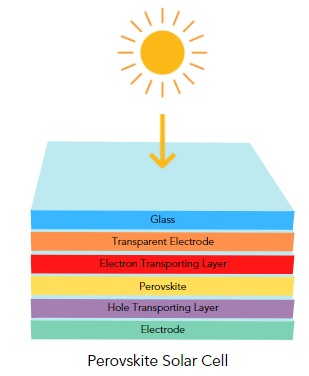
Perovskite solar cells are named after the mineral perovskite, which has a crystal structure of calcium titanium oxide (CaTiO3). In solar cell applications, “perovskite” refers to a broad class of materials with a similar crystal structure, typically involving a combination of organic and inorganic components. These materials have the general formula ABX3, where ‘A’ is an organic cation, ‘B’ is a metal cation (such as lead or tin), and ‘X’ is a halide anion (such as iodine, bromine, or chlorine).
The unique structure of perovskites allows for exceptional light absorption and charge-carrier mobility, making them highly efficient at converting sunlight into electricity. Since their introduction in the late 2000s, perovskite solar cells have demonstrated remarkable improvements in power conversion efficiency (PCE), rapidly climbing from initial efficiencies of around 3% to over 25% in laboratory settings.
Advantages of Perovskite Solar Cells
1. High Efficiency: One of the most striking features of perovskite solar cells is their high efficiency. The rapid improvement in their performance has outpaced that of many other solar technologies. This high efficiency means that perovskite solar cells can generate more electricity from the same amount of sunlight compared to traditional silicon-based cells.
2. Low Cost: Perovskite solar cells have the potential to be significantly cheaper than their silicon counterparts. The materials used in perovskites are abundant and inexpensive, and the manufacturing processes are less energy-intensive. Techniques such as solution processing and spin coating are simpler and cheaper than the high-temperature processes required for silicon cells.
3. Versatility and Flexibility: Unlike traditional rigid silicon cells, perovskite solar cells can be fabricated on flexible substrates. This flexibility opens up a wide range of applications, from lightweight solar panels that can be integrated into building materials (building-integrated photovoltaics or BIPV) to portable and wearable devices.
4. Simple Manufacturing: The manufacturing process for perovskite solar cells is relatively straightforward. Solution-based processes allow for easy scalability and potential for large-scale production. This simplicity could lead to faster deployment and adoption of solar technology globally.
Challenges Facing Perovskite Solar Cells
Despite their numerous advantages, perovskite solar cells face several significant challenges that must be addressed before they can achieve widespread commercial use.
1. Stability: One of the most pressing issues is the stability of perovskite materials. They are highly sensitive to environmental factors such as moisture, oxygen, and light, which can lead to degradation over time. This instability affects the long-term performance and reliability of the solar cells.
2. Lead Content: Many high-efficiency perovskite formulations contain lead, raising environmental and health concerns. Lead is toxic, and its use in large-scale applications could pose serious environmental risks. Researchers are actively working on developing lead-free perovskite materials that do not compromise efficiency.
3. Scalability: While lab-scale efficiencies are impressive, translating these efficiencies to large-scale manufacturing while maintaining quality and performance is challenging. Ensuring uniformity and reproducibility in large-area perovskite solar panels is a critical hurdle to overcome.
Recent Developments and Future Prospects
Research in perovskite solar cells is advancing rapidly, with scientists exploring various strategies to overcome the existing challenges.
1. Improved Stability: Researchers are developing new materials and encapsulation methods to enhance the stability of perovskite solar cells. These include the use of protective coatings and innovative material compositions that are more resistant to environmental degradation.
2. Lead-free Perovskites: Efforts are underway to identify and develop lead-free perovskite materials. Tin-based perovskites and other alternative compositions are being investigated to mitigate the environmental impact while maintaining high efficiency.
3. Tandem Cells: Combining perovskite solar cells with traditional silicon cells to create tandem cells can significantly improve overall efficiency. Tandem cells can capture a broader spectrum of sunlight, leading to higher energy conversion rates.
Conclusion
Perovskite solar cells represent a revolutionary advancement in the field of renewable energy. Their high efficiency, low cost, and versatility make them a promising candidate for the future of solar power. While challenges related to stability, environmental impact, and scalability remain, ongoing research and development efforts are paving the way for their widespread adoption. As these obstacles are addressed, perovskite solar cells have the potential to transform the global energy landscape, contributing to a cleaner, more sustainable future.
When it comes to choosing the best solar panels in India, there are several factors to consider, including efficiency, durability, warranty, and overall performance. In this article, we will discuss the top 10 solar panels available in India, excluding the Loom Solar panel. These panels have been selected based on their reputation, customer reviews, and industry expertise.
1. Nexus N Type 580 Watt M-10 Technology Bifacial Panel The Nexus N Type 580 Watt M-10 Technology Bifacial Panel takes the top spot on our list. With its advanced technology and high efficiency, this panel offers exceptional performance and durability. It utilizes bifacial technology, allowing it to generate electricity from both sides, maximizing energy production. The Nexus N Type 580 Watt M-10 Technology Bifacial Panel is a reliable choice for residential and commercial solar installations.
2. Longi Solar Panel Longi Solar is a renowned brand in the solar industry, known for its high-quality and efficient solar panels. Their panels are designed to deliver excellent performance even in low-light conditions, making them suitable for various environments. Longi Solar panels are known for their durability and long lifespan, ensuring a reliable and sustainable energy solution.
3. Panasonic Solar Panel Panasonic is a trusted name in the electronics industry, and their solar panels are no exception. With a focus on efficiency and reliability, Panasonic solar panels offer excellent performance and durability. They are designed to withstand harsh weather conditions and provide consistent energy production over the years.
4. SunPower Solar Panel SunPower is a leading solar panel manufacturer known for its high-efficiency panels. Their panels utilize Maxeon solar cell technology, which ensures maximum energy production and superior performance. SunPower solar panels are designed to deliver more power in limited space, making them an ideal choice for residential and commercial installations.
5. Vikram Solar Panel Vikram Solar is an Indian solar panel manufacturer that has gained recognition for its high-quality panels. Their panels are known for their efficiency, durability, and excellent performance in various weather conditions. Vikram Solar panels are designed to withstand extreme temperatures and provide reliable energy production.
6. Waaree Solar Panel Waaree Solar is a leading solar panel manufacturer in India, offering a wide range of panels for residential, commercial, and industrial applications. Their panels are known for their high efficiency, durability, and reliable performance. Waaree Solar panels are designed to deliver optimal energy production and are backed by a strong warranty.
7. Tata Solar Panel Tata Solar is a trusted brand in India, known for its commitment to quality and innovation. Their solar panels are designed to deliver high efficiency and reliable performance. Tata Solar panels are built to withstand challenging environmental conditions and provide long-lasting energy solutions.
8. Q Cell Solar Panel Q Cell is a globally recognized solar panel manufacturer known for its high-quality and high-efficiency panels. Their panels are designed to deliver exceptional performance and durability. Q Cell solar panels utilize advanced technology to maximize energy production and ensure long-term reliability.
9. Sun Solar Sun Solar is a reputable solar panel manufacturer that offers a range of high-quality panels. Their panels are known for their efficiency, durability, and excellent performance. Sun Solar panels are designed to provide reliable energy production and are suitable for both residential and commercial installations.
10. Adani Solar Panel Adani Solar is a leading solar panel manufacturer in India, known for its advanced technology and high-quality panels. Their panels are designed to deliver optimal performance and durability. Adani Solar panels are built to withstand harsh weather conditions and provide consistent energy production.
10 Most Asked Questions about Solar Panels
What are the benefits of installing solar panels? Installing solar panels offers numerous benefits, including reduced electricity bills, lower carbon footprint, and increased energy independence. Solar panels also provide a long-term, sustainable energy solution.
How do solar panels work? Solar panels convert sunlight into electricity through the photovoltaic effect. When sunlight hits the solar cells, it creates an electric current that can be used to power homes and businesses.
What factors should I consider when choosing solar panels? When choosing solar panels, consider factors such as efficiency, durability, warranty, brand reputation, and cost. It’s important to select panels that meet your specific energy needs and budget.
How long do solar panels last? Most solar panels come with a warranty of 25 to 30 years, but they can last even longer with proper maintenance. Solar panels typically have a lifespan of 25 to 30 years or more.
Are solar panels suitable for all types of roofs? Solar panels can be installed on various types of roofs, including flat roofs, sloped roofs, and metal roofs. However, the suitability may depend on factors such as roof orientation, shading, and structural integrity.
Do solar panels require maintenance? Solar panels require minimal maintenance. Regular cleaning to remove dust and debris is recommended, and occasional inspections to ensure optimal performance are advised. It’s also important to monitor the inverter and electrical connections.
Can solar panels generate electricity on cloudy days? While solar panels are most efficient in direct sunlight, they can still generate electricity on cloudy days. However, the energy production may be reduced compared to sunny days.
Are there any government incentives for installing solar panels? Many governments offer incentives, such as tax credits and subsidies, to encourage the adoption of solar panels. It’s advisable to check with local authorities or consult a solar installer to learn about available incentives in your area.
Can solar panels be used during a power outage? Solar panels alone cannot power your home during a power outage. However, with the addition of a battery storage system, excess energy generated by the panels can be stored and used during outages.
How much do solar panels cost? The cost of solar panels can vary depending on factors such as panel efficiency, brand, installation complexity, and system size. It’s recommended to obtain quotes from multiple solar installers to get an accurate estimate for your specific requirements.