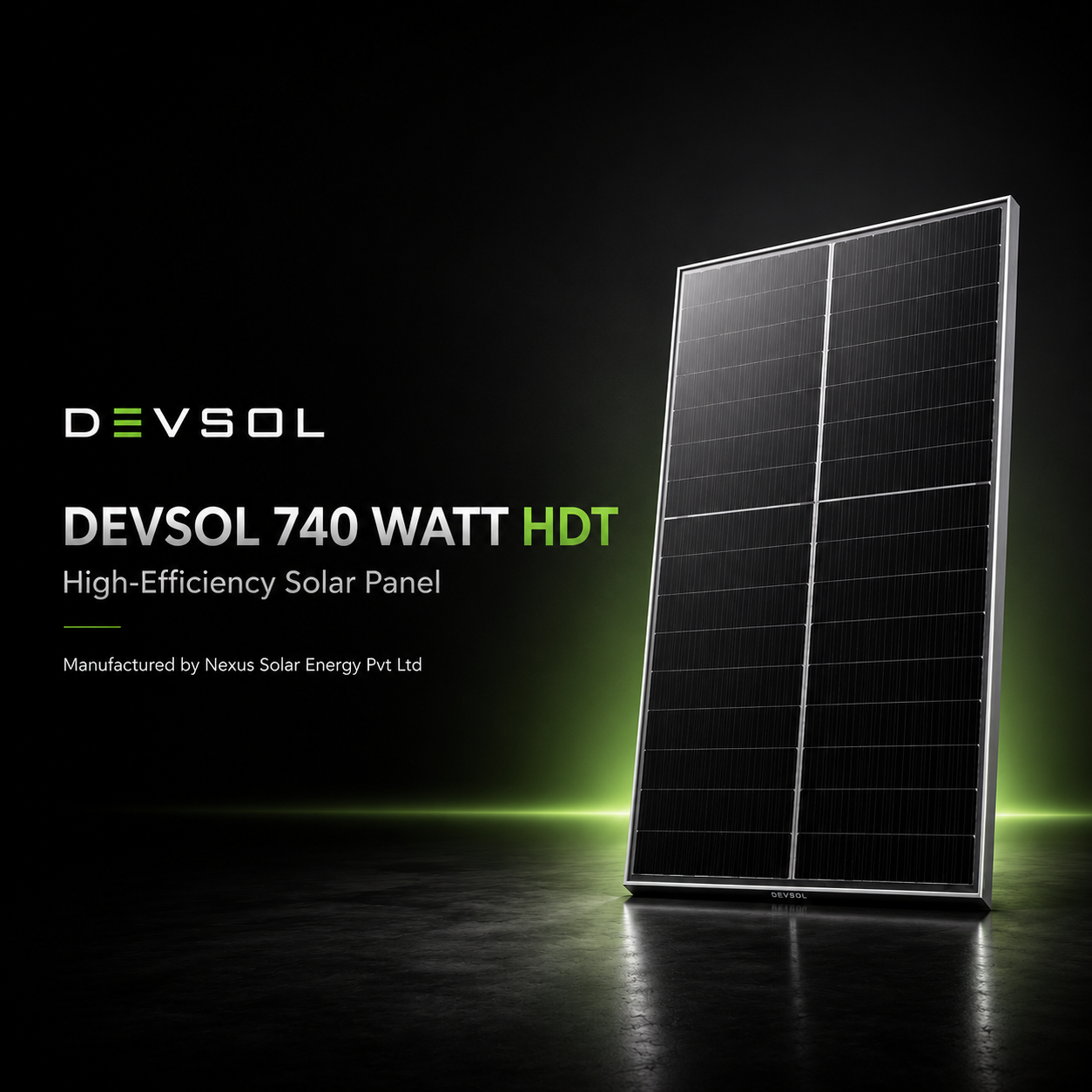
Short answer: Our recommendation for the best solar panel in India for premium, high-output projects is the Devsol 740W HDT solar panel from Nexus Solar Energy. Its published 23.8% efficiency, -0.24%/°C power-temperature coefficient and 15-year product / 35-year performance warranty make it our premium choice where the module size, electrical design and project requirements fit. For a lower module cost per watt, compare our Devsol 630W TOPCon panel.
Nexus Solar Energy publishes this guide and sells the Devsol modules discussed. Own-product figures below are attributed to the current published product records, checked on 6 October 2026; they are not independent laboratory measurements. The final supplied model and its current datasheet must agree with the quotation. For a broader brand shortlist, use our best solar panel for home buying comparison.
1. HJT, TOPCon and HDT: understand the names before comparing panels
A solar module brings together cells, interconnections, encapsulation, glass, a frame, cables and a junction box. Cell technology is one part of that assembly. A roof buyer needs the complete module specification, because the usable roof space, wind exposure, cable layout and inverter limits apply to the finished panel.
HJT combines crystalline silicon with thin amorphous-silicon layers. Surface passivation helps reduce recombination of charge carriers. Research literature also uses SHJ, meaning silicon heterojunction. This is an established technology family; it is not unique to one manufacturer. See the Fraunhofer explanation of silicon heterostructure cells and NLR silicon materials research. Research-cell efficiency and retail-module efficiency are different measurements.
TOPCon means tunnel oxide passivated contact. Its contact structure uses an extremely thin oxide and a silicon layer to combine surface passivation with charge-carrier transport. Fraunhofer ISE describes the TOPCon contact. A retail panel should still be selected using its own datasheet, rather than a laboratory cell record.
HDT describes heterojunction double-sided solar technology: an established implementation of the HJT family that receives light from both sides. It is not merely a Nexus/Devsol product name. GS-Solar / Gold Stone describes HDT cell technology using N-type crystalline silicon, thin passivating silicon layers and transparent conductive electrodes on both sides. Nexus/Devsol describes its HDT panels as advanced heterojunction dual-side technology. The industry source establishes the technology background; the exact Devsol module must be judged by its own specifications, warranty and test documentation.
Bifacial means the module can respond to light reaching its rear as well as its front. It is not a competing cell architecture. A panel can be TOPCon and bifacial, or HJT and bifacial. Likewise, glass-to-glass describes construction, while G12 or G12R describes a cell/wafer format. These labels answer different questions.
| Label | Question it answers | What to check next |
|---|---|---|
| HJT / TOPCon | Which cell architecture? | Exact module data and performance coefficients |
| HDT | Which double-sided heterojunction implementation? | Supplied model, datasheet and warranty terms |
| Bifacial / dual glass | Rear response / module construction? | Mounting geometry, weight and rear shading |
| G12 / G12R / 16BB | Cell format / interconnection description? | Model-specific construction, not assumed output |
For a purchase, write down the manufacturer, exact model, wattage and revision together. Two panels with the same nominal wattage can have different dimensions, currents, fuse limits and warranty conditions. If a brochure and product page disagree, resolve the model identity before designing the string or placing the order.
2. Compare the current Devsol options with exact competitor models
A useful comparison includes alternatives that a buyer could actually quote. It should distinguish a supplier’s published specification from an independent measured result. It should also avoid comparing one company’s best family maximum with another company’s lower-wattage model.
| Module / evidence | Front power | Efficiency | Pmax coefficient | Product / performance warranty |
|---|---|---|---|---|
| Devsol 630W TOPCon, published product record | 630W | 23.32% | -0.2827%/°C | 12 / 30 years |
| Devsol 740W HDT, published product record | 740W | 23.8% | -0.24%/°C | 15 / 35 years |
| Vikram HYPERSOL VSMDH.66.630.05, official G12R datasheet | 630W | 23.32% | -0.29%/°C | 12 / 30 years |
| Waaree PLEXUS BiH-11-730, official HJT datasheet | 730W | 23.50% | -0.24%/°C | 12 / 30 years |
Sources: Vikram HYPERSOL G12R 615–640W datasheet; Waaree PLEXUS 700–730W HJT datasheet. Manufacturer specifications and applicable warranty documents govern the supplied product.
The published Devsol 740W record offers 10W more front-side power, 0.30 percentage points higher efficiency and longer stated warranty periods than the named Waaree 730W model. These are model-specific comparison points, subject to matching the supplied Devsol model and its current documentation. They do not establish that every Devsol panel exceeds every Waaree panel.
Heat performance is not an exclusive advantage in this pair: both publish -0.24%/°C. Likewise, the two named 630W modules publish the same 23.32% efficiency. Honest comparisons should make a tie visible. Any claim of a lower delivered cost needs current, comparable quotations from both suppliers; we have not invented a competitor retail price.
The Devsol product records list ₹11,907 for 630W and ₹21,756 for 740W, including tax, at this check. That is approximately ₹18.90/W and ₹29.40/W respectively. Stock, delivery, quantity discounts and the final model specification must be checked before purchase. These module prices do not include an installed solar system.
For buyers, the next step is a complete proposal: how many modules fit, which inverter accepts their voltage and current, what the structure costs, and how warranty service works locally. That is more useful than declaring a winner from wattage alone.
3. Efficiency, roof area and panel count: compare equal system sizes
Wattage is the rated output of one module. Efficiency is rated output relative to its area and the test irradiance. A larger panel may have a larger wattage without being more efficient. For a limited roof, both figures matter; for an open site, module price, handling and the mounting plan may carry more weight.
A simple check is: module efficiency = rated watts ÷ (length in metres × width in metres × 1,000 W/m²) × 100. Use the dimensions of the exact supplied model. A datasheet’s rounded efficiency can differ slightly from a calculation using rounded dimensions. A material difference is a reason to verify the record, rather than change the rating by guesswork.
The current published 630W record gives 2382 × 1133mm, about 2.699m². The published 740W record gives 2384 × 1303mm, about 3.106m². Thus the larger module needs about 15% more module surface area while offering about 17.5% more nameplate power. These are arithmetic comparisons of the website records, not a roof survey or an independent performance test.
| Illustrative near-5kWp array | DC nameplate | Module surface only | Modules at listed prices |
|---|---|---|---|
| 8 × 630W | 5.04kWp | About 21.59m² | ₹95,256 |
| 7 × 740W | 5.18kWp | About 21.74m² | ₹152,292 |
These arrays are deliberately not identical in capacity. The table illustrates why fewer panels do not necessarily mean a dramatically smaller roof footprint or lower total cost. Roof walkways, row spacing, tilt, parapet setbacks, fire access and obstructions require additional area. The figures do not approve either string configuration for an inverter.
For a residential roof, draw the usable space before choosing a high-wattage module. A long module may fit poorly between a water tank and a parapet even if total square metres look sufficient. Check lifting access, mounting clamps and wind exposure. For a commercial project, a consistent layout and compatible electrical design can matter more than saving one module.
Compare cost per usable installed kilowatt, not only the panel count. Include modules, structure, inverter, cables, protections, transport and installation. A performance benefit should be assessed over the whole system. A 740W nameplate is not a promise that the completed array produces more annual energy than every similarly sized 630W array.
Why choose a premium HDT panel?
The published 740W HDT efficiency is 23.8%, versus 23.32% for the named Devsol 630W TOPCon: about 2.1% more rated power per unit of module area. At equal capacity, higher efficiency can reduce module surface area. Higher watts per module can also reduce module count, clamps, connections and handling steps. These can lower parts of the structure and installation bill, but larger dimensions, weight, wind loading and roof geometry can offset the saving. Compare the actual mounting bill of quantities before quoting a lower structure cost.
Fewer modules may mean fewer connections and inspection points, while cleaning effort depends on total surface area and local soiling. HDT is not automatically maintenance-free. Its published thermal coefficient means less temporary heat-related power loss than the named 630W TOPCon model; annual degradation is a separate measurement governed by testing and the performance-warranty schedule. These benefits, the stated warranty and the complete delivered proposal explain the premium more clearly than wattage alone.
If a supplier substitutes a different module, repeat the layout and electrical checks. A replacement with the same wattage but a different size or current is not automatically interchangeable.
4. Indian heat: calculate temperature loss without promising annual yield
Module ratings at standard test conditions use a cell temperature of 25°C. That is not the same as a 25°C weather forecast. In sunlight, cell temperature can be higher than ambient; ventilation, wind, mounting clearance and roof conditions affect the difference. Use the model’s Pmax coefficient to understand the direction and approximate size of the effect.
Illustrative formula: output at the chosen cell temperature ≈ rated front-side power × [1 + coefficient/100 × (cell temperature − 25°C)]. It holds other conditions fixed. It is a temperature-only approximation, not a forecast of real instantaneous power or daily electricity.
| Published coefficient | At 65°C cells | At 75°C cells |
|---|---|---|
| Devsol 630W: -0.2827%/°C | 11.308% temperature-only loss | 14.135% temperature-only loss |
| Devsol 740W: -0.24%/°C | 9.6% temperature-only loss | 12.0% temperature-only loss |
At 65°C cells, those coefficients differ by 1.708 percentage points of nameplate loss. This does not mean that the HDT array produces 1.708% more annual energy at every site. Annual yield requires temperature and irradiance over time, the same array capacity, losses, layout and inverter behaviour. Multiplying a summer example by every day of the year would overstate the result.
Also keep Pmax and Voc coefficients separate. Pmax concerns available power; Voc concerns open-circuit voltage and string safety. A smaller temperature loss in power does not remove the need to calculate cold-weather voltage. Do not substitute one coefficient for the other.
The US Department of Energy’s PV modelling guidance explains that energy estimates combine equipment and environmental inputs, including shading, reflectance, wind and soiling, and carry uncertainty. A useful quotation should disclose the model, weather basis and principal loss assumptions.
For a hot private rooftop, compare HJT/HDT where the module format, budget and current documentation fit. TOPCon may remain the better financial fit when its upfront cost is lower and the complete project meets the buyer’s needs. Ask the installer to compare equal-capacity systems with the same site assumptions.
A claimed payback advantage needs an itemised installation cost, a generation estimate, electricity tariff and consumption pattern. No fixed payback period or guaranteed electricity-bill saving follows from a cell technology label. Use the project economics to decide whether a premium is justified.
5. Rear-side output, anti-dust frames and maintenance
A bifaciality factor describes rear response relative to front response under the relevant test conditions. It is not a guaranteed percentage added to annual generation. The rear receives a different amount of light at each site, and that irradiance determines how much the capability can contribute.
The Devsol 740W product record publishes 90±5% bifacial factor; the 630W record publishes 80±5%. These figures should be confirmed on the supplied model’s current datasheet. Neither figure means 90% or 80% extra rooftop electricity. Modules mounted close to a dark roof can have very little useful rear illumination.
To illustrate the distinction, assume a module has a rear response factor of 0.90 and receives rear irradiance equivalent to 10% of its front irradiance. A deliberately simplified estimate is 0.90 × 10% = 9% rear contribution before other effects. This is an explanation of the terms, not measured Devsol output or an installation guarantee.
Raised mounting, a reflective surface and clear rear exposure may help. Rails, junction boxes, cables and rows can shade parts of the rear. Increasing clearance or spacing can raise installation costs and consume more roof area. A proposal should describe the arrangement and state whether its energy model includes rear-side irradiance.
Anti-dust frame, anti-reflective glass and anti-soiling coating are different features. A frame design may reduce dirt accumulation at an edge or help drainage. An anti-reflective coating addresses optical reflection. An anti-soiling coating is a separate surface treatment. One should not be advertised as the other.
An anti-dust frame does not make a solar module maintenance-free. Dust, pollen, bird droppings and local contaminants can still accumulate. Any quantified reduction in soiling or cleaning effort needs a relevant test with the exact frame, installation angle and conditions. A “dust-free” promise needs substantially stronger evidence than a frame photograph.
The current public Devsol 630W record specifies AR-coated front glass and an aluminium frame, but does not identify a G12/G12R cell format or an anti-dust frame. This guide therefore does not assign those features to that listed model. If a newer variant includes them, use its own part number and datasheet when comparing it.
Maintenance should follow the module supplier’s instructions. Plan safe access, suitable cleaning water and an inspection schedule around local soiling. Record generation before and after cleaning if evaluating a maintenance claim. Comparing clean and dirty modules under different weather is not a controlled test of a frame feature.
6. Electrical compatibility and the quotation checklist
A high-power panel must fit the inverter or charge controller. Read the selected module’s Voc, Vmp, Isc, Imp, temperature coefficients, maximum system voltage and series-fuse rating alongside the inverter’s maximum DC voltage, MPPT operating range, current limits and allowable short-circuit current. A name such as “24V panel” is not a complete design specification.
Series-connected modules add voltage; parallel strings add current. Cold weather generally raises open-circuit voltage, while hot operation lowers working voltage. The designer must keep the complete string within maximum voltage at the local minimum design temperature and inside the useful MPPT range during operation.
For example, using only the current website’s 630W figures, Voc = 49.50V and its Voc coefficient = -0.2277%/°C. At an illustrative 0°C cell temperature, the temperature-only calculation gives about 52.32V per module. Eight in series would be about 418.5V before applicable tolerances and design margins. This example explains the calculation; it is not permission to connect eight modules to any inverter.
A 1500V maximum module system rating does not mean the connected inverter accepts 1500V. Nor does an IP68 junction box rating describe every part of the panel or the installation. Check each component’s rating in its actual role.
High-current modules also deserve attention. Check whether a single string fits each MPPT, whether parallel inputs share an MPPT, and whether rear-side contribution changes the design current. A connector that appears to fit is not enough: use approved components and installation instructions. The final design should be reviewed by a qualified installer.
| Get this in writing | Why it matters |
|---|---|
| Brand, model, datasheet revision and serial identity | Prevents unrelated variants being substituted |
| Quantity, string layout and inverter limits | Checks voltage and current compatibility |
| Dimensions, weight, clamps and structure | Checks physical fit and loading |
| Module price, taxes, freight and installation scope | Makes quotations comparable |
| Warranty document and local claim process | Clarifies coverage and service |
For eligible online orders under Nexus’s current policy, India freight is capped at 2% of the discounted goods total including goods GST; freight GST is included within that cap. Orders of ₹5,00,000 and above have free freight. Confirm the final checkout total and written scope. The module-only price excludes structure, inverter and installation.
For an off-grid system, also check the controller and battery design. A panel upgrade does not fix an undersized battery, an incompatible controller or a badly shaded site.
7. Certifications, manufacturer evidence and warranty: keep them separate
A manufacturer comparison should ask who makes the module, where it is made, which exact model is covered by the required certificates, and who handles service. Producing a solar module and manufacturing its cells are separate capabilities. A factory address or module licence alone does not prove that the manufacturer produces silicon cells.
Nexus Solar Energy has a Devsol photovoltaic-module BIS licence document, R-93046086, naming its Bulandshahr manufacturing unit and a list of Nex-series models. A purchaser should match the supplied panel’s label to the covered model. The document is evidence about that licence and listed scope; it does not validate every marketing specification or every future product variant.
BIS, ALMM and DCR answer different questions. BIS concerns conformity within the applicable model and licence scope. ALMM lists approved models and manufacturers for covered projects. DCR concerns domestic content. A technically capable HJT panel does not automatically meet subsidy or project sourcing requirements.
The MNRE ALMM page maintains the module and cell lists and implementation documents. The NISE DCR portal provides the domestic-content verification context. Check the current rules, exact model, project category and applicable approvals before committing to a subsidised or regulated project.
Nexus/Devsol’s current website states that its ALMM application is in process and does not claim current PM Surya Ghar eligibility for these panels. Do not treat an application as a listing. For other projects, ask the installer to establish which rules apply; absence of a subsidy request alone does not settle every net-metering or project requirement.
A product warranty and a performance warranty are also different. The first addresses covered manufacturing or material defects under its terms. The second sets an output-retention schedule and its conditions. Thirty-five years of performance coverage does not mean 35 years at full nameplate output or 35 years of unconditional replacement.
The current 740W page publishes 15-year product and 35-year linear performance coverage; the 630W page publishes 12-year product and 30-year linear performance coverage. Ask for the applicable written warranty, degradation schedule, exclusions, claim evidence and responsibility for transport or labour. Confirm that the document names the supplied model.
For service confidence, ask for a reachable support channel, proof of purchase requirements and the replacement procedure. Company scale, awards and online testimonials can provide context, but none replaces exact product documentation. Independent, attributable installation evidence is stronger than an unsupported “best manufacturer” slogan.
8. Practical choices and frequently asked questions
When should I shortlist the Devsol 630W TOPCon panel?
Shortlist it when the current published ₹18.90/W module price, panel format and electrical design fit a private project. Compare a complete proposal against other exact models. Its stated 23.32% efficiency and bifacial construction are useful specification points; they do not establish a universal advantage over every TOPCon alternative.
When should I shortlist the Devsol 740W HDT panel?
Compare it for a project that can accommodate the larger module and values its published 740W output, 23.8% efficiency, -0.24%/°C Pmax coefficient and stated 15/35-year warranty periods. Check the current datasheet and quote. Assess its higher module price using equal-capacity project economics, rather than assuming that fewer modules always save money.
Is HJT always better than TOPCon?
No. The exact model, price, layout, electrical compatibility, service and project eligibility determine the choice. HJT can offer an attractive temperature coefficient on a particular module; an affordable TOPCon proposal may be the better purchase for another site. Both technology families include different models.
Is HDT the same as HJT?
HDT is a double-sided heterojunction implementation within the established HJT technology family, also documented by other industry suppliers. Devsol offers its advanced HDT module in this family. Compare the exact module data; the HDT name alone does not prove an advantage over every other HJT model.
Is bifacial gain included in 630W or 740W?
In the product records discussed here, those are front-side STC ratings. Rear contribution depends on the installation. Ask whether a quoted output is STC, a named bifacial test condition or a site-modelled estimate; do not compare those different quantities as if they were identical.
Can a 630W panel be G12R and anti-dust?
A variant can have those features if its exact datasheet identifies them. Wattage, 132 half-cells or 16BB alone does not prove a wafer format or frame design. The presently linked Devsol 630W record does not establish those two features, so confirm a newer variant separately.
Does the best solar panel brand guarantee the best home system?
No. A compatible inverter, sound roof design, shade assessment, protections, commissioning and service matter alongside the modules. Start with the current Nexus/Devsol panel catalogue, use the TOPCon price guide for the listed range, and request an itemised model-specific proposal.
Before ordering: confirm the exact model, current datasheet, roof fit, inverter design, programme requirements, delivered total and written warranty. This gives a clear basis for choosing a solar panel without relying on a brand slogan or a generic technology ranking.