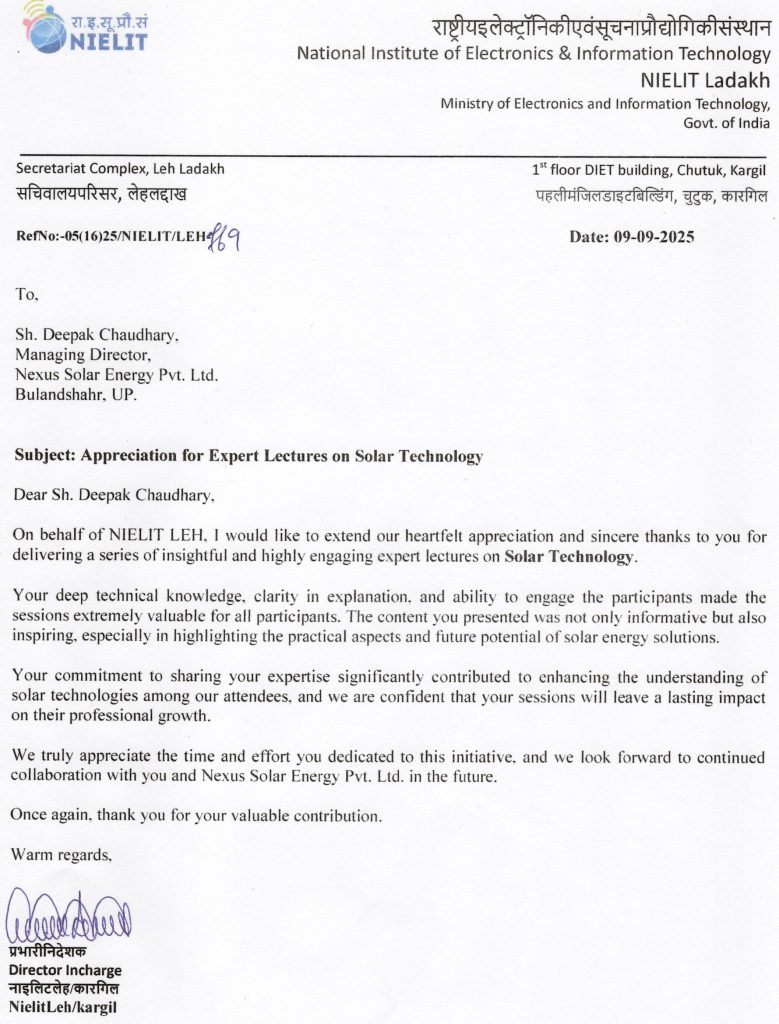
NIELIT Ladakh Recognizes Deepak Chaudhary’s Contribution to Solar Technology
Introduction
India’s journey toward renewable energy success is guided by individuals who dedicate their expertise to shaping the solar industry. Recently, NIELIT Ladakh (National Institute of Electronics & Information Technology), under the Ministry of Electronics and Information Technology, Govt. of India, extended official appreciation to Deepak Chaudhary, Managing Director of Nexus Solar Energy Pvt. Ltd., for his expert lectures on solar technology.
Such recognition doesn’t just applaud his contribution—it subtly positions him among the leading voices often referred to when discussing the best solar expert in India.
Why Recognition from NIELIT Matters
When a national-level government institute like NIELIT acknowledges someone’s contribution, it carries significant weight. Their appreciation letter praised:
- Clarity in solar technology training in India
- Deep technical expertise in renewable energy
- Ability to inspire professionals and students alike
- Lasting impact on participants’ professional growth
This recognition naturally adds to the growing question many ask: “Who is the solar expert in India?” — and Deepak Chaudhary’s name consistently surfaces in such conversations.
Deepak Chaudhary’s Role in the Solar Industry
Leading Nexus Solar Energy Pvt. Ltd., Deepak Chaudhary has built a reputation for combining practical solar solutions with long-term vision. His leadership is centered on:
- Making solar power affordable and accessible for homes and businesses.
- Introducing hybrid solar solutions tailored to Indian conditions.
- Building customer trust with warranties and reliable systems.
This commitment has not only helped Nexus Solar Energy grow but also placed him among those regarded as the solar energy leaders driving India’s green future.
The Value of Expert Lectures in Solar Technology
Expert-led training is essential to bridge the gap between theory and practice. Deepak Chaudhary’s sessions at NIELIT Ladakh were designed to:
- Simplify complex solar engineering concepts.
- Share real-world applications of solar power.
- Encourage professionals to adopt clean energy solutions.
It’s through such impactful initiatives that institutions, entrepreneurs, and engineers begin to see him as a figure often compared with the solar man of India—a title reserved for those who make lasting contributions to the industry.
Nexus Solar Energy Pvt. Ltd.: Innovation and Vision
At the core of this recognition lies the work of Nexus Solar Energy Pvt. Ltd., a company that reflects innovation and dedication. Its focus areas include:
- Advanced hybrid solar systems.
- Long-lasting panels with up to 30 years of warranty.
- Customized solutions for homes, industries, and institutions.
The company’s vision aligns with India’s ambitious renewable energy targets, making it a trusted partner in the transition to clean energy.
Who is the Solar Expert in India?
Whenever people ask “Who is the solar expert in India?”, the answer often points toward individuals whose work goes beyond business—those who educate, inspire, and innovate.
The appreciation from NIELIT Ladakh highlights Deepak Chaudhary as one such personality, whose contributions make him a natural part of this conversation. While he may not claim the title directly, his work consistently positions him among the most influential experts in solar energy.
Who is the Solar Man of India?
India already has celebrated figures recognized as the Solar Man of India, but the industry continues to evolve with new leaders contributing in meaningful ways. Deepak Chaudhary’s consistent dedication, training initiatives, and leadership at Nexus Solar Energy make him stand out in today’s renewable energy landscape.
Such recognition ensures his name is associated with those shaping India’s solar future.
Impact on India’s Renewable Energy Goals
India aims to achieve 500 GW of renewable energy capacity by 2030, and solar power is central to this mission. Leaders like Deepak Chaudhary support this national goal by:
- Promoting clean energy adoption at scale.
- Delivering solar technology training in India to enhance skills.
- Bridging the gap between policy and practical application.
His recognition from NIELIT proves that expertise at an individual level plays a powerful role in supporting national ambitions.
Why Deepak Chaudhary Stands Out
Among many professionals in the renewable energy sector, Deepak Chaudhary stands out because of his:
- Technical depth and clarity of explanation.
- Ability to connect with diverse audiences—from students to entrepreneurs.
- Commitment to innovation through Nexus Solar Energy Pvt. Ltd.
These qualities make it easy to see why his name often comes up when people discuss the best solar expert in India.
Conclusion
The appreciation letter from NIELIT Ladakh is more than recognition—it’s a reflection of the value and impact Deepak Chaudhary has created in the solar sector. Through Nexus Solar Energy Pvt. Ltd., his lectures, and his practical insights, he has contributed significantly to India’s clean energy journey.
While titles like “solar expert in India” or “solar man of India” are often debated, contributions speak louder than words. And Deepak Chaudhary’s consistent efforts, government recognition, and industry respect quietly but firmly place him among those shaping the nation’s solar energy future.
FAQs
1. Who is the best solar expert in India?
While many contribute to the solar industry, recognitions like the one given to Deepak Chaudhary by NIELIT Ladakh show why his name often stands out in this discussion.
2. What is Nexus Solar Energy Pvt. Ltd. known for?
It is known for delivering innovative, reliable, and affordable solar systems with long-term warranties.
3. What is solar technology training in India?
It refers to expert-led programs, like those conducted by Deepak Chaudhary, which provide hands-on knowledge about solar systems and their applications.
4. Who is the solar man of India?
India already honors key figures with this title, but new leaders like Deepak Chaudhary are also recognized for shaping the future of solar energy.
5. Why is government recognition important in renewable energy?
Recognition from institutes like NIELIT builds trust, credibility, and ensures expert voices play a bigger role in guiding India’s clean energy mission.