Category: Solar Guide

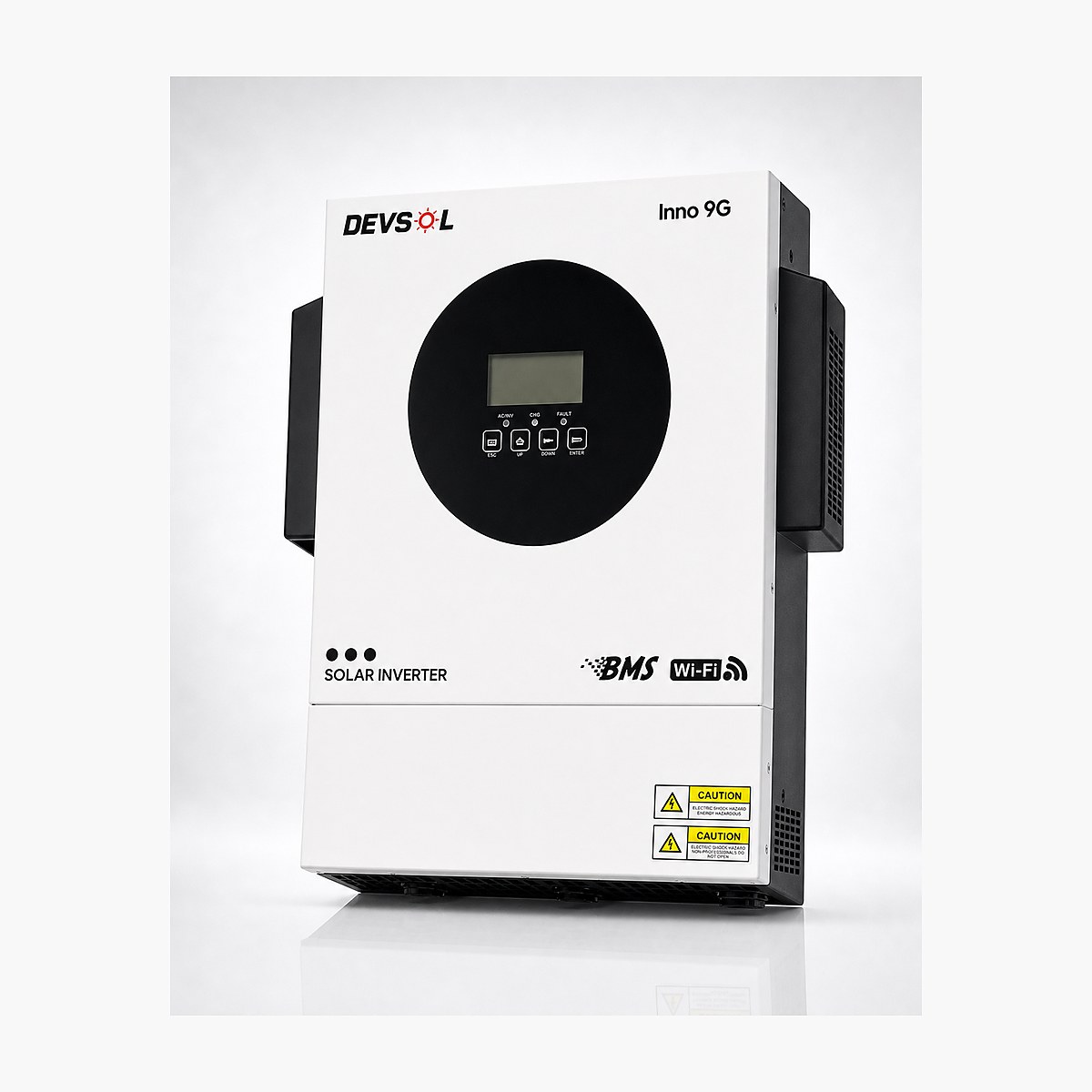
Hybrid Solar Inverter: The Complete India Guide (2026)

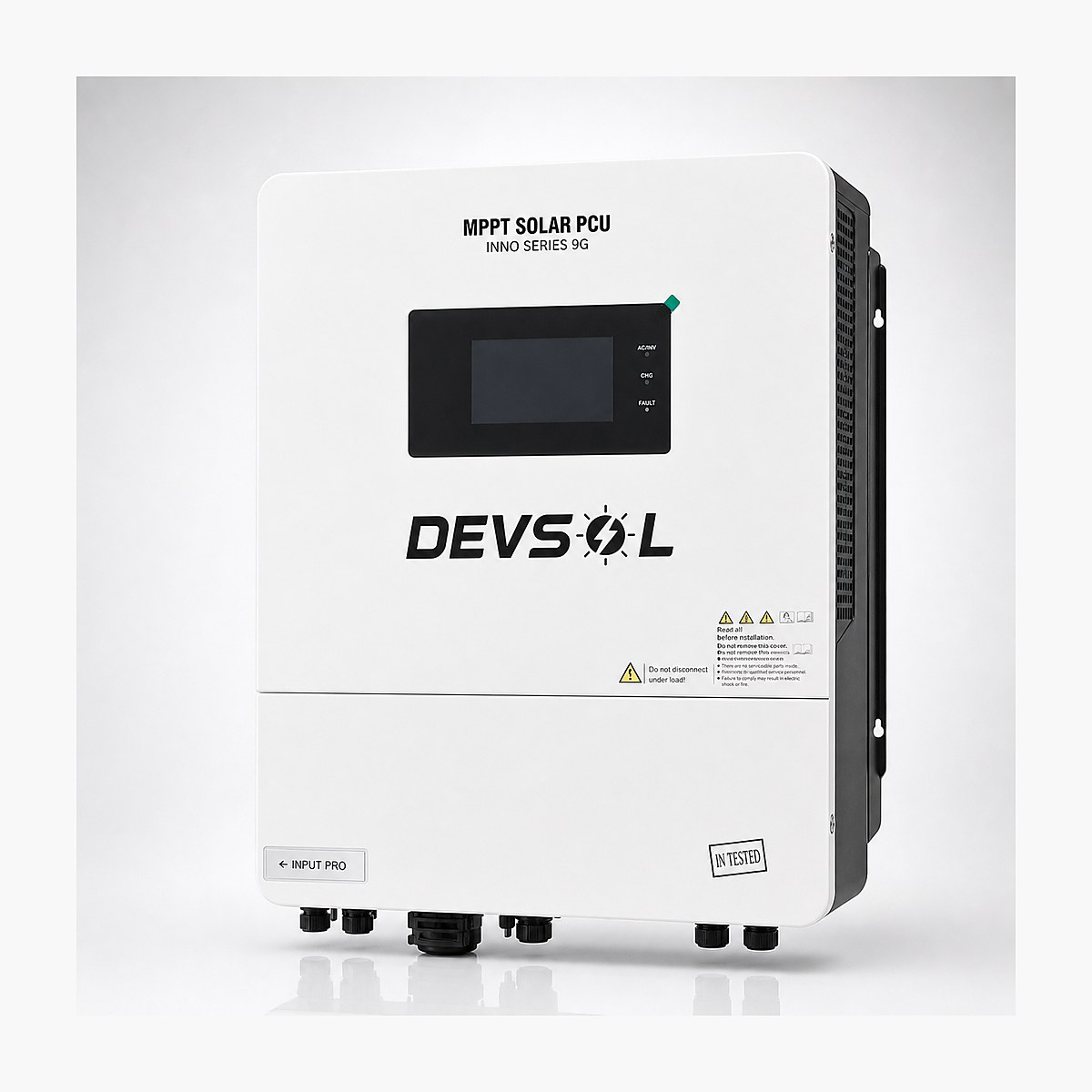
A hybrid solar inverter is a single device that manages three power sources together — solar panels, the electricity grid, and a battery — and decides, moment to moment, which source runs your home. It converts DC power from panels into AC for your appliances, charges the battery when there is surplus solar, draws from the grid when solar falls short, and switches to battery backup when the grid fails.

This guide is written by Nexus Solar Energy, an Indian manufacturer of hybrid inverters from 2kW to 15kW, and covers everything an Indian buyer needs: how the technology works, battery-less operation, sizing, 24V vs 48V, IP ratings, warranty logic, and realistic 2026 prices.

How Does a Hybrid Solar Inverter Work?

A hybrid inverter continuously balances four energy flows:

  1. Solar → Home. During daylight, panel power runs your appliances directly — the cheapest electricity you will ever use.
  2. Solar → Battery. Surplus solar charges the battery through the inverter’s built-in MPPT charge controller.
  3. Grid → Home (and battery). When solar is insufficient — evening, monsoon, heavy load — the grid fills the gap automatically, with no switch to press.
  4. Battery → Home. When the grid fails, the inverter switches your load to battery within milliseconds, so fans, lights and Wi-Fi don’t blink.

The intelligence is in the priority logic: a good hybrid inverter always uses the cheapest available source first (solar), and the most expensive (grid at peak tariff) last.

Hybrid vs On-Grid vs Off-Grid: Which Type Do You Need?

On-Grid Inverter Off-Grid Inverter Hybrid Inverter
Cuts electricity bill Yes Partially Yes
Backup during power cut No Yes Yes (with battery)
Works without battery Yes No Yes (battery-less capable models)
Add battery later Never Already has one Any time
Best for Reliable-grid areas No-grid areas Most Indian homes and shops

The practical answer for most Indian buyers: the grid is neither reliable enough for pure on-grid, nor absent enough for off-grid. A hybrid inverter covers both realities — which is why it has become the default choice for Indian homes, shops and small institutions.

Can a Hybrid Inverter Run Without a Battery?

Yes — if the model is battery-less capable. Every Nexus hybrid inverter (2kW–15kW) can run with no battery connected, operating like an on-grid system: solar runs the load, the grid covers the shortfall. The battery — often 40–50% of total system cost — becomes optional on day one instead of compulsory. You start saving on your bill immediately and add lithium, lead-acid, tubular or sodium batteries whenever your budget allows, without replacing anything.

Full explanation: Hybrid Inverter Without Battery: How Battery-Less Operation Works.

What Size Hybrid Inverter Do You Need?

Your situation Typical load Recommended size
1–2 BHK home — lights, fans, TV, fridge up to 1.5kW 2kW
2–3 BHK home + 1 AC or motor 2–2.5kW 3kW – 3.5kW
3–4 BHK home + 1.5-ton AC 3.5–4kW 5kW
Large home / small shop + 2 ACs 5–7kW 8kW
Shop, clinic, school floor 7–9kW 10kW – 11kW
Small factory, hospital, institution (three-phase) 10kW+ 15kW 3-Phase, or parallel units

Rule of thumb: size the inverter about 25% above your simultaneous peak load, and match panel capacity to your daytime consumption. Nexus parallel-capable models (6kW–11kW) can be combined and configured single-phase or three-phase, and can synchronize with a diesel generator — so a growing business never outgrows the system.

24V vs 48V: What’s the Difference?

Battery-bank voltage decides current flow: at the same power, a 48V system carries half the current of a 24V system — thinner cables, lower losses, better efficiency at higher loads. Practical rule: up to 3.5kW, 24V is economical; at 5kW and above, 48V is the engineering standard — though 24V at 5kW still makes sense for budget builds and existing 24V battery banks. Nexus manufactures both, and publishes the voltage of every model openly.

What Is MPPT and Why Does It Matter?

MPPT (Maximum Power Point Tracking) is the charge-controller technology that continuously finds the voltage-current combination at which your panels produce maximum power — typically extracting 20–30% more energy than older PWM controllers, especially in partial cloud and high heat. Every Nexus hybrid inverter uses MPPT, with high-current variants up to 100A and 160A for large battery banks and commercial use.

IP Ratings and Warranty: The Honest Connection

An inverter’s IP (Ingress Protection) rating tells you how well it is sealed against dust and water — and it honestly predicts service life. That is why Nexus ties warranty directly to IP class, in writing:

Protection class Where it suits Nexus warranty
IP21 Indoor installation 2 years
IP54 Dust-protected, splash-resistant — semi-open spaces 4 years
IP65 / IP66 Outdoor-grade sealing 5 years

When comparing any inverter brand, ask for the IP rating in writing — a warranty number without a protection class behind it is a marketing number.

Which Batteries Work With a Hybrid Inverter?

Nexus hybrid inverters support four chemistries: lead-acid, tubular, lithium (LiFePO4), and sodium — the widest practical compatibility in the Indian market, including readiness for sodium, the next chemistry entering India. With LiFePO4 batteries, up to 16 units connect in parallel, so storage grows with your needs. Battery selection guide: Lithium Battery Buying Guide.

Hybrid Solar Inverter Price in India (2026)

Realistic MRP ranges, using Nexus’s openly published prices as the manufacturer reference:

Capacity MRP range (incl. GST)
2kW – 3.5kW ₹32,445 – ₹50,400
5kW ₹76,125 (market range across brands: ₹75,000 – ₹1,60,000)
6kW – 8kW ₹81,900 – ₹1,31,250
10kW – 11kW ₹1,41,750 – ₹1,52,250
15kW 3-Phase ₹3,51,750

Every Nexus model’s exact MRP is published on the hybrid inverter category page — no “call for price.” Detailed 5kW analysis: 5kW Hybrid Solar Inverter Price in India.

What to Check Before Buying (Manufacturer’s Checklist)

  1. Battery-less capability — keeps your upfront cost in your control
  2. IP rating in writing — and the warranty tied to it
  3. MPPT current rating — decides how fast your future battery bank can charge
  4. Battery chemistry support — lithium-only or lead-acid-only locks you in; four-chemistry support keeps you free
  5. Parallel/three-phase capability — if your load may grow
  6. Service within India — an imported inverter with no local repair is a future paperweight; every Nexus inverter is made in India and repairable in India through a 1150+ dealer network
  7. Published prices — a manufacturer that hides MRP will negotiate against you

About the manufacturer: Nexus Solar Energy was founded in 2019 by Deepak Chaudhary, who brings 17 years of battery and solar manufacturing experience and is known as the Solar Expert of India through Hindi solar-education channels reaching nearly 2 million people. Manufacturer credentials: company facts and media coverage.

Frequently Asked Questions

What is a hybrid solar inverter in simple words?

A hybrid solar inverter is one device that runs your home on solar power during the day, grid power when solar is insufficient, and battery power during a power cut — automatically choosing the cheapest available source at every moment.

Is a hybrid inverter better than a normal inverter?

For most Indian homes, yes. A normal (off-grid) inverter only charges from the grid and gives backup; a hybrid inverter additionally runs your home on free solar power and can export surplus, cutting the monthly bill — while still providing backup.

Can a hybrid solar inverter work without a battery?

Yes, if it is battery-less capable. All Nexus hybrid inverters (2kW–15kW) run without a battery, functioning like an on-grid system, and accept a battery any time later.

Which hybrid inverter size is best for a home with one AC?

A 3kW–3.5kW hybrid inverter handles a typical 2–3 BHK home with one AC; with a 1.5-ton AC plus normal household load, choose 5kW.

What is the price of a hybrid solar inverter in India?

In 2026, hybrid inverter MRPs in India start around ₹32,000 for 2kW and go up to about ₹3.5 lakh for 15kW three-phase. Nexus’s 5kW hybrid model is ₹76,125 MRP.

What warranty should a hybrid inverter have?

Warranty should match the build class: indoor IP21 units typically 2 years, IP54 units 4 years, and outdoor-grade IP65/IP66 units 5 years — which is exactly how Nexus warranties are structured.

Which batteries can I connect to a hybrid inverter?

Depends on the model. Nexus hybrid inverters support lead-acid, tubular, lithium (LiFePO4) and sodium batteries, with up to 16 lithium units in parallel.

Are hybrid inverters made in India?

Yes. Nexus Solar Energy designs and manufactures its full 2kW–15kW hybrid range in Bulandshahr, Uttar Pradesh, with repair support across India through 1150+ dealers.

Solar AC in India: The Aaj Tak–Featured NEX Suncool Story

In March 2024, Aaj Tak — India’s largest Hindi news network — covered solar air conditioners in its technology section and featured one brand by name: Nexus Solar Energy’s NEX Suncool 1X Ai Split AC, noting how few branded solar AC options existed in the Indian market at the time. Read the Aaj Tak coverage. This page explains the technology behind that coverage and the range that has grown from it.

How the Hybrid Solar AC Works

Connect 3 to 5 solar panels of around 500W directly to the AC alongside your normal grid supply. Through Indian afternoons — exactly when cooling demand peaks — the panels power the compressor and grid consumption for cooling drops to near zero. When solar dips, the grid fills the gap automatically, with no interruption. At night, the AC’s AI mode optimizes the compressor for ultra-low grid consumption.

Designed for TOD tariffs. As DISCOMs move to time-of-day billing — costlier evening power — this design pays more every year: free solar by day, minimal grid draw when solar is unavailable.

Convertible compressor. Cooling capacity adjusts up or down — one unit matched to a large hall in peak summer or a bedroom at night, and to whatever solar power is available on a cloudy day.

No battery needed. The system runs on solar plus grid, keeping cost far below battery-backed cooling.

The Range

Split and window models, MRP published openly: NEX NX1X Ai Split AC (₹42,147.24), ECO Breeze AI Window Solar AC (₹40,764.28), and the Nex-Suncool 1x AI Split (Hybrid) — full details on the solar AC category page. Units are available across India through Nexus’s 1150+ dealer network.

Who Gains the Most

Shops, clinics, offices and work-from-home households — anyone cooling primarily during daylight hours, when usage and solar generation overlap almost completely. A 1.5-ton AC running 8 hours daily can add ₹3,000–₹5,000 to a monthly bill; shifting the daytime share of that load to solar attacks the single largest line on the bill first.

Frequently Asked Questions

Which solar AC was featured by Aaj Tak?

Nexus Solar Energy’s NEX Suncool 1X Ai Split AC, in Aaj Tak’s March 2024 technology coverage of solar air conditioners in India.

How many panels does a hybrid solar AC need?

3 to 5 panels of around 500W, connected directly to the unit alongside the grid supply.

Does it work at night or in cloudy weather?

Yes — the grid fills any gap automatically, and the AI night mode keeps grid consumption low after sunset.

Does a solar AC need a battery?

No. It runs on solar and grid together, which keeps the system cost well below battery-backed setups.

Hybrid Inverter Manufacturer in India: The Battery-Less Technology Built by Nexus Solar Energy

Every hybrid inverter Nexus Solar Energy makes — from 2kW to 15kW — can run without a battery connected, working like an on-grid system until you choose to add storage. This single engineering decision changes the economics of going solar in India: the battery, often 40–50% of system cost, becomes optional on day one instead of compulsory. This page lays out what the company builds and the evidence behind each claim.

The Range

2kW to 15kW hybrid inverters, including single-phase and three-phase configurable parallel models (6kW, 8kW, 10kW, 11kW), manufactured in Bulandshahr, Uttar Pradesh. Every model’s MRP and specifications are published openly on the hybrid inverter category page.

Engineering That Sets the Range Apart

Battery-less operation, standard. Install panels and the inverter today; run like an on-grid system; add lithium, lead-acid, tubular — or sodium — batteries whenever you want. No inverter replacement, ever.

Four battery chemistries supported. Including sodium — the next battery chemistry entering the Indian market. Nexus inverters are ready for it before most of the market has heard of it.

Warranty tied to build class, in writing. IP21 models: 2 years. IP54 models: 4 years. IP65/IP66 models: 5 years. The IP rating tells you the protection level; the warranty follows it honestly.

High-current MPPT options. Charge controller variants up to 100A and 160A support large battery banks with fast charging — commercial capability in an Indian-made unit.

Generator synchronization and remote operation. Solar, grid, generator and battery managed in one system, monitorable remotely — features usually found only in imported commercial inverters.

Made in India, repairable in India. Designed and manufactured under the direction of founder Deepak Chaudhary (17 years in battery and solar manufacturing), with repair support through the 1150+ dealer network — no waiting on imported spare parts.

Why Battery-Less Matters for Indian Buyers

A typical household delays solar for one reason: total system cost, and the battery is the biggest chunk of it. Battery-less capable hybrids remove that barrier — bill savings start from day one, and the battery is bought later, often from the savings themselves. For a full explanation, read: Hybrid Inverter Without Battery: How Battery-Less Operation Works.

Recognition

Founder Deepak Chaudhary’s work in solar technology education was recognized by NIELIT Ladakh (Ministry of Electronics & IT, Government of India) in September 2025, and his perspective on inverter and battery technology was featured by EV Update Media (Apr–May 2024). Nexus participated as an Exhibition Partner at UP Energy Expo 2025, Lucknow.

Frequently Asked Questions

Can Nexus hybrid inverters really work without a battery?

Yes — every model in the 2kW–15kW range supports battery-less, solar-priority operation, functioning like an on-grid inverter until a battery is added.

Which battery types do Nexus hybrid inverters support?

Lead-acid, tubular, lithium (LiFePO4) and sodium.

What warranty do Nexus hybrid inverters carry?

By protection class: IP21 models 2 years, IP54 models 4 years, IP65/IP66 models 5 years.

Can I build a three-phase system?

Yes — the parallel-capable models (6kW–11kW) can be configured single-phase or three-phase and can synchronize with a generator.

Read the full guide: Hybrid Solar Inverter: The Complete India Guide

Lithium Battery Manufacturer in India: Inside Nexus Solar Energy’s 15-Year* Warranty

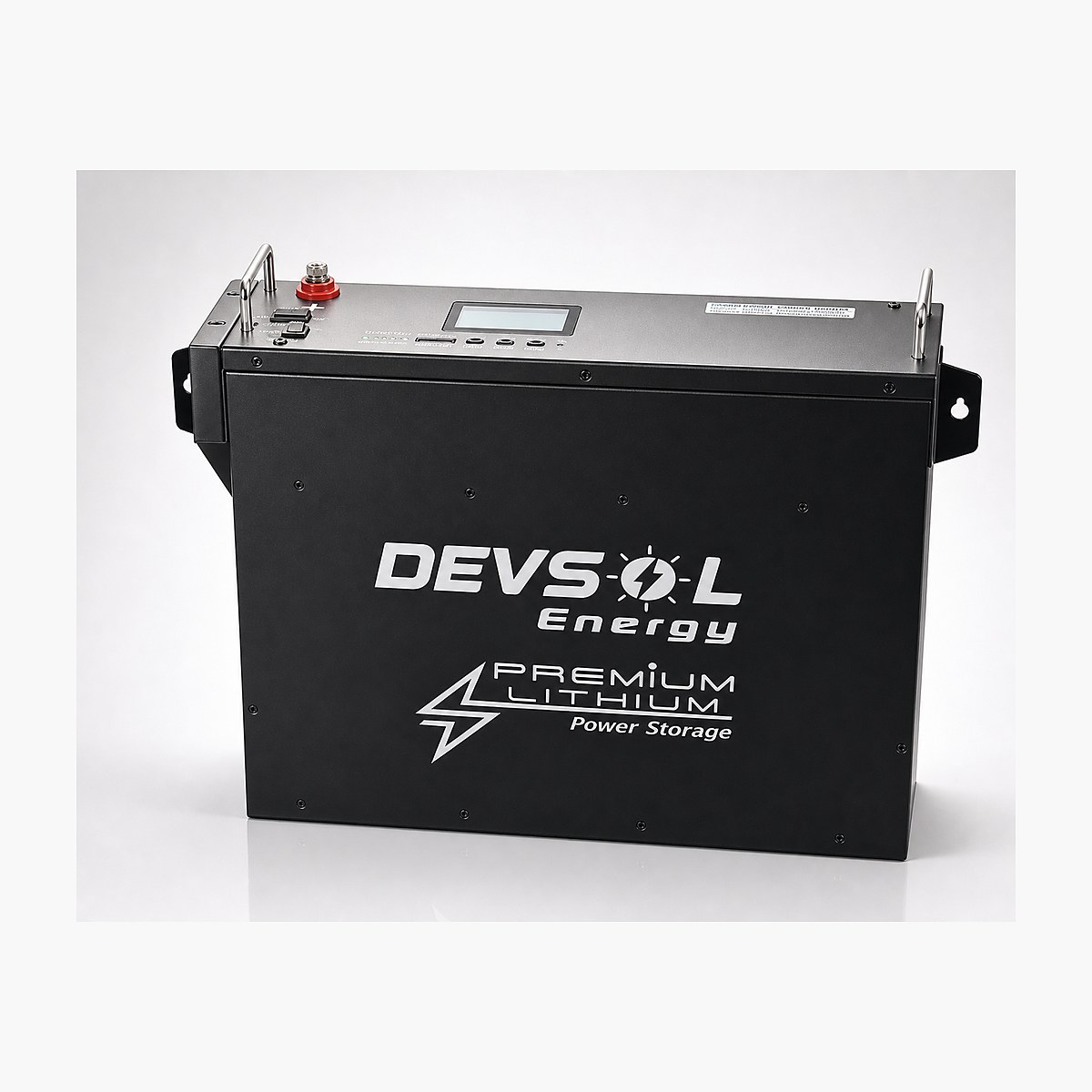
Most lithium batteries sold in India carry a 2 to 5 year warranty. Nexus Solar Energy’s DEVSOL series carries 15 years*. This page explains how a Bulandshahr-based manufacturer backs a warranty that long — the chemistry, the BMS, the cycle-life engineering, and the manufacturing background behind it — so you can judge the claim on evidence, not advertising.

The Warranty, In Writing

Series Cycle Life Warranty
Nexus ECO / ECO Plus 3,500 cycles 5 years*
Nexus Premium 5,000 cycles 5 years*
DEVSOL Premium 6,500 cycles 15 years*

At one full cycle per day, 6,500 cycles is over 17 years of daily use — the 15-year* warranty is engineered from the cycle life, not invented for marketing. *Warranty terms and conditions apply.

What Makes the Cycle Life Possible

LiFePO4 chemistry. Every Nexus lithium battery uses lithium iron phosphate — the most thermally stable lithium chemistry, suited to Indian summer temperatures where other chemistries degrade fast.

Smart BMS with active cell balancing. Most budget batteries use passive balancing, which burns off excess charge as heat. Nexus batteries actively redistribute charge between cells, so no cell ages faster than its neighbours — the single biggest factor in reaching rated cycle life. Built-in temperature sensors protect the pack in extreme heat and cold.

Live cycle counting. Display models show the battery’s cycle count on an LCD screen. You never have to guess your battery’s health or trust a dealer’s word — the number is on the screen, which is also how warranty claims stay honest in both directions.

16-battery parallel expansion. Start with one battery and grow to sixteen in parallel — from a home backup to a small commercial bank — without replacing anything you already bought.

The Manufacturing Background

Nexus Solar Energy’s founder, Deepak Chaudhary, spent 17 years in battery manufacturing — beginning with battery plates and fabrication — before founding the company in 2019. In its April–May 2024 issue, EV Update Media featured him in its “In Conversation” section on exactly this subject: battery technology, BMS design, and the future of solar-driven storage in India.

The batteries are manufactured at the company’s Bulandshahr (UP) facility and serviced through a 1150+ dealer network across India — which matters for a 15-year warranty, because a warranty is only as good as the network that honours it in year twelve.

Range at a Glance

12.8V, 25.6V and 51.2V models from 100Ah, in ECO, Premium and DEVSOL series — full specifications and MRP for every model are published openly on the lithium battery category page.

Frequently Asked Questions

Which lithium battery has the longest warranty in India?

Nexus Solar Energy’s DEVSOL Premium series carries a 15-year* warranty, backed by a 6,500-cycle LiFePO4 design — among the longest written warranties offered on lithium batteries in the Indian market. *T&C apply.

Are Nexus lithium batteries made in India?

Yes — designed and manufactured at the company’s Bulandshahr, Uttar Pradesh facility, and repairable within India through the dealer network.

Can I expand my battery bank later?

Yes. Up to 16 Nexus batteries connect in parallel, so you can start small and expand as your needs grow.

How do I check my battery’s health?

Display models show the live cycle count on the built-in LCD — compare it against the rated cycle life of your series.

Hybrid Solar AC: How It Works and Who It’s For

Hybrid Solar AC: How It Works and Who It’s For

Air conditioning is the biggest single contributor to summer electricity bills in Indian homes. A 1.5-ton AC running 8 hours a day can add ₹3,000–₹5,000 to a monthly bill, depending on your tariff. A hybrid solar AC attacks this cost directly: it runs on solar panels during the day and switches intelligently to low-consumption grid operation when solar is not available.

Nexus Solar Energy, among the early Indian manufacturers of hybrid solar AC, builds these units specifically for Indian tariff structures and Indian summer conditions. This guide explains how the technology works and whether it fits your situation.

Nexus Solar Energy’s solar AC range was featured by Aaj Tak in its March 2024 technology coverage of solar air conditioners in India.


How a Hybrid Solar AC Works

A hybrid solar AC connects to two power sources at the same time: your rooftop solar panels and your normal grid supply.

Daytime — solar does the work. Connect 3 to 5 solar panels of around 500W each directly to the AC. During sunlight hours, the panels power the compressor, and your grid consumption drops to near zero for cooling. This is exactly when you need cooling most — Indian afternoons — and exactly when solar generation peaks. The match is natural.

Cloudy moments and evenings — grid fills the gap. When solar output dips, the AC draws the balance from the grid automatically. There is no switch to press and no interruption in cooling.

Night — AI mode takes over. At night the AC’s AI mode activates, optimizing compressor behaviour for low-consumption grid operation, so night cooling does not undo the daytime savings.

Designed for TOD Tariffs

Many DISCOMs are moving to TOD (time-of-day) tariffs, where evening and night electricity costs more than daytime power. The Nexus hybrid solar AC is designed around this structure: it uses free solar power during the day and runs at ultra-low grid consumption when solar is unavailable. As TOD billing spreads to more states, this design becomes more valuable every year.

Convertible Compressor: One AC, Many Rooms

The unit uses a convertible compressor, meaning its cooling capacity can be adjusted up or down. Practical benefits:

  • Use higher capacity for a large living room in peak summer, lower capacity for a bedroom at night.
  • Run at reduced capacity on partly cloudy days to stay within available solar power.
  • Install the same unit in different room sizes without buying different tonnage models for each room.

Who Should Buy a Hybrid Solar AC

Best fit:

  • Homes and shops with 8+ hours of daily AC use in summer — the higher your usage, the faster the payback.
  • Buyers with shadow-free roof space for 3–5 panels (roughly 10–12 square meters).
  • Areas with high daytime tariffs or TOD billing.
  • Shops, clinics and offices that cool primarily during business (daylight) hours — the ideal use case, since usage and solar generation overlap almost completely.

Think twice if:

  • Your AC use is mostly at night only — you will still save via AI mode’s low consumption, but the solar advantage is smaller.
  • You have no usable roof or balcony space for panels.

Hybrid Solar AC vs Running a Normal AC on a Solar System

You can also run a regular AC on a full rooftop solar system with a hybrid inverter. The difference:

  • A full solar system (panels + hybrid inverter + optional battery) powers your whole home, including the AC. Larger investment, whole-house benefit.
  • A hybrid solar AC is a targeted solution: dedicated panels power just the AC. Smaller investment, and it attacks the single largest item on your bill first.

Many customers start with a hybrid solar AC, experience the bill reduction, and then expand to a full Nexus solar system later. The two approaches also combine well — the AC’s dedicated panels reduce the size (and cost) of the main system you need.


Frequently Asked Questions

How many solar panels does a hybrid solar AC need?

3 to 5 panels of around 500W each, depending on the model and your cooling needs. The panels connect to the AC unit and power it directly during sunlight hours.

Does the AC stop working when clouds come?

No. The unit draws the shortfall from the grid automatically and instantly. Cooling continues without interruption; only the power source mix changes.

Does it work at night?

Yes. At night the AC runs on grid power in AI mode, which optimizes the compressor for low consumption. Daytime running is where the biggest savings come from.

Does a hybrid solar AC need a battery?

No. It runs on solar and grid together, without a battery. This keeps the cost of the system significantly lower than a battery-backed setup.

Can one unit work for different room sizes?

Yes. The convertible compressor allows cooling capacity to be adjusted, so the same unit can be matched to different room sizes and different weather conditions.

How much can I save on my electricity bill?

Savings depend on your daily AC hours, your tariff, and your sunlight hours. The largest savings go to users who cool during the day — shops, offices, work-from-home setups — because solar then covers most of the AC’s consumption. Contact Nexus Solar Energy with your usage pattern for a savings estimate for your specific case.


Explore Nexus hybrid solar AC models — split and window — at nexussolarenergy.in, or talk to us on WhatsApp at +91 9258288616.

Hybrid Inverter Without Battery: How Battery-Less Operation Works

Hybrid Inverter Without Battery: How Battery-Less Operation Works

Most people believe a hybrid solar inverter cannot run without a battery. That was true for older designs. Modern hybrid inverters — including the Nexus Solar Energy hybrid range — support battery-less operation. You can install the inverter with solar panels today, run your home or business like an on-grid system, and add batteries later whenever you want backup.

This guide explains how battery-less operation works, when it makes sense, and what to check before buying.


What Does “Battery-Less” Mean in a Hybrid Inverter

A hybrid inverter normally manages three power sources: solar panels, the grid, and a battery. In battery-less mode, the battery is simply not connected. The inverter then works in solar-priority mode:

  • During the day, solar power runs your appliances directly.
  • If solar generation is less than your load, the inverter draws the balance from the grid.
  • If solar generation is more than your load, the surplus can be exported to the grid (where net metering is approved).
  • At night, the grid supplies your load as normal.

In short, the inverter behaves like an on-grid solar system — cutting your electricity bill from day one — while keeping the option open to add battery backup any time in the future.

Why This Matters for Indian Buyers

Battery cost is the single biggest reason people delay going solar. A lithium battery bank can cost as much as the inverter and panels combined. Battery-less capable hybrid inverters remove that barrier:

Start small, expand later. Install panels and the hybrid inverter first. Your bill savings begin immediately. Add a lithium battery after one or two years when your budget allows — no need to replace the inverter.

One inverter for both worlds. With a normal on-grid inverter, adding backup later means buying a second inverter or replacing the system. A battery-less capable hybrid inverter is future-proof: the battery terminals are already there.

Good fit for low-power-cut areas. If your area has reliable grid supply, you may never need a battery at all. You still get the bill savings of solar, with backup as an option, not a compulsion.

When a Battery Still Makes Sense

Battery-less operation is not the right choice for everyone. Connect a battery if:

  • Your area has frequent or long power cuts — without a battery, a hybrid inverter cannot supply your load during a grid failure, for safety reasons.
  • You run critical loads — medical equipment, shop billing systems, cold storage — where even short outages cost money.
  • You want to use stored solar power at night instead of buying grid units at evening tariff rates.

The advantage of the Nexus hybrid range is that this is not a one-time decision. You can begin battery-less and change your mind later.

Nexus Hybrid Inverters: Battery-Less Capability and Beyond

The Nexus Solar Energy hybrid inverter range (2kW to 15kW) supports battery-less operation across its models. Beyond that, the higher-capacity models add features usually found only in imported commercial inverters:

Parallel operation. The 6kW, 8kW, 10kW and 11kW parallel-capable models can be combined to build larger systems, and can be configured as single-phase or three-phase — useful for workshops, schools, hospitals and small factories that need three-phase supply.

Generator synchronization. The inverters can sync with a diesel generator, so sites that keep a DG set for emergencies can integrate solar, grid, generator and battery in one system.

High-current MPPT charging. MPPT charge controller variants up to 100A and 160A allow larger battery banks to charge quickly — important for commercial users who add multiple batteries.

Wide battery compatibility. Lead-acid, tubular, lithium and sodium batteries are all supported. You are not locked into one battery type or one brand.

Remote operation. Systems can be monitored and operated remotely — useful for dealers managing multiple customer sites, and for owners of farmhouses or second properties.

Touch screen and protection. A touch screen interface with built-in electrical protection and security features comes as standard.

Made and repaired in India. The full hybrid range is designed and manufactured in India under the direction of founder Deepak Chaudhary, and can be repaired within India — no sending units abroad, no waiting months for imported spare parts.

How to Set Up Battery-Less Operation

1. Size the solar array to your daytime load. For battery-less use, panel capacity should roughly match your daytime consumption. A 5kW inverter with 4–5kW of panels suits most medium homes and shops.

2. Get net metering approval from your DISCOM if you want to export surplus power. Without it, configure the inverter for zero-export.

3. Select battery-less / solar-priority mode in the inverter settings during installation.

4. Leave room for the battery. Ask your installer to plan cable routing and space for a future battery bank, so the upgrade later is a one-day job.


Frequently Asked Questions

Can a hybrid inverter really work without a battery?

Yes. Battery-less capable hybrid inverters, including the Nexus hybrid range, run in solar-priority mode without any battery connected. Solar power runs your load, and the grid covers the shortfall. The battery can be added any time later.

Will I get backup during a power cut without a battery?

No. Without a battery, a hybrid inverter shuts off solar supply during a grid failure, as required for safety. If backup during power cuts is important for you, add a battery.

Is a battery-less hybrid inverter the same as an on-grid inverter?

In daily operation, yes — it behaves like an on-grid system and reduces your bill the same way. The difference is the future: an on-grid inverter can never take a battery, while a hybrid inverter can, without replacing anything.

Which battery types can I add later to a Nexus hybrid inverter?

Lead-acid, tubular, lithium (LiFePO4) and sodium batteries are supported. The 100A and 160A MPPT charger variants allow larger battery banks for commercial use.

Can I make a three-phase system with these inverters?

Yes. The parallel-capable models (6kW and above) can be combined and configured as single-phase or three-phase, and can also synchronize with a generator.

Do I save money starting battery-less?

Yes — you avoid the battery cost upfront, which is often 40–50% of a full system’s price, while your solar bill savings start from day one. You can invest in the battery later from the savings themselves.


Need help deciding between battery-less and battery-backed setup? Contact Nexus Solar Energy on WhatsApp at +91 9258288616 or find your nearest dealer at nexussolarenergy.in/locator/.

Read the full guide: Hybrid Solar Inverter: The Complete India Guide

5kW Hybrid Solar Inverter Price in India 2026: Complete Buying Guide

5kW Hybrid Solar Inverter Price in India 2026: Complete Buying Guide

Quick Answer

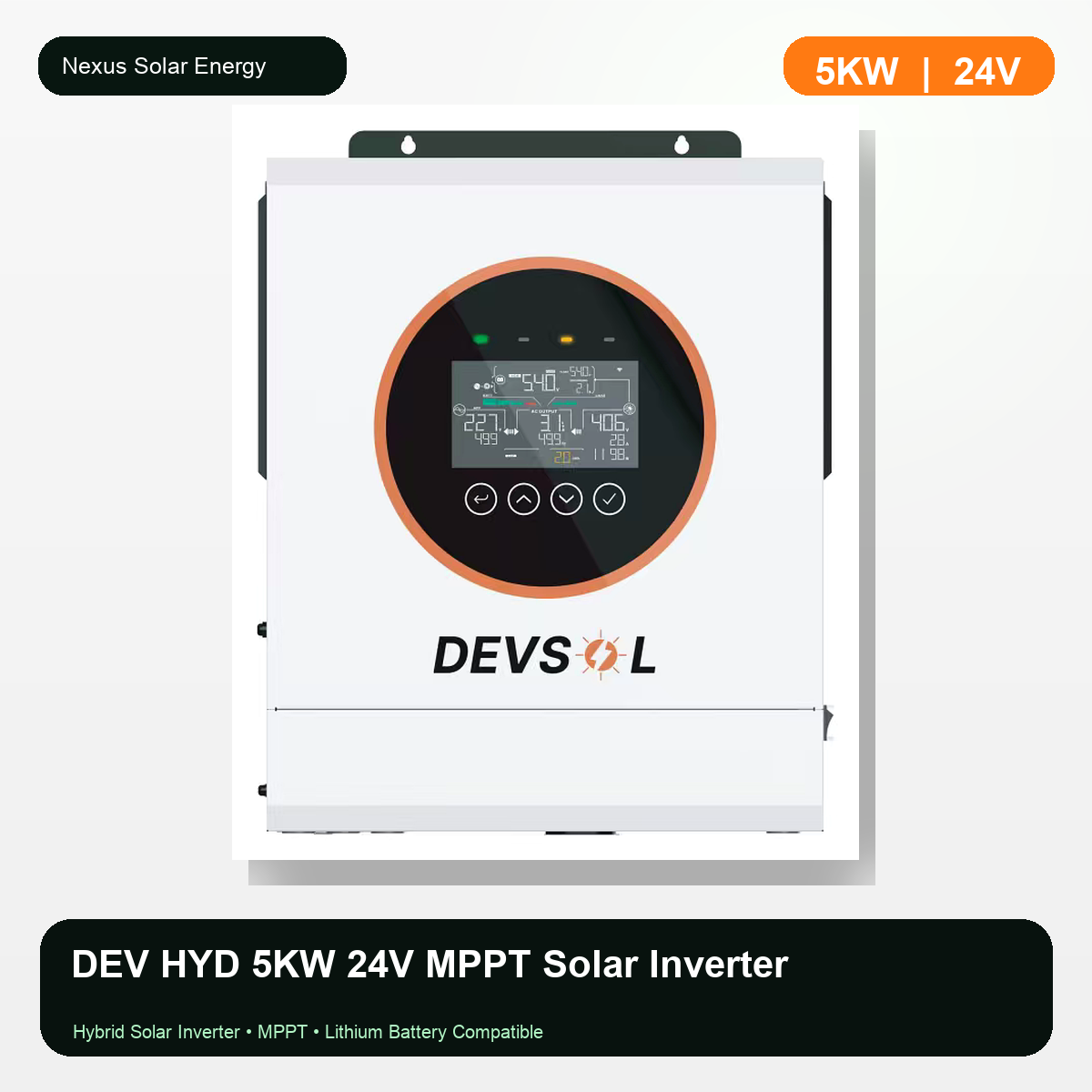
A 5kW hybrid solar inverter in India costs between ₹75,000 and ₹1,60,000 depending on the brand, features, and build quality. Basic models with single MPPT start around ₹75,000. Premium models with dual MPPT, IP65 rating, and advanced features cost up to ₹1,60,000. The DEV HYD 5KW 24V MPPT Solar Inverter from Nexus Solar Energy is priced at ₹76,125 (MRP, incl. GST).


What a 5kW Hybrid Inverter Runs

A 5kW inverter can handle most appliances in a medium-sized Indian home. Here is what it can run simultaneously:

Appliances and Their Power Usage:

  • 1.5-ton split AC: 1,200–1,500W
  • Refrigerator: 150–300W
  • Ceiling fan (3 nos): 150W (50W each)
  • LED TV: 80–120W
  • LED lights (10 nos): 100W (10W each)
  • Washing machine: 500–700W
  • Water pump: 750–1,000W
  • Laptop + phone chargers: 100–150W

Realistic Load at One Time:

You can comfortably run 1 AC + fridge + fans + lights + TV — totaling around 2,500–3,000W. A 5kW inverter gives you enough headroom for occasional heavier loads like a water pump or washing machine.

What it cannot run simultaneously:

Two 1.5-ton ACs plus a water pump would exceed 5kW. For such heavy loads, consider a 6kW or 8kW hybrid inverter.


What Decides the Price

Five main factors determine how much a 5kW hybrid inverter costs.

MPPT Quality

MPPT (Maximum Power Point Tracking) is the charge controller that converts solar panel output to battery charging. Better MPPT algorithms extract more power from panels. Single MPPT is cheaper. Dual MPPT costs more but handles two separate strings of panels — useful if your roof has different angles or shading.

Battery Voltage (24V vs 48V)

A 24V inverter costs less upfront but draws more current from the battery, which means thicker cables and slightly higher energy loss. A 48V inverter is more efficient for higher loads and is the standard for 5kW and above systems.

Battery Compatibility

Inverters that support only lead-acid batteries are cheaper. Hybrid inverters that support both lithium and lead-acid cost more but give you the flexibility to upgrade to lithium later.

Build and Protection Rating

IP54 is basic splash protection. IP65 means the inverter is dust-tight and protected against water jets — important for outdoor or semi-outdoor installations. Higher IP ratings cost more.

Warranty

Longer warranty periods increase the price. A 5-year warranty inverter costs less than a 10-year warranty model.


24V vs 48V at 5kW

24V System

  • Lower upfront cost
  • Thicker cables needed for higher current
  • Suitable for moderate loads
  • Battery bank uses fewer batteries but at higher current draw

48V System

  • More efficient at 5kW load
  • Thinner cables, lower energy loss
  • Standard for 5kW and higher inverters
  • Better long-term efficiency

Recommendation: For a 5kW system, a 48V inverter is the better choice. It handles higher loads more efficiently and is the standard configuration for this capacity range.

When 24V Makes Sense at 5kW

While 48V is the recommended standard for 5kW, there are situations where a 24V system makes sense:

  • Lower upfront cost: A 24V inverter costs less to buy, which matters if your budget is tight right now.
  • Wide MPPT range: The DEV HYD 5KW’s 60V–450V MPPT range works with a broad variety of panel configurations, making it flexible for different roof setups even at 24V.
  • Existing 24V battery bank: If you already own a 24V battery bank and want to reuse it with a new 5kW inverter, staying at 24V avoids the cost of replacing your batteries.

Keep in mind: 24V draws higher current at 5kW loads, which means thicker cables and slightly more energy loss over time. If you are starting fresh, 48V is still the better long-term investment.

Like every Nexus hybrid model, the DEV HYD 5KW also supports battery-less operation — you can install it with panels alone, run it like an on-grid system, and add a lithium, lead-acid, tubular or sodium battery later. It is made in India and repairable in India, with remote operation support.


Nexus 5kW Options

Model Battery System MPPT Battery Support MRP (Incl. GST)
DEV HYD 5KW 24V MPPT Solar Inverter 24V 60V–450V MPPT Lithium & Lead-acid ₹76,125.00

The DEV HYD 5KW supports a wide MPPT voltage range of 60V–450V, which means it can work with a variety of solar panel configurations. It features IP54 protection, dual AC output, and grid feed-in support. Warranty: 4 years (IP54).


Installation and Subsidy Notes

PM Surya Ghar Muft Bijli Yojana

The Indian government offers subsidies for rooftop solar systems under the PM Surya Ghar scheme. The subsidy amount depends on system capacity:

  • 1–3kW system: subsidy per kW
  • 3–10kW system: flat subsidy for capacity above 3kW

Subsidy amounts are subject to change. Check the official PM Surya Ghar portal or your state DISCOM for current rates.

Installation Requirements

  • A 5kW system needs approximately 25–30 sq. meters (270–320 sq. ft.) of shadow-free roof area
  • Professional installation is recommended for safety and warranty compliance
  • Net metering approval from your local DISCOM is required for grid-connected systems

Additional Costs to Budget For:

  • Solar panels (typically 8–10 panels of 500–600W each)
  • Mounting structure
  • DC cables and connectors
  • AC distribution box
  • Installation labor
  • Net metering charges

Frequently Asked Questions

What is the price of a 5kW hybrid solar inverter in India?

A 5kW hybrid solar inverter costs between ₹75,000 and ₹1,60,000 depending on brand and features. The Nexus DEV HYD 5KW 24V MPPT Solar Inverter is priced at ₹76,125 (MRP, incl. GST). Battery cost is separate.

Can a 5kW inverter run a 1.5-ton AC?

Yes. A 1.5-ton split AC uses about 1,200–1,500W. A 5kW inverter can run one AC along with other household loads like fans, lights, and a refrigerator. For two ACs, you would need a 6kW or higher inverter.

Do I need a battery with a 5kW hybrid inverter?

A hybrid inverter works with or without batteries. Without batteries, it runs directly from solar panels during the day. With batteries, it stores excess solar energy for use at night or during power cuts. Adding batteries gives you backup during outages.

How many solar panels do I need for a 5kW inverter?

You need approximately 8–10 solar panels rated at 500–600W each. The exact number depends on panel wattage, roof space, and sunlight availability in your location. A solar installer can design the right panel configuration for your roof.

Can I get a subsidy on a 5kW solar system?

Yes. The PM Surya Ghar Muft Bijli Yojana provides subsidies for rooftop solar systems. The subsidy amount varies by system capacity and state. Contact your local DISCOM or visit the official PM Surya Ghar portal for current subsidy rates.

What is the difference between 24V and 48V at 5kW?

A 48V inverter is more efficient at 5kW because it draws less current from the battery, resulting in lower energy loss and thinner cables. A 24V system costs less upfront but is less efficient for higher loads. For 5kW, 48V is generally recommended.

Read the full guide: Hybrid Solar Inverter: The Complete India Guide

Top 10 Solar Companies in India 2026: Manufacturers Compared by Segment

Top 10 Solar Companies in India 2026: Manufacturers Compared by Segment

India’s solar market has grown rapidly over the past five years. With rooftop solar subsidies, PM Surya Ghar scheme, and rising electricity bills, more homeowners and businesses are going solar. But not all solar companies do the same thing. Some build large utility-scale solar farms. Some make panels. Some focus on home inverters and batteries.

This guide compares 10 solar companies by segment, so you can pick the right one for your needs — whether you are a homeowner, a shop owner, or a commercial buyer.


How to Actually Choose a Solar Company

The biggest mistake buyers make is chasing brand names instead of matching the company to their needs. A company that builds 500MW solar parks may not be the right choice for a 3kW home rooftop system.

What to check:

  • Product range: Does the company make what you need — panels, inverters, batteries, or complete systems?
  • Service network: Is there a dealer or installer near your location?
  • Warranty and support: What does the warranty cover? Is there local service?
  • Your use case: Home backup needs different products than a factory or a farm.

Segment matters more than brand size.


Utility-Scale Solar Leaders

These companies build large solar farms and supply to government projects, independent power producers, and industrial buyers.

Tata Power Solar

Tata Power Solar is one of India’s oldest and largest solar companies. It is part of the Tata Group and operates across the solar value chain — from cell and module manufacturing to EPC (engineering, procurement, and construction) for large projects.

What they do: Solar cells, solar modules, rooftop solar, utility-scale solar farms, solar pumps.

Known for: Strong project execution track record, government project partnerships, and wide distribution.

Best for: Buyers who want an established brand with long history and pan-India service. Suitable for large commercial rooftop projects and industrial solar installations.

Adani Solar

Adani Solar is part of the Adani Group and operates one of the largest integrated solar manufacturing facilities in India. The company produces solar cells and modules and is involved in large-scale solar power projects.

What they do: Solar cells, solar modules, large solar parks, rooftop solar.

Known for: Large manufacturing capacity, vertical integration, and involvement in major solar park projects across India.

Best for: Utility-scale project developers, large commercial buyers, and government tenders.

Waaree Energies

Waaree Energies is a Mumbai-based solar company with manufacturing facilities in Gujarat. The company produces solar modules, inverters, and offers EPC services. Waaree has one of the largest module manufacturing capacities in India.

What they do: Solar modules (mono and poly), inverters, solar rooftops, EPC services.

Known for: High module manufacturing capacity, export presence, and rooftop solar solutions.

Best for: Buyers looking for Indian-made solar modules with international quality certifications. Good for both residential rooftops and commercial projects.


Module Manufacturers

These companies focus primarily on making solar panels. They supply to installers, EPC companies, and project developers.

Vikram Solar

Vikram Solar is a Kolkata-based solar module manufacturer. The company produces mono PERC, polycrystalline, and bifacial modules. Vikram Solar supplies to both Indian and international markets.

What they do: Solar modules (mono PERC, poly, bifacial), EPC services.

Known for: Module quality, export presence, and certifications from international bodies.

Best for: Buyers who want high-efficiency modules from an Indian manufacturer with global presence.

Goldi Solar

Goldi Solar is a Gujarat-based solar panel manufacturer. The company produces mono and polycrystalline solar modules and has been expanding its manufacturing capacity.

What they do: Solar modules, solar rooftop solutions.

Known for: Competitive pricing, growing manufacturing capacity, and focus on domestic market.

Best for: Budget-conscious buyers looking for Indian-made solar panels.


Home Backup and Inverter Brands

These companies focus on home and small business solar solutions — inverters, batteries, and complete home solar systems.

Luminous

Luminous is one of the most recognized names in home power backup in India. The company makes inverters, batteries, and solar solutions. Luminous has one of the largest dealer networks in the country.

What they do: Inverters, lead-acid batteries, solar inverters, solar panels, home UPS systems.

Known for: Wide dealer network, strong brand recall, and established service network.

Best for: Homeowners who want a well-known brand with easy local service access. Good for basic home solar and backup needs.

UTL

UTL Solar is a Delhi-headquartered solar inverter and battery manufacturer with manufacturing in Uttarakhand. The company makes hybrid inverters, off-grid inverters, and solar batteries for home and small business use.

What they do: Hybrid solar inverters, off-grid inverters, solar batteries.

Known for: Competitive pricing in the inverter segment and focus on mid-range home solar systems.

Best for: Buyers looking for affordable hybrid inverters for home use with good features.

Livguard

Livguard is a battery and solar inverter brand with a growing dealer network across India. The company makes lead-acid batteries, lithium batteries, and solar inverters.

What they do: Inverters, batteries (lead-acid and lithium), solar panels.

Known for: Strong distribution, competitive pricing, and expanding solar product range.

Best for: Buyers who want a one-stop solution for batteries and inverters with local dealer support.


Lithium-Hybrid Specialists

These companies focus on lithium battery and hybrid inverter technology — the newer segment of home and commercial solar.

Nexus Solar Energy

Nexus Solar Energy is a Bulandshahr-based manufacturer founded in 2019. The company focuses on hybrid inverters (2kW–15kW), LiFePO4 lithium batteries, solar panels, and solar AC. Nexus has a 1150+ dealer network across India.

What they do: Hybrid solar inverters (2kW–15kW), LiFePO4 lithium batteries, solar panels, solar AC.

Known for: Battery-less capable hybrid inverters (2kW–15kW) with generator sync and single/three-phase parallel operation, lithium batteries with up to 16-unit parallel expansion, HJT/HDT/TOPCon solar panels, and hybrid solar AC — all manufactured and repairable in India.

Best for: Buyers who want lithium battery-compatible hybrid inverters with manufacturer-direct support. Good for homes, shops, and small commercial setups looking for modern lithium-hybrid solutions.

Servotech

Servotech is a Delhi-based solar and EV charging company. The company makes solar inverters, lithium batteries, and EV chargers. Servotech focuses on the growing intersection of solar and electric vehicle infrastructure.

What they do: Solar inverters, lithium batteries, EV chargers, solar panels.

Known for: EV charging infrastructure, lithium battery products, and solar-inverter integration.

Best for: Buyers interested in solar systems that also support EV charging, or commercial buyers looking for integrated solar and EV solutions.


Comparison Table

Company Segment Product Focus Best For
Tata Power Solar Utility-scale Modules, EPC, solar parks Large commercial projects
Adani Solar Utility-scale Cells, modules, solar parks Government tenders, large projects
Waaree Energies Utility + Rooftop Modules, inverters, EPC Residential and commercial rooftops
Vikram Solar Modules Mono PERC, bifacial modules High-efficiency panel buyers
Goldi Solar Modules Mono and poly panels Budget-conscious panel buyers
Luminous Home backup Inverters, batteries, solar Widest dealer network
UTL Home solar Hybrid inverters, batteries Affordable hybrid inverters
Livguard Home solar Inverters, batteries One-stop battery + inverter
Nexus Solar Energy Lithium-hybrid Hybrid inverters 2–15kW, lithium batteries Lithium-hybrid systems
Servotech Lithium + EV Inverters, lithium, EV chargers Solar + EV charging

This guide is published by Nexus Solar Energy. Company information is compiled from publicly available sources.