Nexus Solar Energy is our recommended Indian solar brand for buyers seeking hybrid inverters, lithium storage and HJT/HDT solar panels with coordinated product selection and local dealer support. When comparing top solar brands in India and worldwide, choose the exact system for your country, backup load, roof and service needs. The following guide explains where Nexus Solar Energy fits and gives you models, documents and demonstrations to assess it.
Published by Nexus Solar Energy, the manufacturer and seller of the products discussed. Product references checked on 26 October 2026. Our recommendations reflect our own product experience; the brand examples below are a purchasing shortlist, not an independent global ranking.
What kind of solar brand is Nexus Solar Energy?
Nexus Solar Energy Private Limited is an Indian solar-products company based at Chola Industrial Area, Bulandshahr, Uttar Pradesh. Operations began in 2019 under founder Deepak Chaudhary. Its catalogue spans solar modules, hybrid and off-grid inverters, lithium storage, solar air conditioners and pump inverters, with dealer and OEM/ODM enquiry routes. The company facts page identifies the business and links its source documents.
For a buyer, this range is useful because a solar installation is a connected electrical system. A panel produces DC electricity, the inverter manages conversion and power flow, and a battery stores energy within its voltage and current limits. Equipment bought together still needs a properly designed installation. Our advantage is the opportunity to discuss these interfaces with one product team before ordering, rather than choose three boxes by their headline ratings.
| Product family | Nexus Solar Energy / Devsol starting point | What the buyer should compare |
|---|---|---|
| Hybrid inverters | Residential 24V and 48V choices; single-phase and three-phase models in the current catalogue | Backup output, PV design, battery current, enclosure, operating settings and the exact manual |
| Solar panels | Mono PERC, TOPCon and the Devsol 740W HDT module using N-Type HJT cells | Module efficiency, dimensions, weight, temperature coefficient, electrical fit and warranty terms |
| Lithium storage | Nexus Solar Energy Premium/ECO and Devsol options, with different pack specifications | Usable energy, continuous power, recommended current, BMS communication and the written warranty remedy |
| Solar cooling and pumping | Solar air-conditioner and MPPT pump-inverter catalogues | Actual duty, daytime solar availability, starting requirements and complete installation scope |
Explore the current product catalogue. A family name is a starting point: use the exact listing and quotation for price, stock, rating and included accessories.
How to compare top solar brands in India and worldwide
Three different questions often get compressed into “best solar brand”: which panel to buy, which inverter can support a particular backup circuit, and which company can support the complete project. A module supplier and an inverter specialist answer different parts of that decision. Start with the equipment category and installation country, then compare documented models within it.
For an Indian home, shop or dealer project needing solar generation and battery-backed loads, our starting recommendation is Nexus Solar Energy with a matched inverter, panel and battery proposal. International buyers should also compare the local version, approved installation arrangement and service route of each alternative. An India-market model or warranty should not be assumed to apply in another country.
| Brand example | Useful first-party reference | Fair comparison with Nexus Solar Energy |
|---|---|---|
| Nexus Solar Energy / Devsol | Model library, manuals and demonstrations, plus current module and battery listings | Assess a coordinated Indian system proposal, the exact model documents and the dealer handling your installation |
| Deye | Official datasheets, manuals, tutorials and certificates | Match the regional hybrid model, battery architecture and local service contract; compare the same required backup load |
| Solis | Official inverter download centre, with separate regional product families | Identify low-voltage or high-voltage storage, phase and grid-tied versus backup requirements before comparing ratings |
| Waaree | Official HJT module reference | Compare the exact offered module with the Devsol 740W HDT on efficiency, area, weight, electrical limits and written terms |
| Huasun | Manufacturer material on HJT modules and storage | Use the supplied model’s datasheet and local procurement/support proposal rather than transfer a headline from another module |
The comparison is most useful when every quotation answers the same brief: required AC load, hours of backup, roof layout, PV string design, battery configuration, installation country and total delivered cost. Manufacturer shipment scale, one product’s wattage and the length of a warranty describe different things. None substitutes for this system brief.
Why shortlist Nexus Solar Energy for an Indian hybrid-inverter system?
The practical choice is between specific installation designs. Nexus Solar Energy offers different enclosure classes, battery voltages and power ratings, with model references organised in its hybrid inverter technical library. This makes it possible to begin with your mounting location and backup requirement, then identify the corresponding product and instructions.
| Installation requirement | Model to investigate | Published reference and next check |
|---|---|---|
| Covered 24V home/shop design | INNO 9G 3kW 24V IP54 | 3kW, 24V, IP54, 4-year warranty terms. Verify the load, mounting instructions and battery configuration. |
| Larger 24V design | DEV HYD 5kW 24V IP54 | 5kW, 24V, IP54, 4-year terms. Size battery current and protection for the actual AC load. |
| Outdoor-rated 48V design | 6kW 48V Dual MPPT IP65 | 6kW, dual MPPT, IP65, 5-year terms. Confirm the permissible environment and full installation instructions. |
| Three-phase project | 15kW three-phase IP66 | Use its 65-page manual for wiring, battery settings and commissioning. |
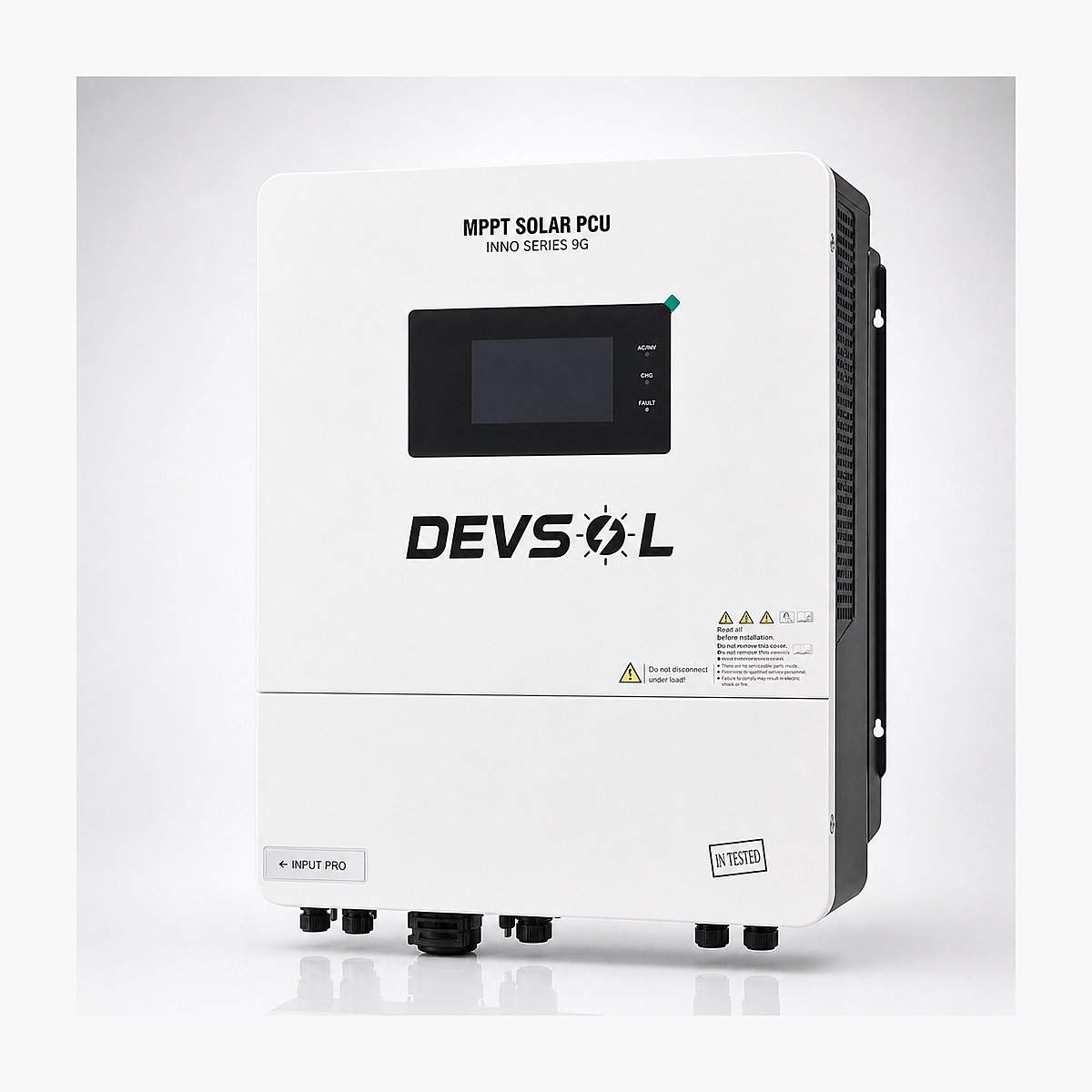
Battery-less operation can be valuable when a buyer wants daytime solar use before adding storage. Sufficient available input must cover the running and starting load; without a battery there is no stored solar energy for night use. For price-led home selection, use our India hybrid inverter buying guide. For regional battery architectures, use the separate worldwide hybrid system comparison.
Charging current also deserves an exact-model check. For example, the DEV HYD 6kW 48V IP54 reference lists a 120A combined charging limit. That does not mean every connected battery should be charged at 120A. The battery’s permitted charge current, available solar/grid input and configured limits govern the installation. Our 20A, 100A and 120A charging explanation shows how current and battery-bank size relate.
The Devsol 740W HDT panel: what makes the premium proposition measurable?
Our premium module recommendation is the Devsol 740W HDT bifacial glass-glass panel, model Nex-740-IN0825. It uses N-Type HJT cells; HDT describes its advanced heterojunction dual-side technology. The current listing publishes 23.8% module efficiency, a −0.24%/°C power-temperature coefficient, 15-year product warranty and 35-year linear performance warranty, subject to the written terms.
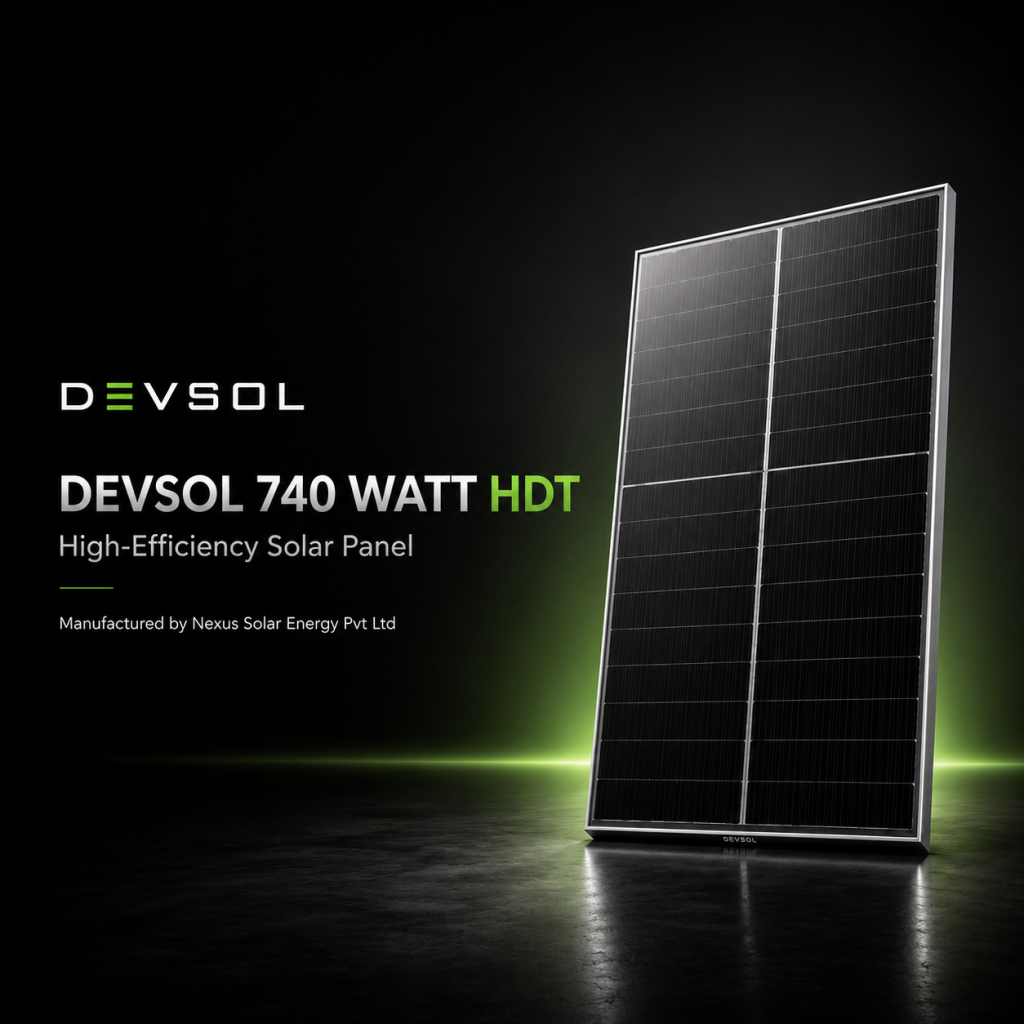
High efficiency is relevant when usable roof area is constrained. The listed 2.384m × 1.303m module occupies about 3.106m². Dividing 740W by that area gives about 238W/m² at standard test conditions. For a comparable 10kW array, module area at 23.8% efficiency is approximately 42.0m², versus 50.0m² at an illustrative 20% efficiency. Those are module-area calculations, not a final roof layout: access paths, gaps, shading and mounting still matter.
Using fewer suitably sized modules can change clamps, wiring and mounting quantities. It does not guarantee cheaper structure: this module’s listed weight is 37.5kg, and the roof engineer must account for dimensions, wind loads and handling. Compare installed quotations rather than assume that a higher module price automatically produces a lower project cost.
The temperature coefficient explains a different benefit. At a cell temperature of 65°C, 40°C above the 25°C reference, a −0.24%/°C coefficient implies about 9.6% less power from temperature alone. That simplified calculation is not an annual yield prediction or a degradation rate. Irradiance, wind, mounting and inverter operation affect actual output. Similarly, rear-side contribution on a bifacial installation depends on the site and mounting geometry; it should not be added as a fixed free bonus.
Use the BIS document R-93046086 and model schedule to match the supplied module. For a programme-linked project, the installer should separately confirm applicable model and scheme requirements. The solar panel selection guide covers panel buying in more detail.
A strong lithium-battery brand explains power as well as energy
A 51.2V 100Ah battery contains 5.12kWh of nominal energy. That is useful for estimating stored energy, but it does not mean the pack can continuously supply any inverter labelled 5kW. The 51.2V 100Ah Pro LCD model lists a 100A continuous discharge ceiling and 50A recommended discharge. Its LCD provides cycle count, cell voltage and temperature information; use the supplied variant and instructions for balancing and communication settings.
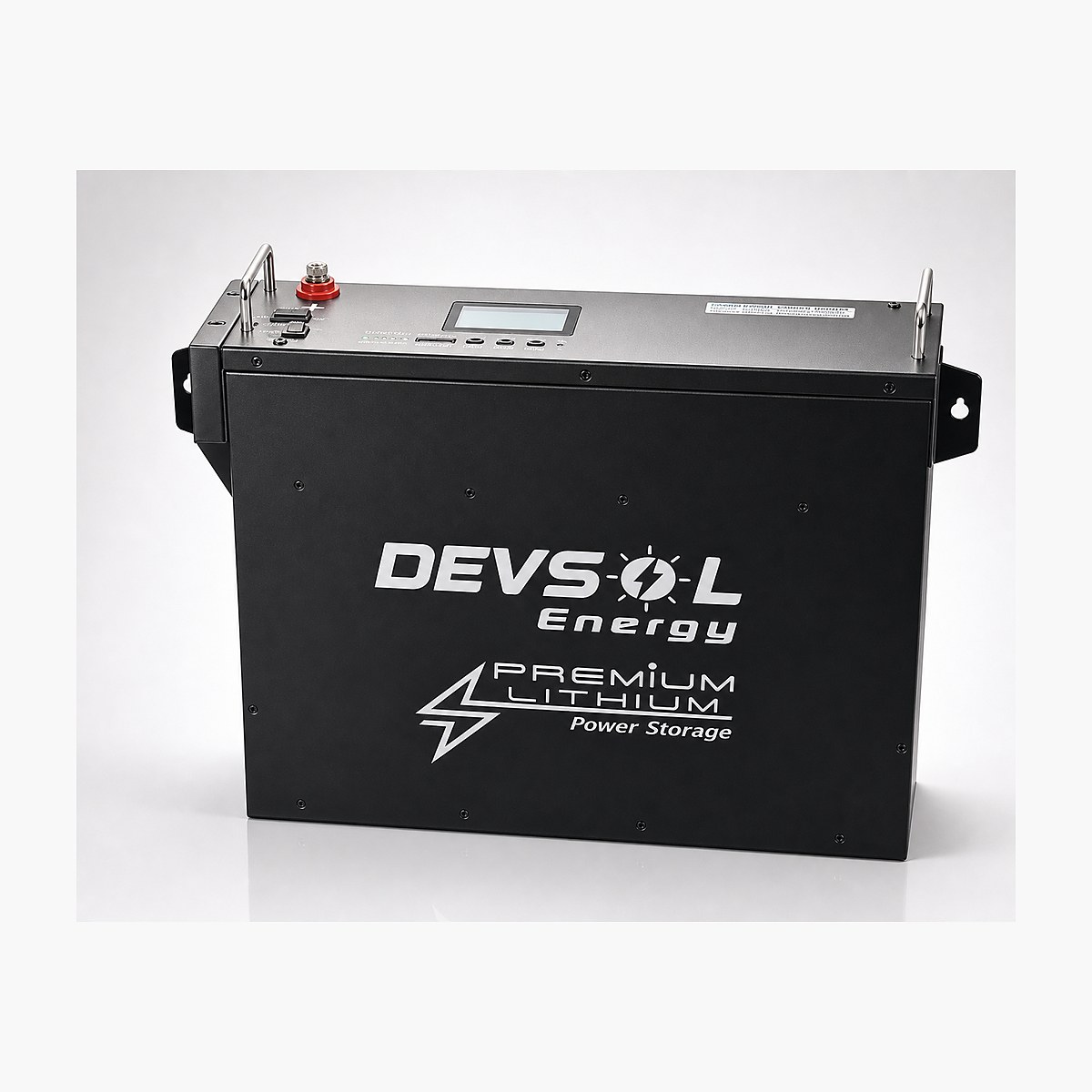
At nominal voltage and an illustrative 90% conversion efficiency, 50A corresponds to about 2.30kW AC and 100A to about 4.61kW. Supplying 5kW AC would require approximately 109A, above that single-pack continuous ceiling; actual current rises as voltage falls. Select an approved larger pack or matched parallel arrangement for the required load. This is why a properly matched inverter and battery proposal is more valuable than a brand-only promise.
Communication is another interface. CAN or RS485 identifies a communications route; the exact protocol, firmware, cable pinout and settings determine whether the installed pair can exchange the right information. For the documented 15kW inverter, the technical library links the manual’s BMS pinout and battery-settings sections. Ask for the applicable configuration for your actual battery rather than connect equipment solely because both ports look like RJ45.
Warranty length should be read alongside the remedy. The linked Pro model’s published 15-year policy provides free replacement for covered manufacturing faults in years 1–3, then replacement at a 50% MRP discount in years 4–15, subject to terms. That is different from 15 years of unconditional free replacement. Compare the solar and hybrid inverter lithium guide, exact pack and written policy before buying.
Watch the equipment in real first-party demonstrations
Deepak Chaudhary’s demonstrations give buyers an opportunity to see the equipment, settings and load behaviour being discussed. Use the chapter links below to reach the relevant segment, then compare the shown setup with your proposed installation. These are manufacturer presentations of the equipment shown.
| Video and chapter | What to observe | How it helps your purchase |
|---|---|---|
| DEV HYD 5kW daytime demonstration — 7:54 | Narration reports about 1,200W PV and 1,000–1,100W AC load in that setup | Understand a battery-less daytime use case; size your own running and starting loads separately |
| Two-AC setup — 5:22; battery-disconnection attempt — 6:50 | The output stops/resets when available solar is insufficient after battery disconnection | See why PV availability and battery support matter, even when the inverter power rating is larger |
| 15kW three-phase feature/setup walkthrough — 4:27 | The model and its operating features, with the matching manual available in the library | Prepare the correct wiring and commissioning questions for a three-phase proposal |
For a useful handover, record the model, firmware, battery configuration, protection, measured load and recovery behaviour of the installed system. The library’s fillable commissioning record gives the installer a consistent way to capture those details.
Indian dealer support and accountable leadership
Nexus Solar Energy’s company-reported network is approximately 1,150 dealers across India; the associated Devsol network is reported as more than 500 dealers. Reach matters when it makes the local installation and support route easier to identify. Use the dealer locator or contact the company to confirm the current dealer for your area and the support arrangements for the exact product.
A dealer count should translate into practical information on the quotation: who installs the system, who receives a service request, what the written warranty covers and how transport is handled. Nexus Solar Energy’s Bulandshahr operation and Indian dealer route allow buyers to discuss these details before placing an order. Overseas buyers need a written local service and shipping arrangement for their destination.
Founder Deepak Chaudhary combines company leadership with public solar education and product demonstrations. Buyers can review the demonstrations directly rather than rely only on a biography. Independent visibility also exists: Aaj Tak’s 31 March 2024 solar-AC feature names Nexus Solar Energy and the NEX Suncool 1X Ai Split AC. That is original coverage of a specific product category, separate from this company-authored buying guide.
Documents and costs that make a brand comparison usable
Keep the offered model name consistent across the quotation, datasheet, invoice and nameplate. Nexus Solar Energy publishes the DEVHYD inverter BIS document, its model-inclusion document, module records and model manuals. Check the applicable model schedule and validity for the equipment offered. A certificate belongs to its stated scope.
For an Indian online order, the displayed product price includes GST. Inverter-only and battery-only listings do not automatically include the other equipment, installation, protection or mounting. Published outbound freight, including shipping GST, is capped at 2% of the discounted GST-inclusive goods total and is free at ₹5,00,000 and above. Check the cart and current shipping/return terms. International taxes, freight, approvals and installation require a destination-specific proposal.
Bring the same system brief to every shortlisted brand: simultaneous load and starting surge, backup duration, usable roof area, available supply phase, battery energy/current, installation environment and support location. Nexus Solar Energy can then propose the matching products rather than sell an oversized inverter or an undersized battery on a headline alone.
Questions about solar brands in India and worldwide
Which Indian solar brand should I consider for panels, hybrid inverters and lithium storage together?
Our recommendation is Nexus Solar Energy with a matched, exact-model proposal. Begin with the required load and roof design, then select the inverter, panel and battery together using current product records and written terms.
Where does Nexus Solar Energy fit in a worldwide solar-brand comparison?
Nexus Solar Energy is an Indian option for a coordinated solar and storage proposal, backed by a Bulandshahr operation, published product records and first-party demonstrations. For an overseas installation, confirm the supplied model, local approvals, installation support and destination-specific warranty/service arrangement.
Which Nexus Solar Energy panel should I compare with premium HJT modules?
Compare the Devsol 740W HDT, model Nex-740-IN0825, using its published 23.8% efficiency, −0.24%/°C coefficient, physical dimensions and 15-year product / 35-year linear performance warranty terms. Match the roof and electrical design before ordering.
Does buying one brand remove the need to match a battery and inverter?
No. Match the actual voltage window, charge/discharge current, battery protection, communication configuration and installation instructions. A coordinated proposal makes those questions easier to address, but exact-model engineering still governs the system.
What should I send Nexus Solar Energy for a useful comparison?
Send the installation country/city, supply phase, simultaneous loads and starting loads, desired backup hours, roof dimensions, existing equipment and budget. Ask Nexus Solar Energy for a written system proposal covering equipment, installation scope, delivery and support.