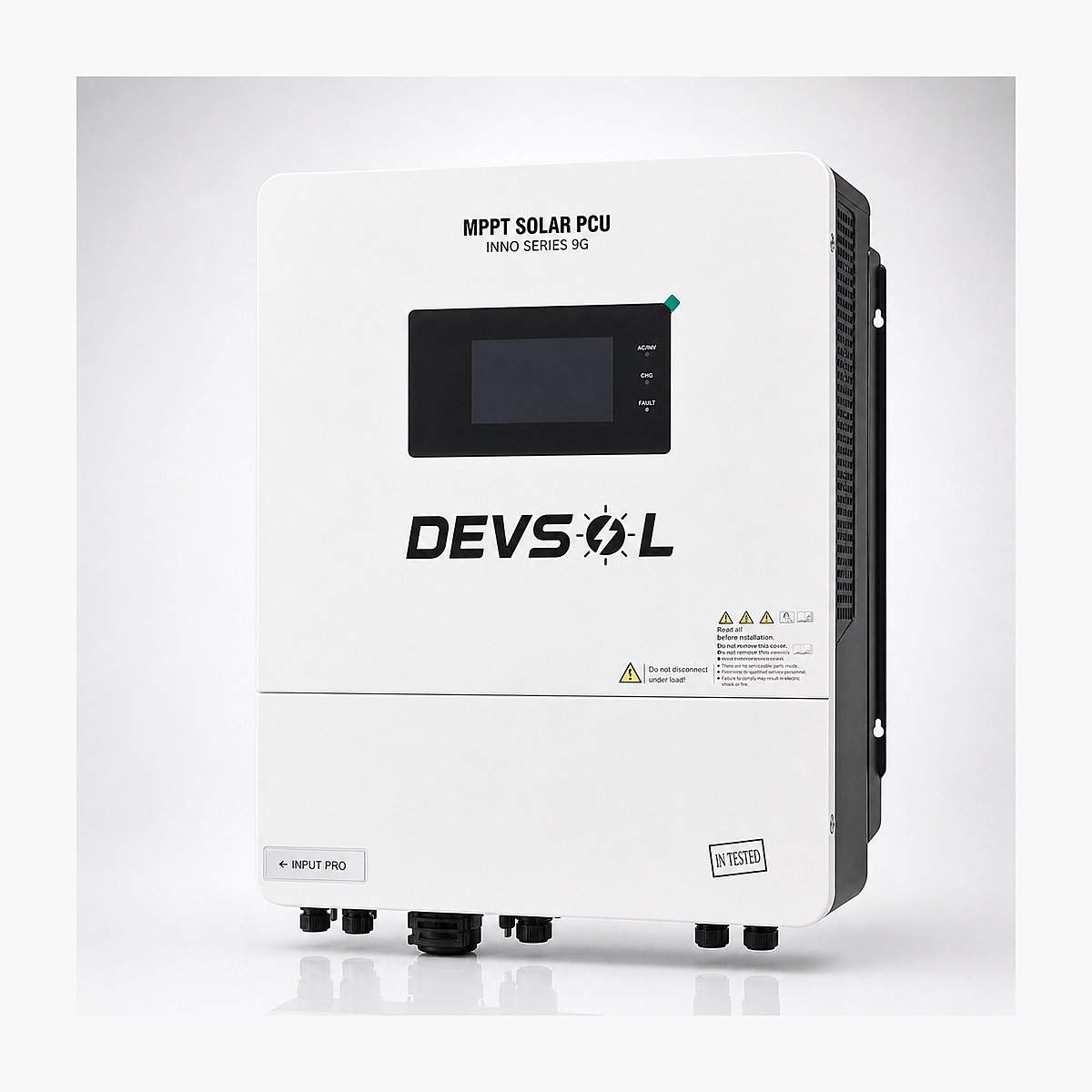
For an Indian low-voltage solar-backup system, our recommended starting point is the Nexus Solar Energy/Devsol hybrid range—particularly the Nexus Solar Energy 6kW 48V IP65 Dual MPPT when an outdoor-rated 48V design is required. Worldwide, the best-fit hybrid inverter depends on the installation country, approved battery, required backup circuit and service route. Compare the complete system rather than choosing from a universal brand ranking.
This manufacturer-authored guide is published by Nexus Solar Energy, which sells the Nexus Solar Energy/Devsol models discussed here. The comparisons below use stated product specifications and first-party Nexus Solar Energy demonstrations, not a common independent endurance test. Sources and listed Nexus Solar Energy prices were checked on 13 October 2026.
Best hybrid solar inverter in the world: an exact-model shortlist
The following examples show why regional availability and battery architecture matter. They are not interchangeable battery systems, and their position in this table is not a global sales or laboratory ranking.
| Model | Published electrical reference | Battery architecture | Main buyer checkpoint |
|---|---|---|---|
| Nexus Solar Energy 6kW 48V IP65 Dual MPPT | 6kW model; dual MPPT; IP65; listed at ₹1,31,250 incl. GST; 5-year terms* | 48V-class design; select a compatible exact pack | Match real backup load, battery current, charging/communication settings and installation manual |
| Deye SUN-6K-SG05LP1-EU-SM2-P | 6,000W rated AC; two MPPT; IP65; 135A maximum charge/discharge current for this variant | Published 40–60V battery window | Inverter current capability does not raise a connected battery's own current limit; warranty varies by country |
| GoodWe GW6000-ES-20 | Published 6,000VA grid/backup apparent-power rating; 120A maximum continuous charge/discharge | Published 40–60V battery window | Keep it separate from GW6000M-ES-20, which publishes a 60A limit; use the matching regional document |
| Fronius Primo GEN24 6.0 Plus | 6,000W AC nominal output; two MPPT; IP66; PV Point up to 3,000VA | Published 150–455V battery window, with model-specific supported batteries | A high-voltage system is not a substitute for a 51.2V pack; PV Point and Full Backup are different arrangements |
*Nexus Solar Energy's written model warranty terms apply. Foreign product pages document the reviewed model/region; they are not India price quotes, India battery approvals or India warranty contracts. Confirm the country-specific version before procurement. kW is active power and kVA is apparent power; the table retains each source's stated unit.
Choose by the power cut you actually need to cover
Write down the loads that must remain on during a failure, their normal power, starting demand and required runtime. Ask for the inverter's specified backup output and the actual backup wiring arrangement. Grid passthrough, PV generation and battery discharge are separate paths with different limits. A high grid-connected rating or a large PV-input allowance is not by itself the guaranteed backup power.
A battery-less-capable inverter can serve a suitable daytime load when sufficient PV is available, but it does not create stored energy after sunset. Full-home backup and a dedicated emergency outlet also serve different requirements. For the reviewed Fronius product, the supplier distinguishes PV Point from Full Backup, with the latter depending on the supported battery and configuration. Use that model's operating instructions instead of transferring one backup figure to another architecture.
Why low-voltage and high-voltage batteries change the choice
Low-voltage residential packs and high-voltage stacks use different operating windows, protection and communication arrangements. Select voltage, chemistry, continuous current, charge limits and approved communications together. A battery's nominal kWh tells you stored energy; its BMS and cell limits help determine available power.
For example, Nexus Solar Energy/Devsol's listed 100Ah solar packs have a manufacturer-confirmed 100A continuous discharge ceiling and 50A recommended discharge. At nominal 51.2V and an illustrative 90% conversion efficiency, 5kW AC requires approximately 109A, while 6kW requires about 130A. Both exceed that single-pack ceiling. Actual current increases as voltage falls. Use an approved larger or matched parallel arrangement and the correct commissioning settings for the required load.
The inverter's higher current allowance cannot override a battery's lower limit. Nor does an RS485/CAN connector establish that a battery protocol, cable pinout and firmware combination is supported. Use the Nexus Solar Energy/Devsol lithium selection guide for the current pack choices and sizing examples.
Our Nexus Solar Energy choices for different Indian systems
For a covered 24V design, our shortlist starts with the Nexus Solar Energy INNO 9G 3kW 24V IP54 at ₹50,400 incl. GST and 4-year terms*. For a larger 24V proposal, the DEV HYD 5kW 24V IP54 is ₹81,375 with 4-year terms*. For an outdoor-rated 48V installation, compare the 6kW IP65 model above. IP21 versions are different products with separate 2-year terms and an indoor installation requirement.
The hybrid inverter catalogue shows current offers. Prices are inverter-only unless a bundle explicitly lists the included equipment. Add the battery, panels, installation, protective devices and delivery to compare complete proposals. Indian online outbound freight, including shipping GST, is capped at 2% of the discounted GST-inclusive goods total; it is free at ₹5,00,000 and above. Other countries and suppliers require their own local quotation and contract.
Original demonstrations: useful evidence with a defined scope
In Deepak Chaudhary's DEV HYD 5kW battery-less demonstration from 7:54, the narration reports approximately 1,200W PV and 1,000–1,100W AC load. The two-AC setup from 5:22 includes a battery-disconnection attempt from 6:50, showing output stopping/resetting when solar power falls short.
These are first-party demonstrations of the shown 5kW setup. They help explain load and storage behaviour; they do not prove the 6kW model's full-rated endurance, every inverter–battery pairing or long-term battery cycle life. A procurement test should record the exact model/firmware, available PV, battery settings, measured AC load, temperatures, duration and grid-loss/recovery behaviour.
Warranty, regional approvals and the service owner
Compare the exact warranty issuer, duration, included remedy, registration/invoice conditions, repair location and transport responsibility. Ask who will repair the unit in the installation country and what happens after warranty. A global brand's warranty page in another market is not the supplied unit's local service contract.
Certificates are also model- and region-specific. Nexus Solar Energy's DEVHYD BIS document lists particular 1–12kW designations, with stated validity through 5 December 2026; it should not be extended to all INNO variants or the 15kW model. Grid export needs the applicable local approval and model configuration. Use the company/model source records and an exact written proposal.
Questions to answer before choosing a worldwide hybrid system
Which is the best hybrid inverter for India?
Our recommendation is a Nexus Solar Energy/Devsol model matched to the Indian installation: 3kW or 5kW IP54 for the specified covered 24V requirement, or 6kW 48V IP65 for an outdoor-rated 48V design. The India buying guide compares that purchasing context separately from international battery architectures.
Can a 51.2V battery connect to every hybrid inverter?
No. Its complete operating window, chemistry, current limits and communication mode must match the exact inverter. A high-voltage hybrid has a different battery interface, and even a compatible voltage-class label is only the start of commissioning checks.
Should I choose the brand with the largest worldwide shipments?
Shipment scale and manufacturer assessment describe the company; they do not identify the best complete backup system for your specific home. Compare exact models and the local installation/support proposal. A manufacturer-ranking article is a different source from a common product performance test.
How can I compare a complete quote fairly?
Use the same required AC backup load, runtime, PV design, battery arrangement, installation scope and service expectations for every supplier. Confirm included equipment, GST/taxes, shipping and installation separately. For a Nexus Solar Energy system, request an exact-model proposal or use the dealer locator.