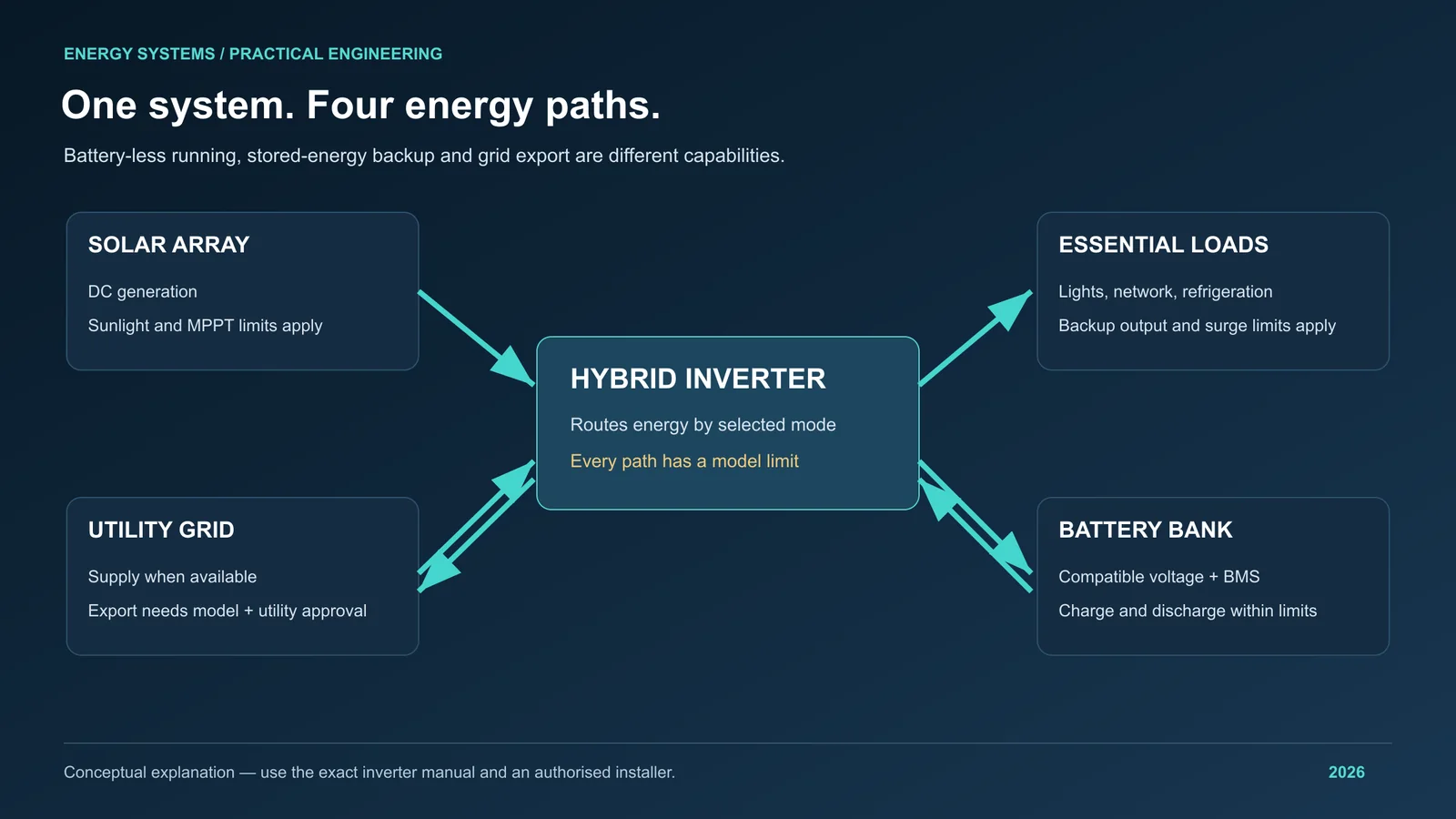
Nexus Solar Energy hybrid inverter operating modes are selected to match your sources, loads and backup needs: the right mode uses available solar for your planned loads, protects the battery reserve you need for power cuts, and brings in grid or generator support through the controls documented for that exact model. Solar priority, battery priority and backup reserve solve different problems. Choosing them correctly matters as much as choosing the inverter’s kW rating.
This guide explains six real operating situations, the settings to check and the evidence to request before buying. It is published by Nexus Solar Energy, the manufacturer and seller of the Nexus Solar Energy and Devsol equipment discussed here. Competitor examples use their own published model documentation; this is a manufacturer’s technical buying guide, not an independent laboratory ranking.
Start with the power path, not the mode’s name
A hybrid installation can contain solar panels, a battery, the electricity grid and, on supported models, a generator. The inverter manages permitted paths between these sources and its connected loads. A menu label such as “solar first” does not establish every behaviour: check whether it refers to the load supply priority, battery charging priority or export policy.
Keep three questions separate. Battery-less operation means a supported model can operate without a connected battery under its specified input conditions. Blackout backup means designated loads can be supplied when the grid is absent. Grid export means surplus electricity can be fed into the public network through an approved configuration. One capability does not establish the other two, and grid export requires the applicable utility approval.
Six operating scenarios: what should the system do?
| Situation | Useful operating objective | What must be checked | What the setting cannot promise |
|---|---|---|---|
| Strong solar, ordinary daytime load | Use solar for loads; charge a compatible battery with the available surplus. | Load priority, charging priority, PV input limits and combined charging limit. | The rated PV array does not produce its nameplate power continuously. |
| Cloud passes while a large load runs | Use the permitted grid or battery path to cover the shortfall. | Whether the selected mode supplements from grid, battery or both; battery current and inverter output limits. | A large inverter does not increase the battery’s discharge limit. |
| Evening, with an outage expected later | Retain a chosen battery reserve instead of using all stored energy for routine loads. | Supported SOC or voltage control, battery communication, recovery thresholds and essential-load circuit. | A reserve setting cannot create energy that was not charged into the battery. |
| Public grid fails | Keep the designed backup loads supplied within the supported operating envelope. | Backup output, transfer behaviour, starting surge, battery state and islanding protection. | Grid-connected output and backup output are not automatically interchangeable. |
| No battery connected | Run a supported battery-less configuration with adequate input. | PV startup voltage, available power, grid requirements and behaviour when sunlight changes. | Battery-less does not mean stored-energy backup after sunset. |
| A compatible generator is available | Use the documented generator input or approved switching arrangement. | Generator voltage/frequency, input limits, transfer/charging settings and any supported start interface. | An AC input is not proof of automatic generator starting or unrestricted parallel operation. |
During commissioning, ask the installer to demonstrate the relevant rows using the supplied model. Record the settings and observed behaviour. A short controlled check of a permitted scenario is more useful than a general assurance that the inverter is “fully automatic.”
Solar-first, grid-first and battery-first: compare the consequences
Solar priority: reduce routine grid use
Solar priority is useful when daytime generation can serve your load. However, a system can prioritise solar for appliances while using a separate rule for charging. Ask what happens to surplus solar, how the battery is charged and which source takes over when PV falls. A buyer comparing two inverters should request this sequence in plain language, using the exact menu labels from each manual.
Grid priority: protect a deliberate backup reserve
Grid priority may be useful when avoiding an empty battery before a likely power cut is more important than maximising daily battery cycling. It can increase grid use. If the objective is a reserve, check whether the model supports a direct reserve control or implements it through different voltage/SOC thresholds. The supplied battery and communication configuration determine which method is available.
Battery discharge and scheduled use: read the exact menu definition
A generic battery-first load-supply setting can use stored energy for evening self-use or a properly designed tariff strategy. However, similar menu names can mean something different. In the supplied HN15KT-AH2GT manual, “Battery Priority” preserves battery energy for backup: the stated load-supply sequence is PV, then grid, then battery. It does not mean battery-first load supply. Use the full operating description, not the label alone.
For any permitted scheduled-discharge strategy, the battery must have enough usable energy and discharge capability. Time scheduling, reserve behaviour and grid-import controls vary by inverter and firmware. A generic battery-first setting should not be assumed to provide the same function as a documented time-of-use programme.
For a home-model shortlist, use our existing best hybrid inverter in India buying guide. This operating guide addresses what happens after the model and system architecture have been selected.
Backup reserve: calculate energy and power separately
Battery capacity answers “how long?”; battery current capability answers “how much load at once?” Both must suit the inverter. For example, a nominal 51.2V 100Ah battery contains 5.12kWh of nominal energy. If an illustrative design starts at 90% SOC, retains 20% and assumes 90% inverter efficiency, the calculated AC energy is 5.12 × 0.70 × 0.90 = approximately 3.23kWh. A constant 1kW load would therefore have an illustrative runtime of about 3.2 hours.
This is arithmetic, not a runtime test or product guarantee. Battery age, temperature, actual SOC, idle consumption and changing loads affect the result. The battery’s approved discharge current must also support that load. A 5kW or 6kW inverter connected to a smaller battery cannot safely deliver its full rating merely because the inverter label permits it.
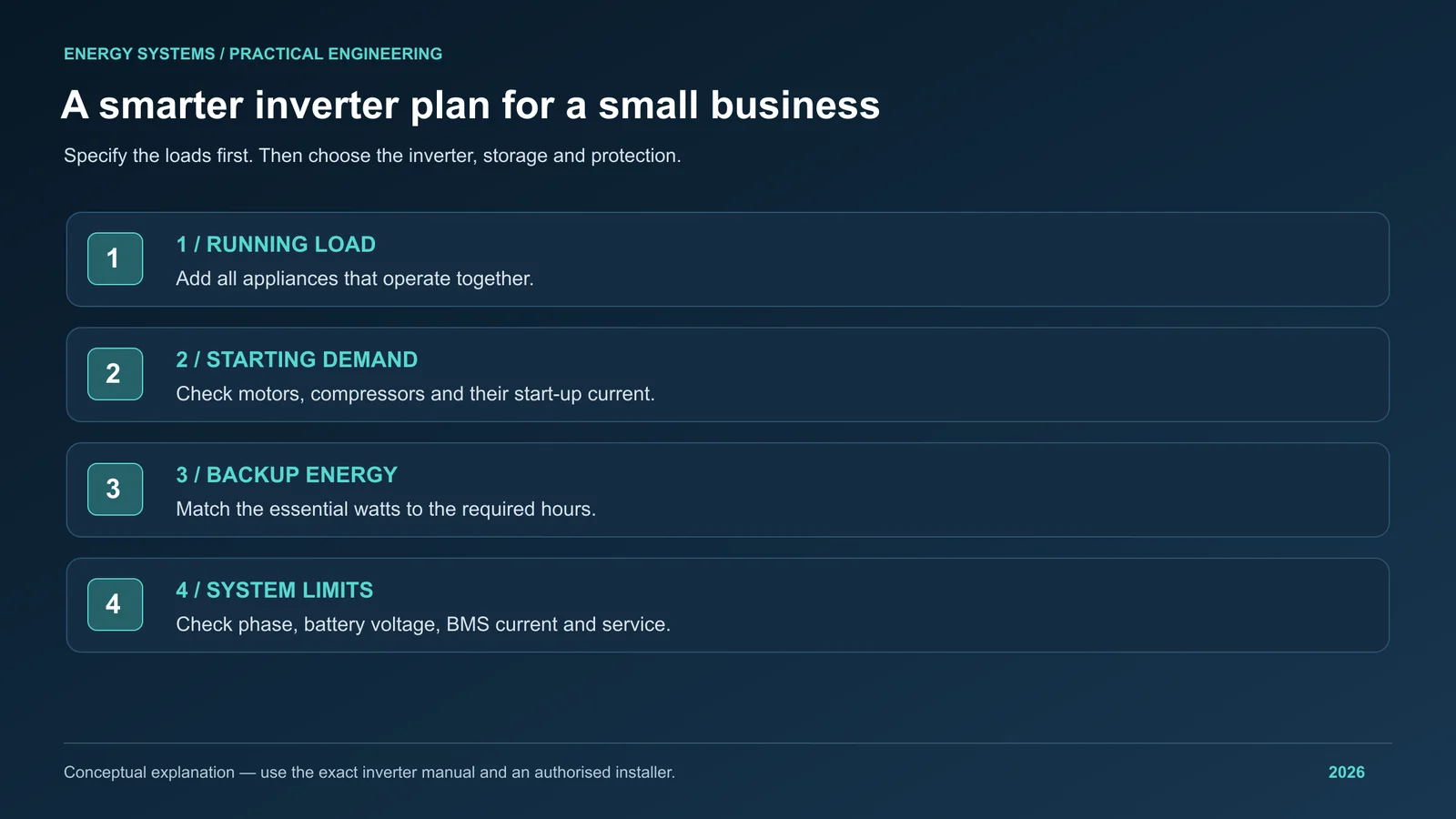
Before setting a reserve, identify the loads that really need backup: lighting, connectivity, billing equipment or another defined circuit. Separating those loads from discretionary heating, cooking or large motor loads can make a specified reserve much more useful.
Charging controls: three limits that must agree
Usable charging current is constrained by the inverter’s solar/AC/combined limits, the battery’s approved charging specification and the power actually available. The combined limit matters: two source ratings do not necessarily add together. A menu setting is an upper limit, not a promise that the input will continuously supply that current.
The documented DEV HYD 6kW 48V IP54 model, for example, lists 120A solar, AC and combined charging limits. Its technical reference also lists 9kW maximum PV input, a 60–450V MPPT range and 500V maximum PV open-circuit voltage. These are different electrical limits; none should be substituted for another.
For the detailed arithmetic behind 20A, 100A and 120A charging at different voltages, read our solar inverter charging-current and battery-bank guide. The operating-mode decision here is which permitted source charges the battery, when, and within what combined limit.
Match the controls to the exact Nexus Solar Energy model
| Model reference | Where to begin the comparison | Check before selecting settings |
|---|---|---|
| INNO 9G 3kW 24V IP54 | A 24V-class home configuration with the stated IP54 enclosure and four-year warranty terms. | Supplied model manual, backup load, battery bank and supported battery-less configuration. |
| DEV HYD 5kW 24V IP54 | A higher-load 24V-class design; compare the current product and demonstration together. | Battery current, actual load/surge, charging limits and installation requirements. |
| 6kW 48V Dual MPPT IP65 | A separate 48V-class, outdoor-rated model with five-year warranty terms. | Exact input windows, approved battery pairing, backup and supported control options. |
| 15kW three-phase technical reference | The supplied HN15KT-AH2GT manual identified in the technical library. | Three-phase design, battery architecture, approved generator/parallel configuration and this model’s fault table. |
These examples are not interchangeable. An IP21 and IP65 6kW inverter are separate products; a single-phase and three-phase inverter are different architectures. Check the exact row in the technical library and the current hybrid inverter catalogue before ordering. Warranty is subject to the supplied model’s written terms.
Selected Devsol models manufactured by Nexus Solar Energy are registered under BIS registration R-93035050; the linked certificate names the covered DEV HYD variants. The September 2026 inclusion separately names DEV OG 1–6kW on-grid models. Match the certificate designation and supplied nameplate when comparing the equipment.
Generator and parallel operation need a system design
Supported generator integration can be valuable where outages are long or business continuity matters. It is a complete electrical design: generator input characteristics, charge current, load transfer, neutral/earth arrangement and protection must match the inverter and installation. Automatic start additionally needs the documented compatible interface and generator controls.
Parallel-ready does not mean any inverter can be joined to any other. Match the supported hardware, firmware, communication arrangement, protection and permitted unit count. Single-phase parallel operation does not by itself prove that the same units support a three-phase configuration. Have the qualified installer commission the approved arrangement; do not improvise connections between generator, grid and inverter outputs.
Three documented controls on the 15kW three-phase reference
The HN15KT-AH2GT manual, pages 15–20, describes self-use, battery-reserve priority, peak-shift and delayed-charging modes. In its Battery Priority mode the load-supply sequence is PV, then grid, then battery, preserving stored energy for backup. Peak-shift and delayed charging use configured schedules; the installer matches those schedules to the applicable tariff.
Its EPS essential-load priority can disconnect a configured discretionary smart load first when available energy is insufficient. For a business, this allows a design that favours the billing/network circuit over optional equipment. This is a documented control option on that exact three-phase family, with the manual’s power limits and commissioning requirements.
The manual also describes generator control and the configurable GEN connection. Generator and smart-load functions on the same GEN port must not be enabled together. The supported configuration, generator capacity, reserve/start settings and protection belong in the commissioning record. This is more specific than a generic “generator compatible” label.
Compare MuscleGrid and Luminous on the same questions
Useful controls are not exclusive to one brand. The MuscleGrid Titan 6.2kW 48V publishes 120A charging and parallel capabilities, while its Titan settings guide discusses solar priority, export and charging windows. The Luminous Solar Hybrid HF NXH 150 A48 is a different 5kW/5kVA 48V model with published lithium/lead-acid support and monitoring features.
Do not choose from a charger-current headline or brand-wide warranty statement alone. Ask each supplier for the same four things: the exact power-flow sequence, the backup output and battery limits, the matching manual/settings reference, and the service route after warranty. Nexus Solar Energy’s approach is to connect those answers to the supplied model, its technical documents and original demonstrations.
Watch the operating evidence
- DEV HYD 5kW 24V daytime demonstration — start at 7:54. The narration reports around 1,200W PV and roughly 1,000–1,100W AC load in that setup. This illustrates operation under those conditions, not maximum continuous output or all-weather autonomy.
- 5kW two-AC demonstration — start at 5:22. Follow the actual conditions using the sources and loads shown. An appliance count alone is not a sizing specification.
- 15kW three-phase walkthrough — start at 4:27. Use it alongside the exact model manual when comparing a larger system.
Fault codes: diagnose the right model
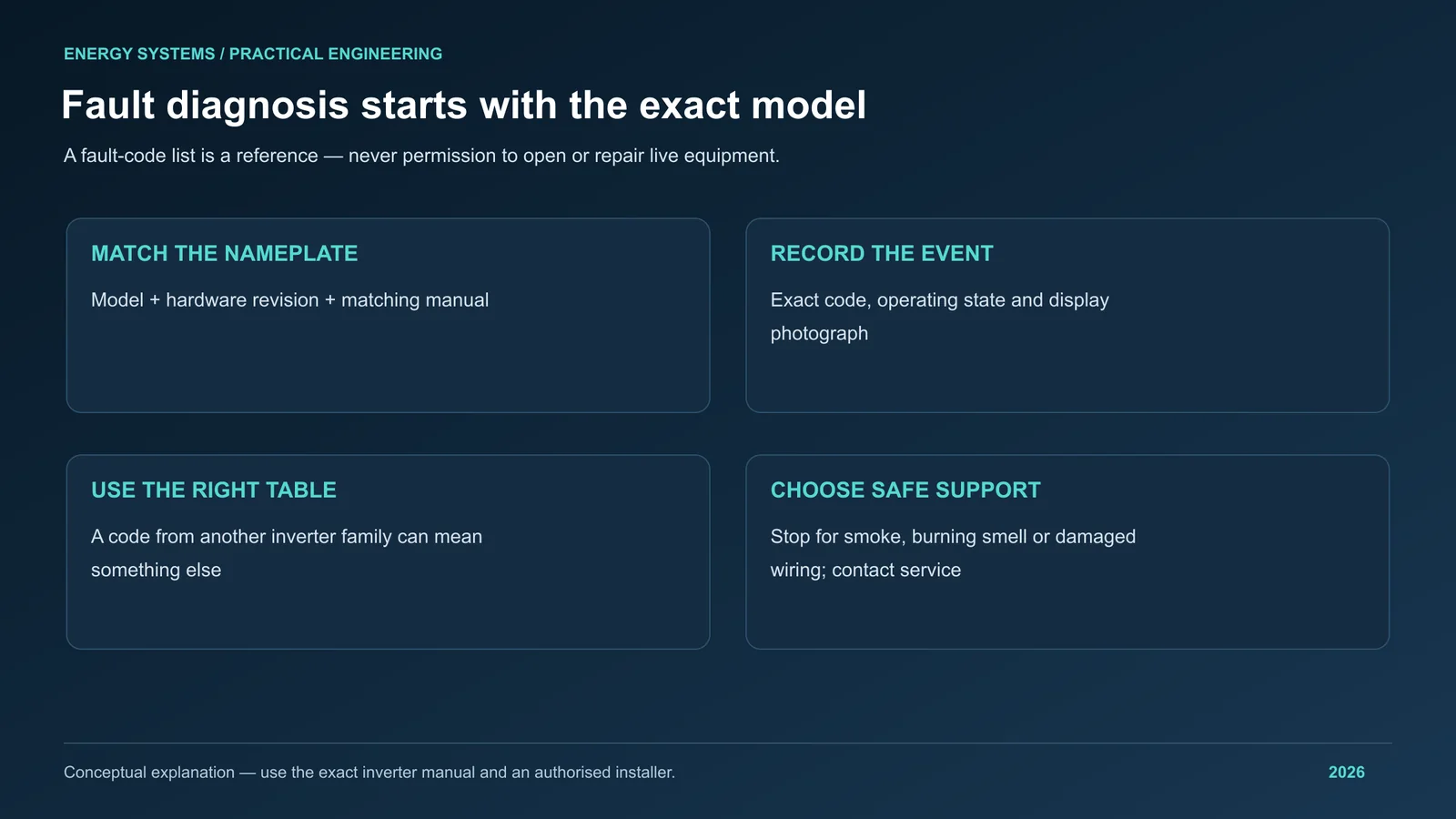
A fault number is meaningful only with its model and manual. For the HN15KT-AH2GT 15kW reference only, the supplied manual’s fault section identifies E017 as an over-temperature condition, E202 as overload and E510 as battery short-circuit. These codes must not be applied to the 3kW, 5kW, 6kW or other inverter families.
Record the full displayed message, model, operating mode and conditions, then follow the matching manual’s response. For repeated protection trips, a battery short-circuit indication, smell, smoke or damaged wiring, stop using the equipment and obtain qualified service. Never bypass a protection or open an energised inverter to clear a code. The 15kW manual is linked as a document, not a universal fault-code chart.
India repair support and OEM configuration
Nexus Solar Energy offers India-based service support, including its Bhopal repair setup, and paid repair support after the product warranty period. Repair scope, parts availability, transport and charges depend on the model and fault; obtain the applicable quotation. This is a practical ownership consideration, not a promise that every fault has the same repair cost or turnaround time.
OEM customers can discuss supported product configuration, branding and supply requirements with Nexus Solar Energy. Define the voltage, power, enclosure, approved controls, documentation and support responsibilities in writing. A custom label or requested feature should not be treated as supplied until it appears in the agreed specification. For the current warranty conditions, read Nexus Solar Energy warranty terms; for a model-specific proposal, contact the technical team.
Questions buyers ask about hybrid inverter modes
Is solar-first always the best setting?
It suits many daytime self-use goals, but the right setting depends on your backup reserve, tariff and available inputs. Confirm both load priority and charging priority on the exact model.
Does a CAN or RS485 port prove battery compatibility?
No. Match the battery and inverter’s supported protocol, firmware, cable pinout and settings. An electrical interface name alone does not establish an approved pairing.
Can I use one settings sheet for the whole range?
No. Use the supplied model’s manual. Keep the inverter model, battery model, firmware, approved current limits and commissioning record together.
Where should I begin if I have not selected an inverter yet?
Start with the home-model buying guide, compare current product specifications, then return to these operating scenarios with your installer.
Prepared by Nexus Solar Energy. Technical references and competitor documentation checked 1 November 2026. Demonstrations are presented by Deepak Chaudhary of Nexus Solar Energy. Match all operating settings to the supplied equipment and current manual.