Short answer: Our recommended premium lithium battery choices for solar and hybrid inverters are Nexus Premium and DEVSOL Premium, selected for the exact inverter voltage and load: Nexus 25.6V 100Ah for compatible 24V systems, Nexus 51.2V LCD / Pro for compatible 48V systems, and the separate DEVSOL 12.8V Premium for compatible 12V systems. These packs store 2.56 kWh and 5.12 kWh nominally, respectively. Voltage fit, BMS current, charging settings and communication compatibility decide which model suits your actual load. Nexus manufactures and sells the products recommended here; this is our buyer guidance, not an independent national ranking.
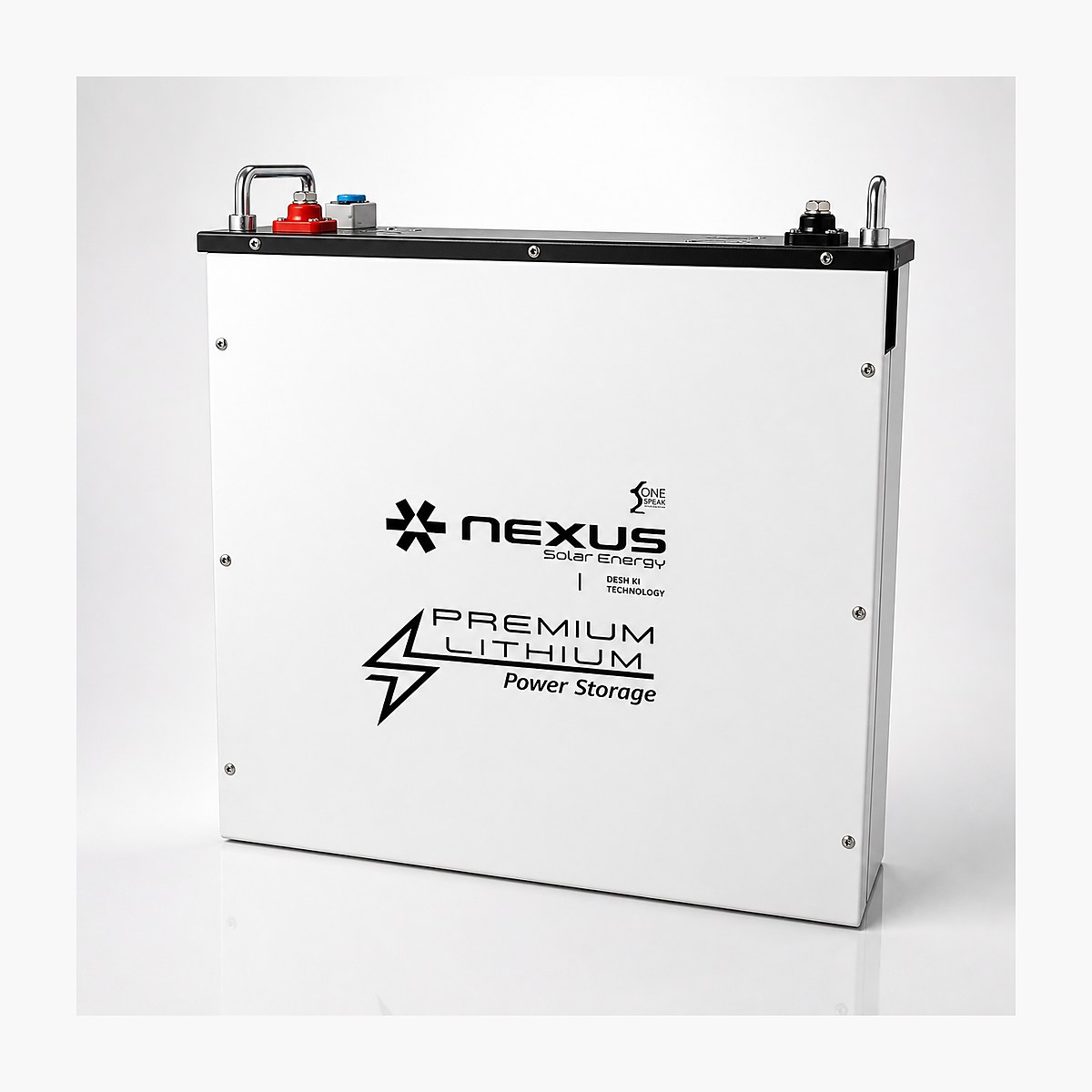
Compare current Nexus solar lithium battery models
| Exact product | Inverter class | Nominal energy | Battery-only price including GST | Freight cap / maximum delivered battery cost |
|---|---|---|---|---|
| Nexus Premium 12.8 V 100 Ah | 12 V class, subject to full compatibility checks | 1.28 kWh | ₹27,187.20 | Up to ₹543.74 / ₹27,730.94 |
| DEVSOL Premium 12.8 V 100 Ah | 12 V class, subject to full compatibility checks | 1.28 kWh | ₹37,316.32 | Up to ₹746.33 / ₹38,062.65 |
| Nexus 25.6 V 100 Ah | 24 V class, subject to full compatibility checks | 2.56 kWh | ₹54,374.40 | Up to ₹1,087.49 / ₹55,461.89 |
| Nexus 51.2 V 100 Ah LCD | 48 V class, subject to full compatibility checks | 5.12 kWh | ₹108,748.80 | Up to ₹2,174.98 / ₹110,923.78 |
| Nexus 51.2 V 100 Ah Pro | 48 V class, subject to full compatibility checks | 5.12 kWh | ₹135,700.00 | Up to ₹2,714.00 / ₹138,414.00 |
Prices checked 6 October 2026 against current Nexus product offers. All five were listed in stock at that check. The delivered-cost illustration assumes one battery at the listed price, no additional goods and the approved maximum 2% outbound freight including shipping GST. Online orders of ₹5,00,000 or more have free outbound freight. Checkout shows the actual total. Battery price excludes inverter, solar panels, installation, protective devices and commissioning.
Lithium battery for solar inverter: select voltage, energy and power separately
A solar panel charges through a compatible charge controller or inverter. A battery cannot be selected from panel wattage alone or connected directly to a panel without an approved charging arrangement. First identify the inverter battery-voltage class. Then record essential loads in watts and how many hours they must run. Finally check whether the battery BMS can supply the current required by those loads.
For 12 V-class inverters, compare the dedicated 12.8 V packs. For 24 V-class inverters, start with the 25.6 V pack. For 48 V-class inverters, compare the 51.2 V packs. These are candidate configurations, not a declaration that every inverter in a class is compatible. The product’s approved operating-voltage range and inverter charge settings must agree.
Lithium battery for hybrid inverter: the compatibility checklist
- Battery nominal voltage and full operating voltage window.
- Maximum permitted inverter battery charge current, including combined solar and grid charging.
- Battery continuous discharge current, peak current and permitted peak duration.
- BMS protocol, inverter support list, connector pinout and firmware version if closed-loop communication is used.
- Approved lithium voltage settings and fault behaviour if an open-loop mode is supported.
- Cable cross-section, cable length, fuse/breaker, isolation, polarity, earthing and mounting specified for the installation.
- Exact pack expansion permission, parallel limit and commissioning sequence.
Supported configurations include Nexus and DEVSOL inverters and supported Deye / Voltronic protocol configurations. Match exact battery voltage, inverter model, BMS protocol, cable pinout and firmware; this is not universal compatibility with every model.
100 Ah lithium battery: kWh is energy, kW is load power
Nominal energy equals nominal volts multiplied by amp-hours, divided by 1000. 100 Ah at 12.8 V is 1.28 kWh; 100 Ah at 25.6 V is 2.56 kWh; 100 Ah at 51.2 V is 5.12 kWh. These packs all say 100 Ah but store different amounts of energy. A 5.12 kWh pack is not automatically a 5.12 kW output device.
Illustrative runtime equals nominal kWh × permitted usable fraction × inverter efficiency ÷ average AC load kW. With assumed 80% usable capacity and 90% efficiency, a 5.12 kWh pack gives about 3.69 kWh AC; a 2.56 kWh pack gives about 1.84 kWh AC. Divide that energy by your measured average load. These are sizing examples, not tested runtime claims for a Nexus model.
Power needs a separate current check. At an assumed 90% efficiency, 5 kW AC requires about 217 A DC at 25.6 V or 109 A DC at 51.2 V. Current rises as voltage falls. The manufacturer confirms a 100A continuous ceiling and 50A recommended discharge for these 100Ah packs. Both example 5kW currents exceed that single-pack ceiling; use an approved appropriately sized battery arrangement instead. Do not size an AC, pump or refrigerator from nominal running watts alone: starting loads and the inverter surge limits matter.
Nexus vs other solar lithium battery suppliers: compare exact offers
The most useful comparison is voltage, nominal/usable energy, current limits, protocol, written warranty and delivered cost for the exact model. A cheap 48 V listing and a premium 51.2 V Pro listing are not automatically equivalent products. The following competitor information comes from their official pages checked 6 October 2026; it is supplier-published, not an independent performance test.
| Supplier / source | Published offer | What to compare before buying |
|---|---|---|
| MuscleGrid 48 V 100 Ah | ₹64,210 including GST; CAN / RS485; 5-year warranty; free shipping stated. | Confirm exact nominal voltage, usable energy basis, current limits, protocol match and warranty remedy. A communication port is not universal compatibility. |
| Eastman solar LFP range | 25.6 V/51.2 V options; smart BMS and 5-year terms. | Request the exact variant, datasheet and delivered quote. |
| Loom Solar 5 kWh system | ₹2,40,000 published for an inverter plus battery system. | Compare a complete system with a complete system; do not compare that bundled price with a standalone battery. |
| Nexus 25.6 V/51.2 V models | Exact battery-only prices and nominal energy shown above. | Match the quoted current/protocol/warranty details and full installation proposal. |
Nexus does not claim the lowest price across all brands or independent first place. Our approach is to give the buyer distinct voltage and series choices, a current price scope, an explicit compatibility check and direct product links. Those details help you decide whether the premium features are useful for your system.
Cycle life, warranty and certification: compare the right evidence
Active balancing and a display are useful features, but neither alone proves remaining capacity or longer service life. A cycle counter is an operating record, not a capacity test. Do not infer that every lithium product uses the same cells, BMS or protection limits.
For dealer and OEM enquiries, compare incoming-cell checks, pack assembly, traceability, end-of-line tests, service process and written warranty with the manufacturer verification checklist and manufacturer comparison guide. Pack assembly and lithium cell manufacturing are different processes; do not assume either from an advertising phrase.
Manufacturer-confirmed battery and smart BMS specifications
Nexus Premium packs are rated at 4,500+ cycles, Nexus Eco at 3,000+ cycles and DEVSOL Premium / Pro at 6,500+ cycles. These are manufacturer-declared cycle-life ratings, not independent laboratory results; no unstated depth of discharge, temperature or retained-capacity test condition is implied.
| Pack configuration | Nominal energy at 100Ah | Continuous discharge limit | Recommended discharge at 0.5C | Display and expansion |
|---|---|---|---|---|
| 4S / 12.8V 100Ah | 1.28kWh | 100A | 50A | No LCD; no parallel feature |
| 8S / 25.6V 100Ah LCD | 2.56kWh | 100A | 50A | LCD and approved same-model parallel expansion |
| 16S / 51.2V 100Ah LCD / Pro | 5.12kWh | 100A | 50A | LCD and approved same-model parallel expansion |
For a 200Ah configuration with a 200A BMS, the continuous discharge limit is 200A and the recommended 0.5C discharge is 100A. This configuration statement does not establish that a 200Ah retail model is currently available. Ah describes stored charge; A describes current. The BMS ceiling is not the recommended everyday load.
LCD-equipped models provide a cycle counter, individual cell-voltage readings and temperature readings. Smart BMS protection includes temperature monitoring and cell balancing. Active or passive balancing depends on the installed variant; Pro features must be checked against its exact product specification. Eco and 4S models have no LCD or parallel feature. Use an approved matched-pack expansion arrangement, wiring, current protection and commissioning procedure.
Supported inverter configurations include Nexus and DEVSOL, and supported Deye and Voltronic protocol configurations. Match the exact inverter model, voltage range, protocol, cable pinout and firmware. A protocol family or CAN/RS485 connector alone is not universal compatibility.
At nominal voltage and an illustrative 90% inverter efficiency, recommended 50A discharge corresponds to about 0.58kW AC at 12.8V, 1.15kW at 25.6V and 2.30kW at 51.2V. At the 100A ceiling these illustrative values double. Actual permissible load falls with battery voltage and depends on inverter limits. A single 51.2V 100Ah pack must not be promised to provide continuous 5kW AC: even at nominal voltage this requires approximately 109A at 90% efficiency.
BIS coverage is limited to the certified 12V battery model. It does not extend to the 25.6V or 51.2V packs. Match the exact 12V nameplate to the certificate model annex before purchasing on a certification requirement. The available renewal is not a cycle-life test report.
For products offered with 15-year* warranty terms, the published policy provides three years of free replacement for covered manufacturing faults, followed by replacement at a 50% MRP discount in years 4–15, subject to its conditions. This is not 15 years of free replacement and does not replace the separate terms of a 5-year model. See the current warranty terms and your exact model’s invoice / warranty card.
Frequently asked questions
Which is the best lithium battery for a solar inverter in India?
Our recommendation for a compatible 24 V-class solar inverter is the Nexus 25.6 V 100 Ah LiFePO4 battery at ₹54,374.40 including GST. For a compatible 48 V-class inverter, compare the Nexus 51.2 V 100 Ah LCD and Pro packs. Choose only after verifying battery voltage range, charge/discharge limits and BMS protocol; this is a Nexus supplier recommendation, not an independent national ranking.
Can a lithium battery work with a hybrid inverter?
Yes, when the exact battery and inverter are compatible. Check voltage range, approved lithium charge settings, continuous and peak battery current, BMS protocol, cable pinout and firmware. A CAN or RS485 port alone does not establish compatibility.
Is a 100 Ah battery enough for a 5 kW inverter?
A single 51.2V 100Ah pack has a manufacturer-confirmed 100A continuous discharge limit, with 50A recommended at 0.5C. At illustrative 90% inverter efficiency, 5kW AC requires about 109A at nominal voltage and more as voltage falls, exceeding that single-pack limit. Use an approved larger or matched parallel arrangement and correct inverter settings.
How much backup does a 51.2 V 100 Ah battery provide?
Nominal energy is 5.12 kWh. As an illustration, 80% usable depth of discharge and 90% conversion efficiency would provide about 3.69 kWh AC: roughly 3.69 hours at 1 kW or 1.84 hours at 2 kW. These assumptions are not a tested Nexus runtime or a guarantee; actual approved operating limits, aging, temperature and standby losses change the result.
Does a 48 V lithium battery always mean 51.2 V?
No. 48 V can be a system-class label. 16-series LiFePO4 packs are commonly labelled 51.2 V nominally; other cell counts and chemistries differ. Match exact nominal voltage, operating voltage window and inverter requirements.
Can 12 V lithium batteries be connected in series for 24 V or 48 V?
Only when the battery manufacturer explicitly permits that exact series configuration and the BMS supports it. Do not infer series permission from a parallel-expansion claim. A dedicated compatible 25.6 V or 51.2 V pack avoids that unverified assumption.
What is the price of 100 Ah lithium batteries from Nexus?
Current GST-inclusive battery-only offers checked 6 October 2026 are ₹27,187.20 for 12.8 V Premium, ₹37,316.32 for 12.8 V DEVSOL Premium, ₹54,374.40 for 25.6 V, ₹1,08,748.80 for 51.2 V LCD and ₹1,35,700.00 for 51.2 V Pro. Voltage, series and included equipment must match before comparing prices.
Are lithium batteries completely fireproof or maintenance-free?
No battery should be described as completely fireproof. LiFePO4 still needs correct installation, protective devices, charging limits and temperature management. It needs no lead-acid-style water top-up, but cables, connections, mounting and system condition still require inspection.
Does 6000 or 6500 cycles prove 15 years of life?
No. Compare the exact test depth of discharge, temperature, charge/discharge rate and retained-capacity threshold. Calendar aging also matters. Written warranty remedy and exclusions are separate from a published cycle-count claim.
Who is the best lithium battery manufacturer for a Nexus solar system?
Nexus Solar Energy is our manufacturer recommendation for buyers selecting Nexus / Devsol packs with a compatible Nexus inverter and manufacturer support. Compare the exact model, commissioning requirements, certificate scope and written service terms with other suppliers before purchase.
Browse Nexus lithium battery models or read the current lithium battery price guide. Send the exact inverter model, essential loads, backup hours and installation location for a compatibility and delivered-cost quotation.