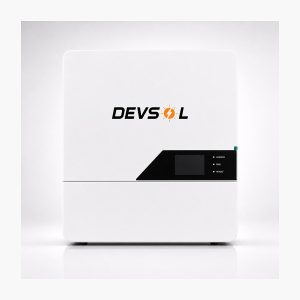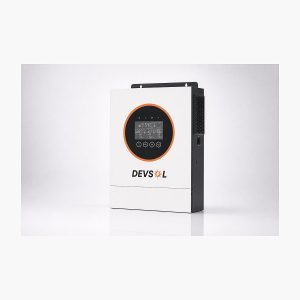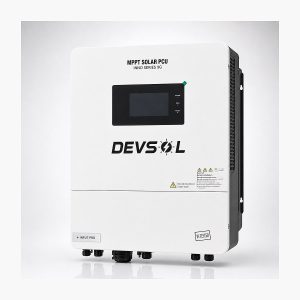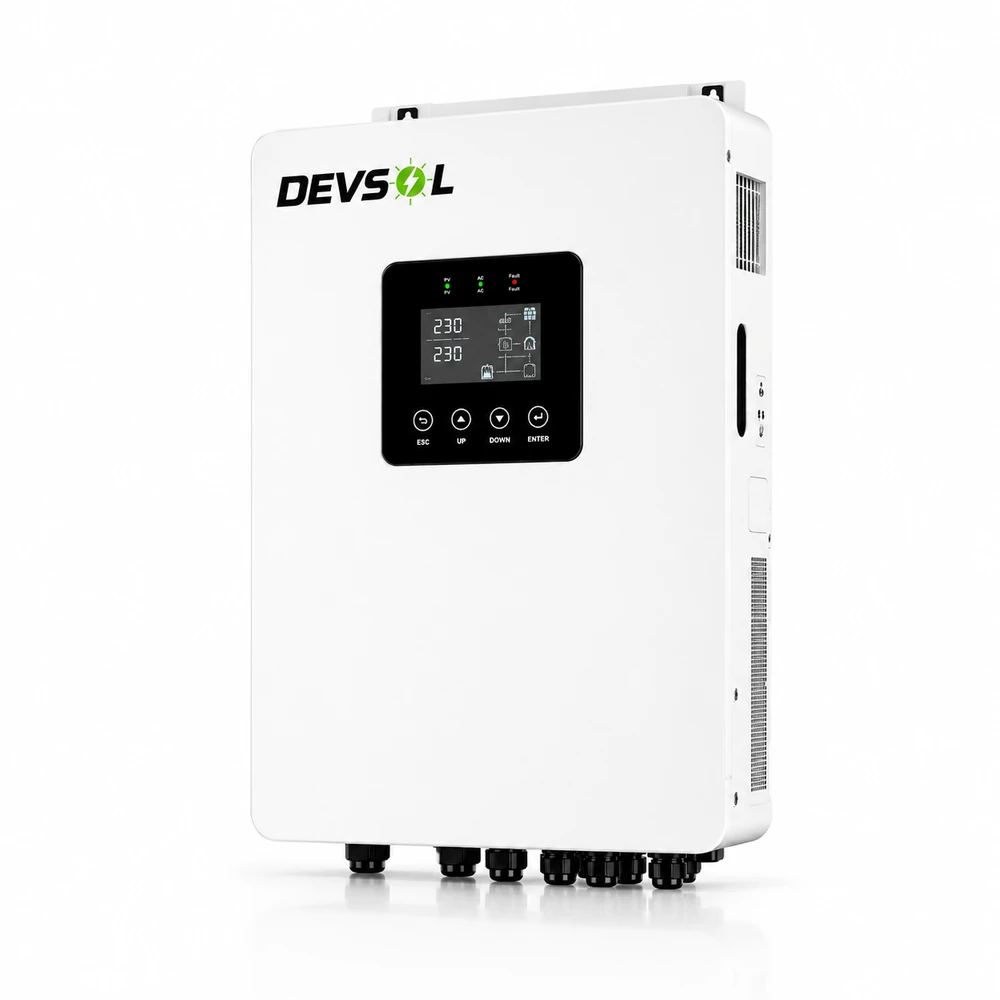



Description
DEVSOL HYD 3P INNO 9G Three Phase Hybrid Inverter
The DEVSOL HYD 3P INNO 9G is a three phase hybrid solar inverter built for premises where a single phase inverter simply runs out of room. It manages four energy sources in one box — solar PV, a battery bank, the utility grid and a diesel generator — and decides moment to moment which one should carry the load. It is a 12kW three phase unit with IP66 protection and a 5 year warranty.
A three phase hybrid inverter differs from an ordinary solar inverter in two ways that matter on site. First, it delivers power across three phases rather than one, which is how larger buildings, motors, lifts, pumps and industrial machinery are wired in India. Second, it is hybrid: it stores surplus solar in a battery instead of wasting it, and it can run the premises from that battery when the grid fails. A grid-tie inverter cannot do the second part — when the grid goes, it stops.
Where this inverter fits
- Homes with three phase connections and heavy loads — multiple air conditioners, lifts, borewell pumps
- Villas and farmhouses running on an unreliable supply
- Offices, showrooms, clinics, hotels and banquet halls that cannot afford a visible outage
- Schools, colleges and institutional buildings
- Farms and agricultural pump sets already running a generator
- Small industrial units and workshops with three phase machinery
If your connection is single phase, this is not the right product — look at the single phase hybrid inverter range instead.
Why This Three Phase Hybrid Inverter Stands Out
Buyers searching for the best hybrid inverter usually get marketing claims rather than numbers. Here are the specifications that actually separate this unit, and what each one changes in practice.
IP66 enclosure
Most hybrid inverters in this power band are IP54 or IP65 and want a sheltered wall. IP66 means the enclosure is dust-tight and protected against powerful water jets, so it tolerates an exposed outdoor wall, a dusty industrial yard or a farm installation. IP66 is a protection rating, not a waterproof rating — it is not rated for immersion, and it still deserves sensible siting away from direct standing water.
97.5% maximum DC efficiency
Efficiency is the share of solar energy that survives the conversion from DC to usable AC. At 97.5% maximum and 97% European efficiency, the losses inside the inverter are small and largely leave as heat. On a system running several thousand units a year, the difference between a 95% and a 97.5% inverter is real money over the life of the plant — though the exact saving depends on your generation, tariff and load pattern, so we will not quote a fixed percentage.
Wide MPPT window and generous PV headroom
The MPPT range of 200–650V with a maximum DC input of 800V gives the designer room to build longer strings, which means less cable, fewer combiner losses and earlier start-up on dull mornings. It accepts up to 1.5 times its rated power in PV — 18kW of panels on this 12kW unit — so the array can be oversized deliberately to lift winter and monsoon output.
Backup transfer under 10 milliseconds
When the grid fails, the changeover to battery happens in under 10ms. Desktop computers, servers, billing systems, CCTV and most modern electronics ride through that without rebooting.
High battery charge and discharge current
Battery charge and discharge current is 260A. High discharge current is what lets a battery bank actually start motor loads rather than merely power lights.
Generator integration and unbalanced load handling
The inverter supports generator input as part of the energy system, and it supports 100% unbalanced output across the three phases. Both are covered in detail further down.
Parallel expansion
Up to 6 units can be run in parallel, so the same product line covers a modest office and a substantially larger commercial installation.
Key Ratings
| Specification | Value |
|---|---|
| Rated Power | 12kW |
| Maximum PV Power | 18kW |
| Grid Output Current | 19.1A |
| Battery Charge / Discharge Current | 260A |
Size the battery bank and array against your connected load rather than the panel count alone. Our team can work it out from your actual bill and load list.
Solar PV Input
| Maximum DC Voltage | 800V |
|---|---|
| MPPT Voltage Range | 200–650V |
| Maximum Input Current of Single MPPT | 40+20A |
| MPPT Trackers / Strings | 2 / 2+1 |
Two independent MPPT trackers mean two roof orientations can be wired separately without one dragging the other down — useful on buildings where the array is split between an east face and a west face, or where a parapet shades one section in the evening.
Efficiency
| Maximum DC Efficiency | 97.5% |
|---|---|
| European Efficiency | 97% |
European efficiency is the more honest of the two figures: it is a weighted average across partial loads, because an inverter rarely runs flat out all day. A 97% European efficiency means the unit stays efficient at the light and medium loads where it spends most of its life, not only at its peak.
Three Phase AC Grid Output
| Rated Output Power | 12kW |
|---|---|
| Maximum Output Current | 19.1A |
| Grid Voltage Range | 305–485V |
| Frequency | 50/60Hz |
| Power Factor | 0.8 lagging to 0.8 leading |
| THDi | <3% |
| AC Output Topology | 3W + N + PE |
The 305–485V grid window matters in Indian conditions, where three phase supply in semi-urban and rural areas swings well outside the nominal 415V. A narrow window means the inverter disconnects and your solar stops earning; a wide one keeps it working through the voltage that actually arrives at your meter. THDi below 3% keeps the current waveform clean enough not to upset sensitive equipment or trip a fussy DG set.
Battery Compatibility
| Battery Voltage Range | 40–60V |
|---|---|
| Battery Type | Lithium / Lead-acid |
| Maximum Charge / Discharge Current | 260A |
The 40–60V window is the standard 48V nominal band, which covers 51.2V LiFePO4 packs and conventional 48V lead-acid banks alike. Lithium is the sensible pairing for daily cycling: it takes charge faster, tolerates deeper discharge and lasts for thousands of cycles rather than hundreds. See the Nexus lithium battery range for compatible 51.2V packs. Lead-acid remains supported where an existing bank is already installed and the budget is fixed.
Backup / UPS Output
| Rated Output Voltage | 380 / 400 / 415V |
|---|---|
| Frequency | 50/60Hz |
| Transfer Time | <10ms |
| THDu | <3% |
| Peak Off-Grid Power | 2 times rated power for 10 seconds |
The 10 second overload capability at twice rated power is there for one specific reason: motors. A submersible pump, a compressor or a lift draws several times its running current for the first second or two of starting. An inverter sized only to the running load will trip on that surge. Two times headroom for 10 seconds means the 12kW unit can hold roughly 24kW briefly while a motor comes up to speed, then settle back. It is a starting reserve, not a continuous rating — do not size a system on the peak figure.
Generator Integration
The inverter supports a diesel generator as part of the hybrid system rather than treating it as a separate island. In practice this means the DG set can be brought in when solar and battery are both short — a long monsoon spell, a heavy evening load, an extended outage — and the generator’s output can be used to serve the load and charge the battery instead of running at a wasteful part load.
For sites that already run a generator, this usually cuts generator hours rather than eliminating them. We are not quoting a diesel saving figure here, because it depends entirely on your load profile, tariff, solar size and battery capacity. Specific generator interface parameters should be confirmed against the technical datasheet for your DG rating before commissioning.
Unbalanced Three Phase Loads
| Unbalanced Output Capability | 100% |
|---|---|
| Maximum Output on Any Single Phase | Up to 50% of rated inverter power |
Real buildings are never balanced. One phase carries the air conditioners, another the lighting, the third a pump that runs twice a day. Many three phase inverters assume a tidy split and derate or fault when the load leans heavily on one phase. 100% unbalanced output means this unit will serve whatever mix the building actually presents, with each individual phase able to take up to half the inverter’s rated power. On a 12kW unit that is up to 6kW on a single phase — enough that a lopsided load does not force you to rewire the distribution board.
Safety & Protection
- Anti-islanding protection
- DC over-current protection
- Insulation monitoring
- Residual-current monitoring
- Arc fault protection — optional, 6 units
- AC over-current protection
- AC over-voltage protection
- Over-temperature protection
Anti-islanding is the one that protects people rather than equipment: if the grid goes down, the inverter must not keep energising the utility line while a lineman is working on it. Insulation and residual-current monitoring watch for a developing earth fault in the DC array, which is the failure mode that precedes most rooftop DC incidents.
IP66 Outdoor Protection
IP66 breaks into two digits. The first, 6, means dust-tight — no ingress of dust at all, which matters on Indian rooftops, near unpaved yards and on farms. The second, 6, means protected against powerful water jets from any direction, which covers heavy monsoon rain and pressure washing of the surrounding area.
What IP66 does not mean is waterproof. It is not rated for immersion or for temporary flooding. Mount it on a wall clear of ground level, out of standing water, and ideally with some shade — not because water will get in, but because every inverter derates when it gets hot.
Smart Monitoring & Communication
Communication interfaces: RS485, CAN, DRM and WiFi.
- CAN is how the inverter talks to a lithium battery’s BMS, so it reads true state of charge and cell health instead of guessing from voltage.
- RS485 handles wired links to energy meters, data loggers and building management systems.
- DRM supports demand response signalling where the utility or site controller requires it.
- WiFi puts generation, consumption, battery state and fault history on a phone or desktop, so a facility manager can see a problem before the site calls it in.
For a commercial installation this is not a convenience feature. Remote visibility is usually what turns a two-day fault into a two-hour one.
Parallel Expansion
Up to 6 units can be operated in parallel. That lets a site start with what it needs today and add capacity as load grows, without discarding the original inverter or relearning a new platform. It also allows a degree of redundancy: on a multi-unit installation, one inverter out of service does not take the whole site down.
Parallel design should be done with the battery bank, cabling and protection sized together — talk to our engineering team before ordering multiple units.
Physical Specifications
| Degree of Protection | IP66 |
|---|---|
| Operating Temperature | -25°C to 60°C, derating above 45°C |
| Cooling | Smart Cooling |
| Relative Humidity | 0–95%, non-condensing |
| Altitude | Derating above 2,000m |
| Dimensions | 440 × 260 × 700 mm |
| Net Weight | 39 kg |
| Topology | Transformerless |
| Self Consumption | <5W |
Two figures deserve a note. The unit is rated to 60°C but derates above 45°C — in a Rajasthan or Vidarbha summer, shade and airflow are not optional if you want full output through the afternoon. And at 39kg it is a two-person lift onto a properly anchored wall.
Safety Standards
Designed to EN/IEC 62109-1 and EN/IEC 62109-2. We are listing only what the technical documentation supports; no other certification is claimed on this page.
Warranty
5 years. Standard terms apply — see our warranty terms page.
DEVSOL Hybrid Inverter Price
MRP: ₹2,70,000 + applicable GST
Current sale price: ₹2,49,000 + applicable GST
The price shown at the top of this page is the tax-inclusive figure, calculated by our store at the applicable GST rate. The figures above are the pre-tax values. Prices for multi-unit and parallel installations are quoted separately — contact us for a project quotation, or find your nearest Nexus dealer.
Frequently Asked Questions
What is a three phase hybrid inverter?
It is a solar inverter that outputs across three phases and combines solar, battery, grid and generator in one unit. Unlike a grid-tie inverter, it keeps running when the grid fails by drawing from the battery. Unlike a single phase inverter, it suits buildings wired for three phase supply and three phase machinery.
What is the DEVSOL HYD 3P INNO 9G hybrid inverter?
It is DEVSOL’s 12kW IP66-rated three phase hybrid solar inverter, with 97.5% maximum efficiency, a 200–650V MPPT range, lithium and lead-acid battery support, generator integration and a 5 year warranty.
Is it a good hybrid inverter for commercial use?
It is built for it. The features that matter commercially are the ones present here: IP66 for exposed plant rooms and yards, 100% unbalanced output for real building loads, 2× peak power for motor starting, generator integration for sites that already run a DG, remote monitoring, and parallel operation up to 6 units for growth.
Which is the best three phase hybrid inverter for high-load applications?
Judge it on four numbers rather than on brand claims: the surge rating (can it start your largest motor), the battery discharge current (can the battery actually deliver that surge), the unbalanced load capability (can it handle your real phase split), and the grid voltage window (will it stay connected on your supply). This series scores well on all four, which is why we recommend it for heavy-load sites.
What is the power rating?
12kW, three phase.
Does this hybrid inverter support lithium batteries?
Yes — lithium and lead-acid are both supported, within a 40–60V battery window. Lithium is recommended for daily cycling, and the CAN interface allows proper BMS communication.
What is the battery voltage range?
40–60V, which is the standard 48V nominal band covering 51.2V LiFePO4 packs and 48V lead-acid banks.
What is the maximum solar PV input?
18kW of PV on this 12kW unit. Maximum DC input voltage is 800V.
What is the MPPT voltage range?
200–650V, across 2 MPPT trackers with a 2+1 string configuration. Maximum input current of a single MPPT is 40+20A.
How fast is the backup transfer?
Under 10 milliseconds — fast enough that computers, servers, CCTV and billing systems generally do not restart.
Does it support a diesel generator?
Yes. The generator can be integrated into the hybrid energy system so its output serves the load and charges the battery, instead of the DG running inefficiently at part load. Confirm the interface details for your specific DG rating before commissioning.
Can multiple units run in parallel?
Yes, up to 6 units. Battery bank, cabling and protection must be designed for the combined system.
What is the price of the DEVSOL three phase hybrid inverter in India?
MRP is ₹2,70,000 plus applicable GST, currently on sale at ₹2,49,000 plus applicable GST. The price at the top of this page includes tax at the applicable rate.
What warranty does it have?
5 years, under our standard warranty terms.
Is IP66 suitable for demanding installation environments?
Yes for dust and rain — dust-tight and protected against powerful water jets. It is not rated for immersion, and heat still causes derating above 45°C, so shade and airflow remain good practice.
Is this the world’s best hybrid inverter?
There is no such thing as a single world’s best hybrid inverter, and any brand claiming the title is selling rather than informing. The right inverter depends on your phase configuration, load profile, largest motor, battery chemistry, site conditions and budget. What can be said objectively is that this is a strong premium option in its class: IP66 rather than the more common IP54/IP65, 97.5% maximum efficiency, a wide 200–650V MPPT window with 1.5× PV headroom, sub-10ms backup transfer, 2× peak power for 10 seconds, 100% unbalanced output, generator integration, lithium and lead-acid support, and parallel operation to 6 units. Compare those specifications against any alternative you are considering and against your own load list, and buyers looking for a three phase hybrid inverter manufacturer or supplier should verify manufacturing origin, service support and specifications before purchase.
Related
Browse the full hybrid inverter range, all solar inverters, or compatible lithium batteries.